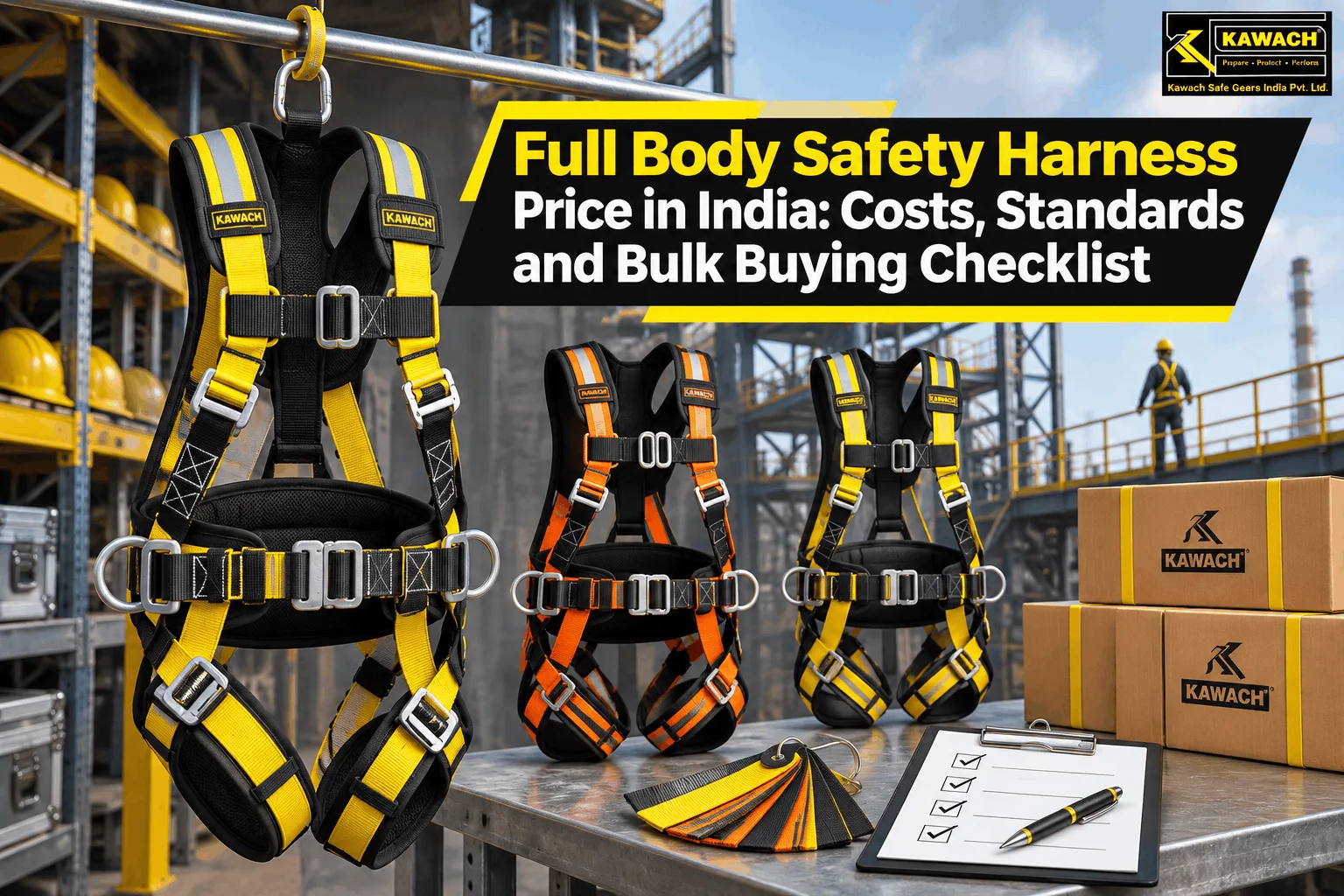
A procurement officer sees two quotations for a full body safety harness. One is substantially cheaper. Both listings show shoulder straps, leg straps and a dorsal D-ring. Are they equivalent? Not necessarily. The price of a harness says little about whether its design, documentation, permitted uses and compatibility are suitable for the worksite.
This buying guide explains full body safety harness prices in India, which specifications affect cost, how to read standard references and how to compare a complete fall-protection system before placing a bulk order. It is intended for industrial purchasers, EHS teams, contractors and site managers—not as a substitute for engineered fall-protection planning or practical training.
Quick answer: Publicly advertised Indian harness prices range widely. Some marketplace listings show basic products for under ₹1,000, while published industry market estimates describe approximately ₹1,500–₹5,000 for many standard full-body harnesses and materially higher prices for specialized designs. Such figures are indicative third-party market observations, not Kawach prices, verified compliance or a current quotation. A suitable, inspected and compatible system matters more than the cheapest harness line item. See Indian supplier listings and published market context.
Full body safety harness price: the buying answer
Short answer: The quoted price depends on harness design, adjustment range, approved uses, documentation, order quantity and whether the offer is for the harness alone or a kit. A harness must be selected as part of a compatible, site-approved fall-arrest system; a low price does not establish conformity or suitability.
Before comparing quotations, confirm: (1) the exact harness model, (2) the applicable IS 3521 part and edition, (3) permitted attachment points and user range, (4) the included connecting equipment, and (5) the site’s anchor, clearance, training and rescue plan.
What are you actually buying when you buy a harness?
A full-body harness is the body-support component of a personal fall-arrest system. It distributes forces through appropriate parts of the body when used correctly with compatible elements. The harness does not arrest a fall by itself. The system may also require a suitable anchorage, connector, lanyard with energy absorber or approved retractable device, adequate fall clearance, a rescue plan and trained supervision.
The Kawach full-body harness range currently identifies FBH-KN-56, FBH-K-112-TL and FBH-K-112. These names help a buyer start a shortlist, but the approved use of a specific model must be taken from its current marking, datasheet and instructions. Do not assume those models have identical attachment points, weight limits or certifications.
Indicative full body harness price bands in India
Pricing is fragmented because harness models vary by design, intended use, quality assurance and supply channel. The table offers planning context only, not a published Kawach rate card.
| Product segment | Indicative published-market context | What matters most |
| Low-price marketplace listings | Some basic listings appear below ₹1,000 | Treat price as a listing, not evidence of suitability or conformity |
| General industrial full-body harnesses | Roughly ₹1,500–₹5,000 in some market estimates | Correct standard and edition, fit, attachments, marking and supplier documentation |
| Specialist or task-specific designs | Can exceed ₹5,000 and rise substantially higher | Application-specific features, compatibility, approved use and training |
These bands come from differing sources and commercial channels, so they are not directly comparable. A quotation may exclude the lanyard, energy absorber, anchorage connector, installation or rescue equipment. Always ask what is included and what is excluded.
What these Indian harness price bands do-and do not-show
The ranges above are illustrations based on public marketplace listings and broad published market commentary. They are not a current Kawach price list, a representative national price survey or a valid comparison of equivalent certified models. A dated written quote for the same model specification and included components is required for a fair commercial comparison.
Seven factors that influence harness price
1. Harness design and permitted uses
A simple fall-arrest harness and a task-specific harness may differ in attachment configurations, adjustability and accessories. Fall arrest, work positioning and rescue are separate functions. A side D-ring or positioning attachment should not be treated as an approved fall-arrest attachment unless the manufacturer explicitly permits it for that purpose. Read the model instructions and use only the attachment configuration authorized for the system.
2. Fit range, adjustment and worker comfort
A harness used for long periods must fit the worker and allow safe movement. Adjustment points, leg-strap construction, padding and design can influence comfort. Padding alone is not proof of better protection. A sample fit assessment across actual worker sizes often provides more value than comparing marketing terms.
3. Materials and manufacturing control
Webbing, stitching, connectors, fittings, labels and traceability processes influence construction and quality. The applicable standard and product testing are more important than a generic claim such as “high strength.” If a supplier makes a conformity claim, ask for documentation traceable to the exact model and scope, not a certificate for another product.
4. Applicable standard and documentation
For India, IS 3521 (Part 1):2021 addresses full-body harnesses within personal fall-arrest systems; BIS issued guidance related to a 2025 amendment. Other standards such as EN 361 may be relevant for specified projects. Check which regulation, tender requirement and current edition apply, and verify evidence from the relevant issuing body. An ISO 9001 certificate for a company is not the same thing as product conformity to a harness standard.
5. Intended work environment
Scaffolding, plant maintenance, tower work and confined spaces impose different constraints. Corrosion, frequent movement, sharp edges and rescue access may affect component selection. No price list can replace a site-specific assessment of anchor locations, possible fall paths, clearance, sharp edges and suspension rescue arrangements.
6. System compatibility
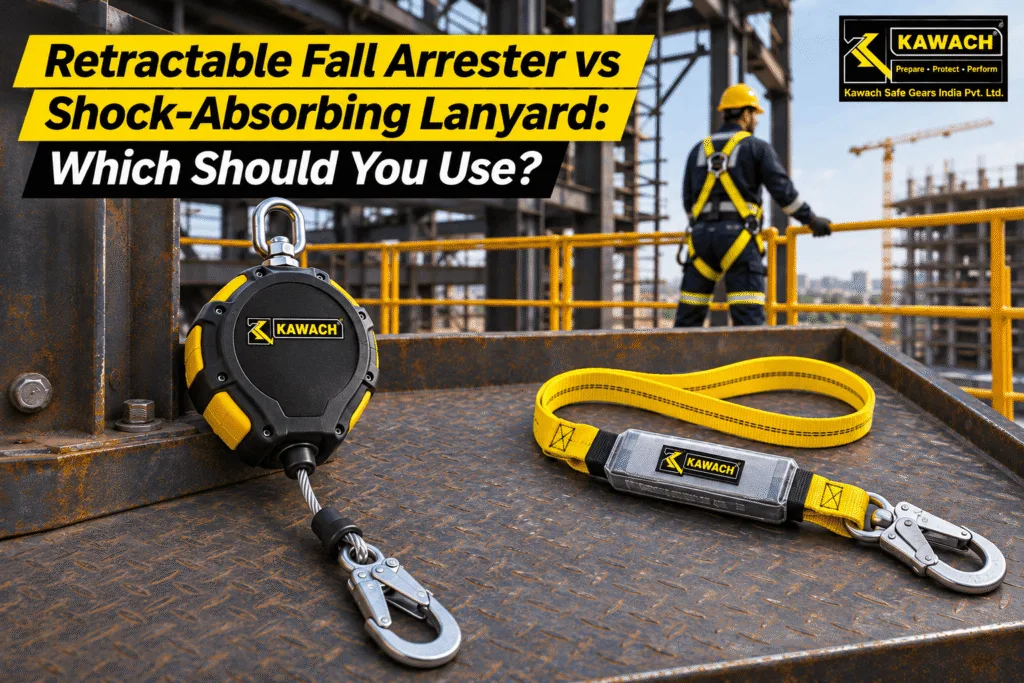
An appropriate harness still fails the procurement test if it is combined with incompatible or incorrectly installed equipment. The selected connectors, lanyards, energy absorbers, self-retracting lifelines and anchorages must be suitable together and used in accordance with the applicable instructions.
Explore the broader Kawach fall-protection equipment category for product groups, then ask for confirmation of compatibility rather than choosing components purely by visual resemblance.
7. Bulk quantity, traceability and after-sales service
Large sites should budget for inspection records, user training, spare stock, replacements, documentation and rescue arrangements. The vendor’s ability to identify batches, supply instructions, respond to issues and maintain consistent models can matter more than a small saving per unit.
The hidden cost of buying only the harness
A personal fall-arrest system is not complete when the harness arrives in a carton. If a site has not specified an engineered anchorage, approved connecting device and rescue process, the harness purchase may be ineffective even if every piece of equipment is genuine. Installation and rescue planning can be significant parts of the project cost.
The U.S. OSHA fall-protection criteria and technical manual provide useful technical reference points about equipment, attachment and fit. They are not a substitute for Indian law, the current project specification, manufacturer instructions or the competent person’s system design.
A procurement budget should therefore distinguish at least four lines: the harness, the connecting/energy-management equipment, the anchorage/installation solution, and training/inspection/rescue arrangements. The appropriate quantities and costs depend on the work plan.
Harness quotation checklist for Indian projects
Ask each supplier to respond to the same technical RFQ. Include:
1. Work-at-height application: construction, maintenance, tower, roofing, vertical access or another task.
2. Required functions: fall arrest, work positioning, rescue or a documented combination.
3. Applicable standards: exact standard, part, year and performance or marking requirements.
4. Model details: model ID, full-size range, attachment configuration and user instructions.
5. User considerations: worker sizes, clothing, tools and permitted combined user weight, where specified.
6. System details: anchors, lanyards, fall arresters, connectors, lifelines, edge exposure and fall clearance.
7. Evidence: product test reports, applicable licence or conformity documentation and traceable labels.
8. Commercial terms: quantity, unit price, tax, delivery, warranty or service conditions, stock and replacement process.
9. Training and rescue: responsibilities for fitting, inspection, emergency response and maintenance.
For projects with several work-at-height activities, a single harness model may not solve every scenario. A competent person should first define the appropriate system and working method.
How to evaluate a harness sample before approving a bulk order
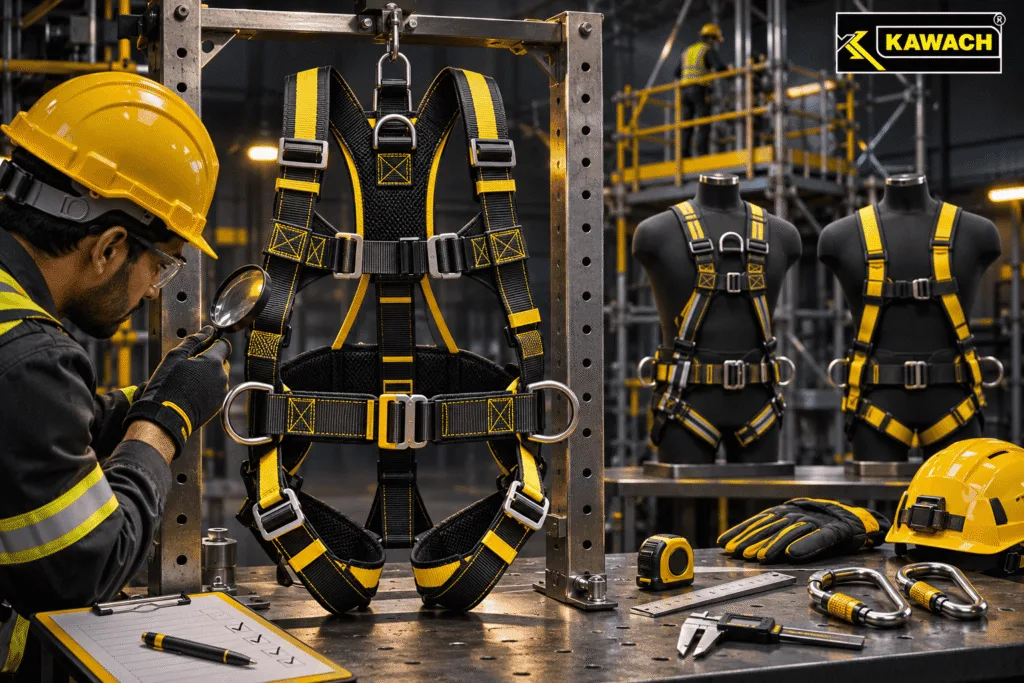
Ask for a manufacturer-supplied sample and complete instructions. Check the labeling, model traceability and documentation first. A competent supervisor should inspect the sample and confirm that the harness can fit representative workers correctly without twisting, loose straps or obstructed movement. Determine whether permitted attachment points are accessible during the actual task.
Next, verify the complete system proposal: connectors must mate correctly, the anchor design must be suitable, fall clearance must be sufficient and rescue arrangements must be practical. A product should not be field-tested by exposing a person to an intentional fall. Use controlled, approved training methods and competent assessment instead.
If workers cannot fit the harness correctly or the complete system is not compatible, do not accept the order just because the unit price is low.
What should you ask a harness manufacturer about certifications?
Ask for the exact standard and edition under which the product was assessed, along with model-specific supporting evidence. If BIS marking or licensing is claimed, verify the relevant authorization and coverage. If an EN-based claim is made, identify the applicable assessment documentation and product scope. A certificate mentioning a company name but not the ordered model may not provide adequate assurance.
Also confirm the permitted load range, inspection and service-life instructions, cleaning guidance, storage conditions and withdrawal procedure. Do not invent a universal harness replacement interval. Serviceability depends on the product instructions, damage, exposure, inspections and any fall-arrest event.
Compare harness quotations against the actual fall-protection plan
Before requesting prices, the EHS lead or other competent professional should define the work-at-height controls and the fall-protection system required for the task. Purchasing a full-body harness before the system is designed can produce a shelf full of equipment that is difficult to integrate safely with the chosen anchorage, connecting device or rescue arrangement.
Record the work activity, access method, likely exposure, edge conditions, potential swing-fall path and requirements for an approved connection. Determine whether the intended task involves fall arrest, restraint, positioning or another specific operation. These functions can require different system arrangements, and a listing that shows several D-rings does not establish approval for every function. Always follow the exact manufacturer’s permitted use and a site-approved design.
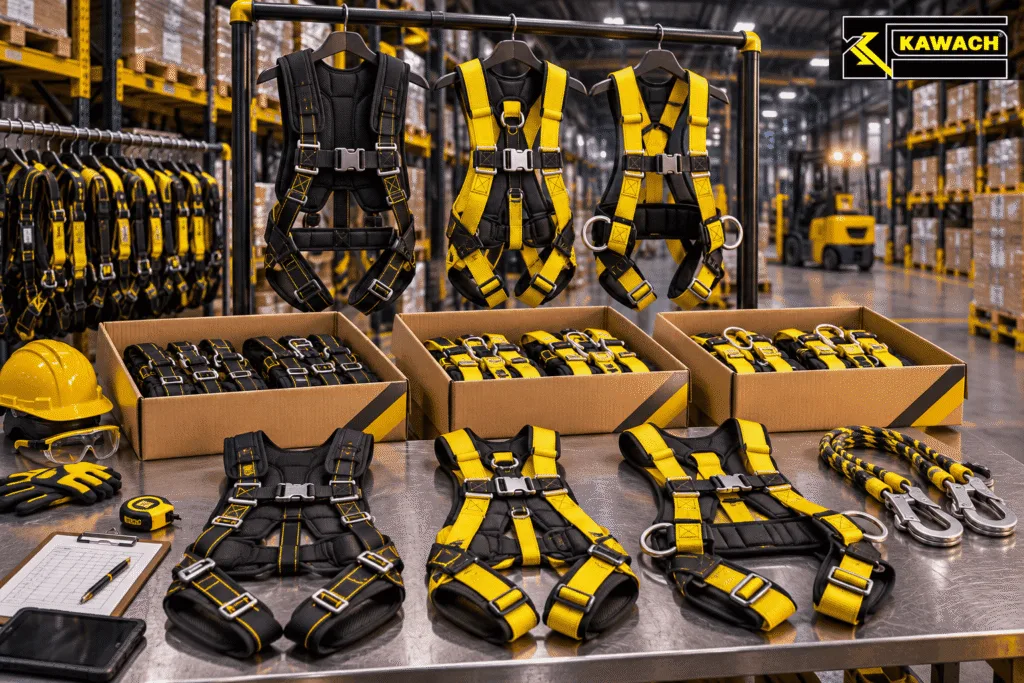
Once the needed system characteristics are clear, ask vendors to quote identified models, not unnamed “full body safety harness” products. Have each offer identify the harness by part number, provide its instructions and relevant documentation, state the manufacturer’s user-size and usage limitations, and list all included hardware. If the purchase is a complete kit, require individual part numbers and documents for the connection device and other components as well.
Keep a separate technical acceptance column and a separate cost column. Mark missing documents as pending and do not rank unverified products as equivalent to models supported by evidence. This preserves an auditable basis for selection. For a large project, record the professional who approved the system configuration and the source document revision used at the time.
A low price becomes meaningful only when the equipment has been shown to suit the specified work. Procurement should not override a documented safety objection because a vendor offers a discount or faster dispatch.
Worked example: the difference between a harness price and a system budget
Consider a hypothetical contractor outfitting 40 authorized workers. Quote A lists a harness at ₹1,100 per unit. Quote B lists a harness at ₹1,750 per unit. The purchase prices for 40 harnesses would be ₹44,000 and ₹70,000 respectively. These figures are invented only to demonstrate calculation, not actual Kawach rates, recommended models or evidence of equivalence.
The contractor cannot conclude that Quote A is the safer or better deal from those totals. It must verify the required harness model and approved use; compatible connecting devices; anchorage design; the clearance available at each work position; inspection, training and rescue arrangements; and costs for transport, replacement or spare units. Some of those are site-system costs, not items that can be assigned accurately to the harness price alone.
Suppose Quote A omits the required compatible connecting equipment while Quote B includes it. The two headline rates cannot be compared until the missing item is priced and its compatibility approved. Conversely, an expensive bundled kit is not automatically suitable if the constituent components or clearances are wrong. Do not solve a compatibility question by assuming that parts from different suppliers are interchangeable.
An RFQ summary should therefore separate harness-only unit cost, included components, additional verified equipment, training and inspection obligations, and site-specific system costs. It should show the quantity, freight, taxes and delivery stage for every item. This approach helps finance teams understand why a compliant work-at-height program cannot be evaluated through the cheapest harness line item alone.
What genuine technical evidence should accompany a harness?
Trustworthy harness documentation begins with identification. Ask to see a clear marking or label showing the model, manufacturer and information required by the applicable product standard and instructions. Confirm whether the supplied sample matches the ordered product and can be traced back to the relevant documentation. A product catalogue screenshot by itself is not proof of conformity.
For Indian procurement, review the appropriate requirements under IS 3521 (Part 1):2021, together with amendments or other standards applicable to the specified component. Ask the supplier to explain the evidence for the exact model and its approved attachment configurations. Be cautious when a general quality-system certificate or a certificate for a different product is presented as proof of a harness’s properties.
Request the current user instructions, including fitting method, inspection criteria, permitted applications, prohibited combinations, maintenance, storage, service life or withdrawal rules, and what to do after equipment has been involved in a fall arrest. Determine who is authorized to inspect, approve or withdraw a unit. Have the competent safety professional review the material before workers use the product.
If a vendor advertises additional features such as special work positioning or rescue use, those claims require separate confirmation against the supplied model’s instructions and test evidence. Never infer a permissible attachment or rescue method from the shape of a D-ring or the presence of a strap.
Keep a copy of the accepted technical documents with the purchase record. When later batches are delivered, check that the model and documented configuration are still the ones approved. Procurement traceability is particularly important when several contractors order similar-looking harnesses for the same project.
Fit, issue records and replacement planning for large teams
A harness that cannot be adjusted to a worker’s body according to its instructions should not be issued merely because it is the model selected for bulk purchase. A supervised fitting trial with representative workers can identify size-range problems and confusing buckle systems before an order is scaled across a large workforce. Workers should not attempt to make the harness fit by tying knots or modifying webbing.
Set up an issue register that records the actual unit identifier, user or storage assignment, inspection status, training completion and any authorized withdrawal from service. Establish where equipment is stored and which competent person makes return-to-service decisions. The aim is to preserve equipment history, not to create a paper process that replaces physical checks.
A spare-equipment allowance should reflect legitimate operational needs and expected replacement processes—not permission to keep defective equipment circulating. When a harness is damaged, uncertain or withdrawn under the manufacturer’s rules, it must be isolated so that it cannot be returned to work by mistake.
For procurement and SEO credibility alike, model-specific user information is more valuable than broad sales claims. Showing the actual harness, label, permitted application and available instructions helps a buyer assess whether to request a quotation, while keeping safety-critical decisions with qualified personnel.
Three common procurement mistakes
Buying a “safety belt” for fall arrest. Work-positioning belts and full-body fall-arrest harnesses are not interchangeable. Choose the body-support device and system specified for the risk.
Assuming “one size fits all.” An adjustable harness still needs to fit the individual worker correctly and remain within its permitted user range.
Buying a harness without a rescue plan. After a fall, suspension and access complications require prompt, planned rescue by trained personnel. A harness alone provides no rescue capability.
Request a Kawach quotation with the right details
Kawach Safe Gears India Pvt. Ltd. lists full-body safety harnesses within its fall-protection range. To get a useful technical and commercial response, provide the worksite, intended activity, quantity, proposed connection system, required standard, worker size range and delivery location.
Contact Kawach to request current model details and a quotation. Treat the response as part of a competent procurement and safety review, not a replacement for the site’s approved fall-protection design.
How this price guide was prepared
This guide combines publicly described market pricing with BIS’s harness product manual and fall-protection reference material from OSHA. OSHA material is cited as US technical guidance, not Indian law. No current Kawach harness price, certification scope or field test is claimed without the matching document. A qualified professional must approve any proposed fall-arrest system.
Frequently asked questions
What is the price of a full body safety harness in India?
Indian listings vary from low-price marketplace offers to several thousand rupees for general industrial harnesses, with specialist designs costing more. Price alone does not verify quality or suitability. Ask for a model-specific quotation and evidence.
Does a full body harness include a lanyard?
Not necessarily. Some offers include a connecting device; others supply the harness alone. The quotation must state exactly what is included, and compatibility must be verified before use.
Is IS 3521 relevant for full body harnesses in India?
Yes. IS 3521 (Part 1):2021 is the Indian standard specifically addressing full-body harnesses for personal fall-arrest systems. Check the current edition, amendments, tender requirements and applicable product documentation.
Can a full body safety harness be used for every height job?
No. The choice of fall protection depends on the task, risk assessment, hierarchy of controls, anchorages, clearances and rescue arrangements. A competent person must determine the appropriate system.
How many harnesses should a contractor buy for 100 workers?
The quantity depends on the number of simultaneous users, individual sizing, shifts, inspection failures, controlled spares and site rules. Do not assume a universal ratio; determine the actual staffing and risk requirements.