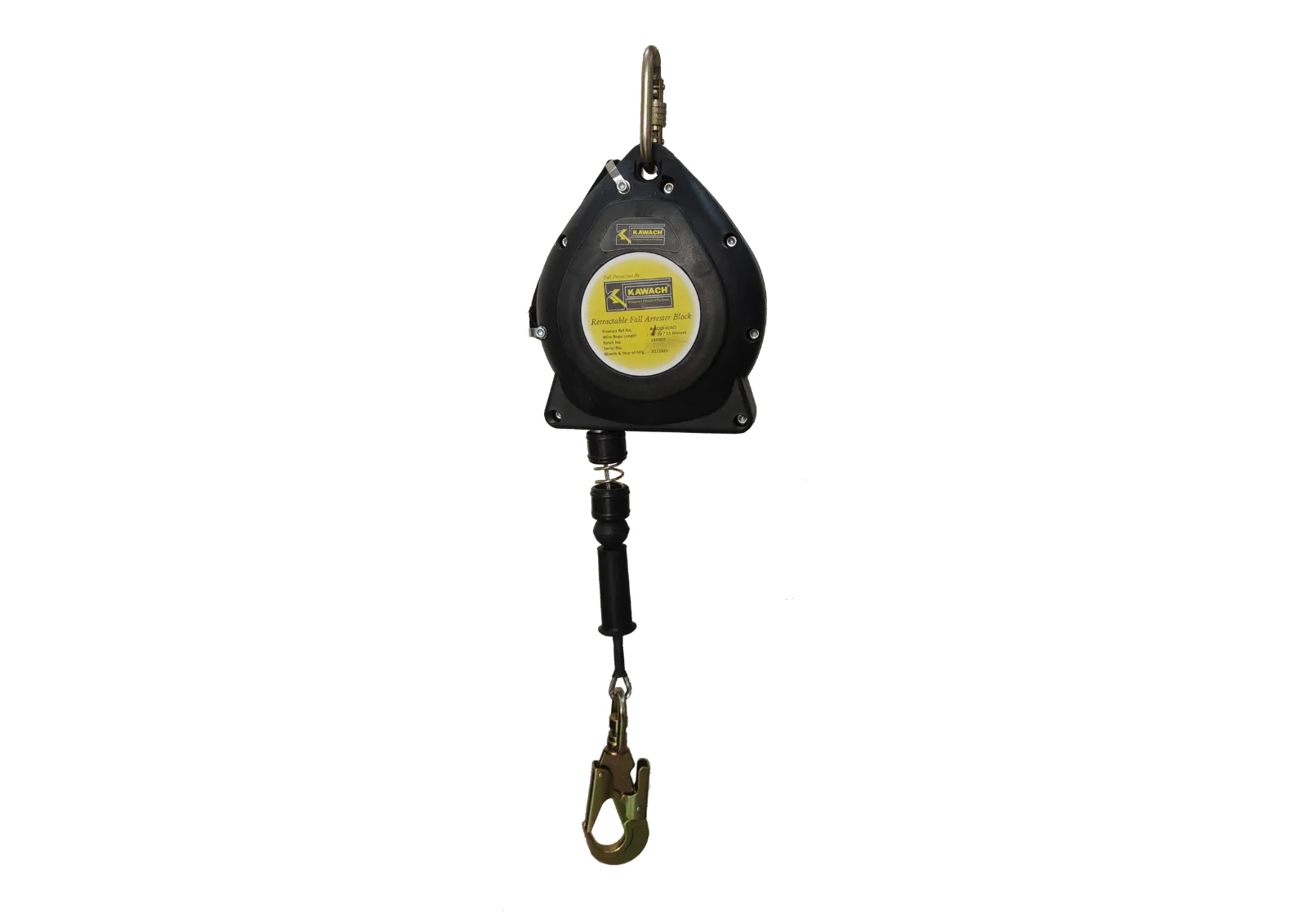
High-performance retractable fall arrest that allow smooth mobility while instantly locking to minimize impact during a fall.
Protect workers at height with Kawach Retractable Fall Arrester blocks, designed to support controlled movement and provide dependable fall protection in construction, maintenance and industrial environments.
A Retractable Fall Arrester-also known as a retractable fall arrest block or self-retracting lifeline-automatically extends and retracts as the user moves. If a sudden fall occurs, its internal locking mechanism engages to restrict further movement of the lifeline.
When correctly selected and connected to a suitable anchorage and full body harness, the device becomes an important component of a complete Fall Arrest System.
1. Automatic lifeline extension and retraction
2. Reduced loose cables around the working area
3. Improved mobility during work at height
4. Rapid locking response during a fall
5. Suitable options for construction and industrial applications
No products found.
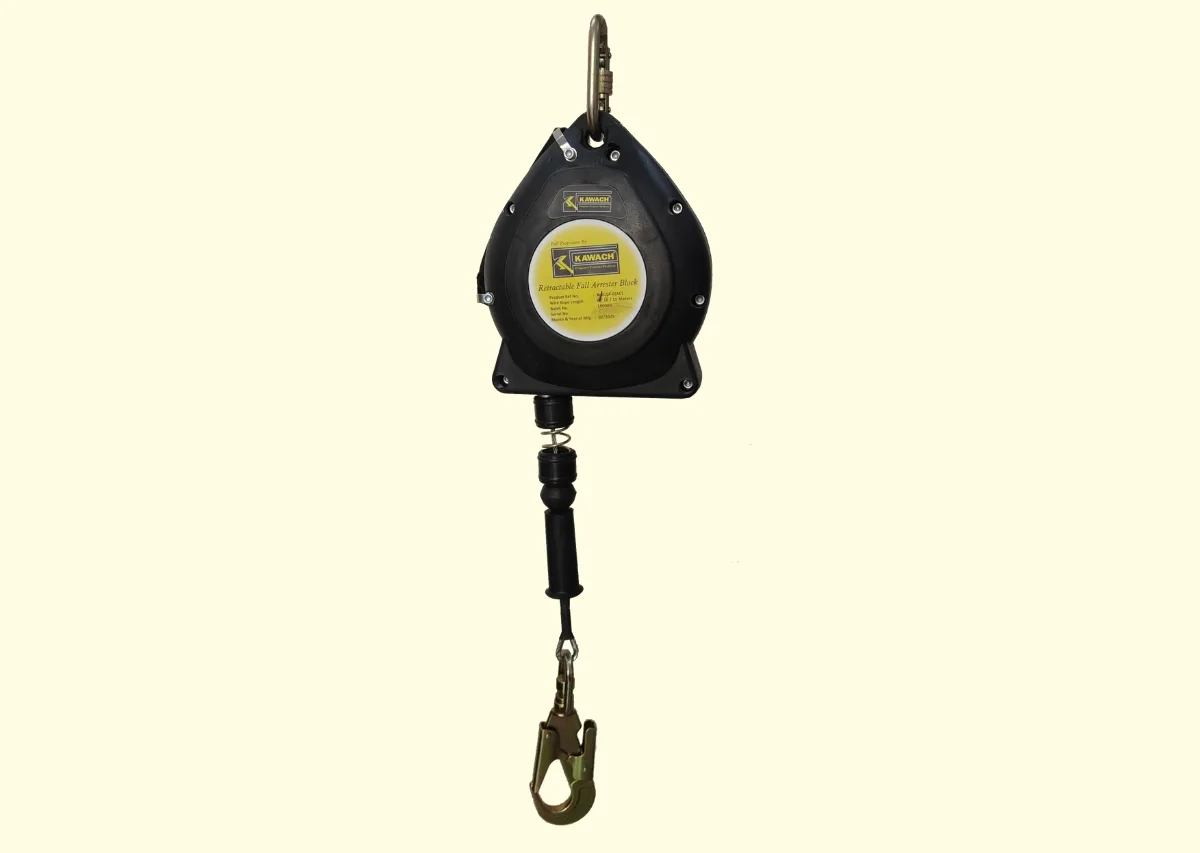
A Retractable Fall Arrester-also called a retractable fall arrest block or self-retracting lifeline-is a mechanical device containing a wire rope, cable or synthetic webbing lifeline wound around an internal drum.
The lifeline extends when the worker moves away from the anchorage and retracts when the worker moves closer to it. During ordinary movement, the internal drum rotates freely under controlled tension. When a rapid movement associated with a fall occurs, the locking and braking mechanism activates.
A complete personal Fall Arrest System normally includes:
1. A suitable anchorage or anchorage connector
2. A compatible full body safety harness
3. A connecting device, such as a Retractable Fall Arrester
4. Properly matched connectors
5. Adequate fall clearance
6. A planned rescue procedure
OSHA describes a personal fall arrest system as a combination of a body harness, anchorage and connector used to arrest a worker’s fall. The connecting arrangement may include a lanyard, a lifeline, a deceleration device, or an appropriate combination of these components.
A retractable block is therefore not a complete Fall Arrest System on its own.
Work at height may expose workers to falls from: Roofs and fragile surfaces, Scaffolding, Structural steel, Elevated platforms, Towers and poles, Open edges, Industrial machinery, Storage systems, Loading areas, Shafts and confined spaces and Maintenance access points
The priority should be to avoid working at height wherever reasonably practical. When the work cannot be completed from the ground, measures that prevent a fall-such as guardrails, safe platforms and work-restraint systems-should be considered before systems that arrest a fall after it begins.
HSE guidance follows this hierarchy: avoid work at height where possible, prevent falls where avoidance is not possible and minimise the distance or consequences of a fall when residual risk remains. It also recommends considering collective protection before personal protection.
A Fall Arrest System may be needed when workers must enter an area where a fall cannot be completely prevented through collective or restraint measures.
The system operates differently during normal movement and during a fall.
1. The lifeline extends as the worker moves away from the unit.
2. It retracts as the worker moves towards the unit.
3. The retraction mechanism takes up excess line.
4. The worker can move within the system’s approved working area.
5. Controlled tension helps reduce loose lifelines around the work area.
1. The lifeline accelerates rapidly.
2. The internal mechanism detects the sudden change in speed.
3. The drum locks or the braking system engages.
4. Further extension is restricted.
5. The complete Fall Arrest System brings the worker to a controlled stop.
The actual activation distance, arrest distance, maximum user weight and permitted working orientation depend on the selected product. These values must be taken from the official technical data sheet and user instructions.
Automatic retraction reduces excess loose cable or webbing. This may help minimise trip hazards and reduce the free line available before the device begins arresting a fall.
The lifeline adjusts continuously as the worker moves. This makes a self-retracting lifeline useful for tasks that require repeated movement within an approved working zone.
A retractable block is designed to lock when it detects a sudden acceleration of the lifeline. When installed and used correctly, it can arrest a fall over a shorter distance than some fixed-length connecting arrangements.
The self-retracting action allows workers to focus on their assigned task without repeatedly shortening or repositioning a conventional lanyard.
Depending on the product’s certification and manufacturer-approved configuration, retractable fall arresters may be used in overhead, vertical, horizontal, leading-edge or retrieval applications.
Not every retractable block is suitable for every application. Product selection must be based on the actual worksite configuration.
The Kawach PCGS-K product page lists the following construction and performance details:
1. High-impact-strength polymer casing
2. Galvanized steel wire rope
3. Wire-rope diameter of 4.8 mm
4. K-123 swivel snap hook
5. Anchorage eye with swivel action
6. Minimum breaking strength stated as greater than 12 kN
7. Conformity stated to EN 360:2002
The swivel action is intended to reduce unwanted twisting of the wire rope during worker movement or a fall event. The polymer casing protects the internal components during normal industrial handling.
Before purchasing or approving a PCGS-K unit, request and verify:
1. Available lifeline lengths
2. Minimum and maximum user weight
3. Product manufacture date
4. Serial number
5. Inspection requirements
6. Service interval
7. Approved anchorage position
8. Permitted operating angle
9. Fall-clearance requirement
10. Leading-edge suitability
11. Temperature range
12. Chemical and corrosion limitations
13. Relevant conformity certificate
14. Warranty and servicing procedure
Only the specifications contained in the official manual, certificate and model-specific technical data sheet should be used for system design.
A properly selected retractable fall arrest block can support workers involved in structural work, roofing, formwork, scaffolding, external maintenance and work near exposed edges.
Workers moving across steel members require a carefully engineered anchorage and connection system. An overhead retractable block can provide controlled movement where the installation and product instructions permit the application.
Maintenance teams may need fall protection when working above machinery, storage tanks, process equipment, cranes or elevated service platforms.
Retractable fall arrest equipment may be used during elevated maintenance, loading operations and work around high-level storage systems where other preventive measures cannot eliminate the hazard.
Technicians working on towers, poles and elevated utility structures may require specialised fall protection selected for the work position, anchorage arrangement and environmental conditions.
Equipment used in these environments may require additional resistance to corrosion, chemicals, heat or other hazardous conditions. Site approval and product compatibility must be verified before use.
Work inside towers and around nacelles can involve vertical movement, restricted access and rescue challenges. Product selection should be coordinated with the access and rescue system.
Confined-space work may require a retractable device with an integrated retrieval function. A standard fall arrest block must not be treated as a rescue winch unless it is specifically designed and certified for retrieval.
Choosing a Fall Arrest System based solely on price or lifeline length can result in an unsafe configuration. A competent person should consider all of the following factors.
Determine whether the unit will be installed:
1. Above the worker
2. At shoulder level
3. Below the dorsal D-ring
4. On a horizontal lifeline
5. Near a leading edge
6. On a tripod or davit system
A model intended only for overhead use must not be installed at foot level unless the manufacturer expressly approves that configuration.
Select a length that allows the worker to reach the authorised work area without introducing unnecessary excess line.
The longest available model is not automatically the safest choice.
Account for the worker’s body weight, along with clothing, tools and other equipment. The total must remain within the manufacturer’s approved weight range.
There must be enough unobstructed space below the worker for the system to activate, decelerate and stop the fall before the person contacts the ground, machinery or a lower structure.
The required clearance may include:
1. Free-fall distance
2. Device activation distance
3. Deceleration distance
4. Harness movement
5. Worker height
6. Lifeline stretch, where applicable
7. An additional safety margin
Use the model-specific manufacturer calculation rather than a generic online formula.
When a worker moves too far sideways from an overhead anchorage, a fall can cause pendulum-like movement. The worker may strike a wall, a column, a piece of equipment, or a structural member.
The work zone should therefore remain as close beneath the anchorage as the approved system permits.
If a lifeline can pass over an exposed edge during a fall, the cable or webbing may be cut, abraded or subjected to higher forces.
Use only equipment specifically approved for the relevant leading-edge configuration.
Consider exposure to: Moisture, Dust, Cement, Welding sparks, Sharp materials, Oils, Chemicals, Corrosive atmospheres, High or low temperatures and Electrical hazards
The lifeline and casing material must be compatible with the actual conditions.
The employer must plan how to rescue a worker after a fall. OSHA requires provision for prompt rescue, while fall-loaded equipment must be removed from service until inspected and declared safe by a competent person.
1. Complete a task-specific work-at-height risk assessment.
2. Confirm that the hierarchy of controls has been followed.
3. Verify that the selected device is suitable for the application.
4. Check the product label and inspection status.
5. Inspect the harness, connectors, anchorage and retractable block.
6. Calculate the available fall clearance.
7. Identify possible swing-fall and leading-edge hazards.
8. Confirm that a practical rescue plan is ready.
9. Ensure every user has received appropriate training.
Secure the retractable block to an approved anchorage using the correct connector. Confirm that all connector gates close and lock fully.
Connect the lifeline hook to the designated fall-arrest attachment point on the full body harness. In a conventional Fall Arrest System, this is commonly the dorsal attachment near the centre of the back at shoulder level, unless the manufacturer-approved configuration specifies another connection. OSHA also identifies the central back near shoulder level as the standard harness attachment position for personal fall protection.
Do not connect the snap hook:
1. To another snap hook
2. Directly to unsuitable webbing
3. To an incompatible D-ring
4. Around a structural member
5. To an unverified anchorage
6. To an object that can press against and open the gate
1. Keep the line as close to vertical as the approved system permits.
2. Maintain awareness of sharp edges and hot surfaces.
3. Do not wrap the lifeline around beams, pipes or columns.
4. Do not tie knots in the wire rope or webbing.
5. Do not use the device to lift tools or materials.
6. Do not modify, paint, dismantle or lubricate the unit unless instructed.
7. Do not allow the line to retract uncontrolled.
8. Stop work immediately if retraction or locking becomes irregular.
OSHA requires personal fall protection components to be used only for employee fall protection, not for hoisting equipment or materials.
Inspect the Retractable Fall Arrester before every work shift.
Check for: Cracks or deformation in the casing, Missing or loose fasteners, Corrosion, Damaged, missing or unreadable labels, Broken wires, Kinks or flattened sections of cable, Cuts, burns or abrasion, Chemical contamination, Irregular cable extension, Slow or incomplete retraction, Excessive slack, Failure to lock during the approved function test, Bent or damaged snap-hook body, Faulty hook gate, Damaged swivel, Activated load or fall indicator, if fitted and Evidence of unauthorised opening or repair
OSHA requires personal fall protection systems to be inspected during each work shift, with defective components removed from service. It also requires that lifelines and harness components be protected against cutting, abrasion, melting and other damage.
1. It has arrested a fall
2. It fails to retract smoothly
3. It does not lock correctly
4. The cable or webbing is damaged
5. The casing is cracked or deformed
6. The inspection date has expired
7. The product identity cannot be confirmed
8. The equipment’s history is unknown
9. A competent person considers it unsafe
Internal repair and servicing should only be completed by the manufacturer or an authorised service provider.
Kawach states that its safety equipment is manufactured under controlled production processes at its Bawana, Delhi facility. The company describes its approach as involving material control, production oversight and final product checks.
Kawach also operates a Training Cell that provides product-use guidance for clients. Its published training topics include:
1. General PPE awareness
2. Working-at-height guidance
3. Wearing and inspection of fall-protection equipment
4. Identification of fall hazards
5. Height-rescue training
6. Live product demonstrations
7. On-site practical guidance
Kawach states that this training is provided to purchasing clients and can be adapted to worksite-specific risks and equipment requirements.
1. Manufacturer-controlled production
2. Published product specifications
3. Product-selection guidance
4. On-site usage demonstrations
5. Fall-protection and rescue training
6. Support for industrial and construction requirements
7. After-sales assistance
8. Access to product and certification information
Kawach’s certification page lists ISO-, BIS-, CE- and laboratory-testing credentials at the company level. Buyers should still verify the exact certificate applicable to the individual retractable fall arrester model being purchased.
To strengthen buyer confidence, this page should display original Kawach material such as:
1. A clear product photograph from multiple angles
2. Close-up images of the wire rope and snap hook
3. A visible model and identification label
4. An extension and retraction demonstration video
5. A locking mechanism demonstration
6. A pre-use inspection demonstration
7. Photographs from the Kawach worksite training
8. A downloadable technical data sheet
9. A model-specific conformity certificate
10. An anonymised customer application example
A retractable block should be used with compatible equipment selected as a complete system. Depending on the task, this may include:
1. Full body safety harness
2. Certified anchorage
3. Anchorage connector
4. Horizontal or vertical lifeline
5. Self-locking connectors
6. Safety helmet with a chin strap
7. Rescue equipment
8. Tool-tethering system
9. Suitable safety footwear
10. Work-at-height training
Individually certified components do not automatically form a safe Fall Arrest System. Compatibility, system performance, anchorage, clearance and rescue arrangements must be evaluated together.
Speak with the Kawach team before selecting equipment for a new application.
Share details such as:
1. Work activity
2. Maximum working height
3. Available anchorage
4. Required movement area
5. User weight, including tools
6. Edge exposure
7. Environmental conditions
8. Available clearance
9. Rescue requirements
10. Number of workers
A Retractable Fall Arrester is a mechanical connecting device used in a Fall Arrest System. Its lifeline automatically extends and retracts as the worker moves and locks when it detects sudden fall-related acceleration.
No. It must be combined with a suitable anchorage, full body harness, compatible connectors, adequate fall clearance and a rescue plan.
A fall-restraint system is intended to stop a worker from reaching a location where a fall can occur. A Fall Arrest System is intended to stop and support a worker after a fall has begun.
Where practical, preventing access to a fall hazard is preferable to relying on fall arrest.
Only when the selected model and system configuration are specifically approved for below-dorsal or leading-edge use may a standard overhead model not be installed at foot level without written manufacturer approval.
This depends on the model. Some products are approved only for vertical overhead applications, while others are designed and tested for horizontal or leading-edge use.
Check the official manual and certificate.
Only when the equipment is specifically approved for that edge condition may standard wire rope, cable, or webbing be damaged during a fall over an exposed edge.
A conventional Fall Arrest System is commonly attached to the designated dorsal fall-arrest point on the upper back. Follow the instructions supplied with the harness and retractable block.
It should be visually and functionally checked before each work shift. Formal periodic inspections and servicing must follow the manufacturer’s instructions, applicable regulations and site conditions.
Remove the complete affected system from service immediately. Arrange rescue of the suspended worker and have the equipment evaluated by a competent or authorised person before any possible return to use.
No unauthorised person should open or repair the unit. The internal spring, brake and locking mechanism require approved parts, procedures and testing.
No. Personal Fall Arrest System components should not be used for lifting tools, equipment or materials unless the product is explicitly designed and approved for that purpose.
Fall clearance is the unobstructed vertical space required for the system to activate and safely stop a fall before the worker strikes the ground or a lower object.
A swing fall can occur when a worker falls while positioned away from the anchorage. The worker may swing towards a structure, wall or piece of equipment.
Yes. Arresting the fall does not complete the emergency response. The employer must have a realistic method for promptly recovering a suspended worker.
Kawach states that its Training Cell provides purchasing clients with on-site demonstrations and guidance covering PPE use, fall protection, equipment inspection and height rescue.
Typical applications include construction, steel erection, manufacturing, warehousing, utilities, telecommunications, oil and gas, wind energy, industrial maintenance and facade work.
Selecting a Retractable Fall Arrester requires more than choosing a cable length. Anchorage position, worker weight, fall clearance, edge exposure, environmental conditions, equipment compatibility and rescue arrangements must all be considered.
Contact Kawach for verified product specifications, model-selection support, technical documentation, bulk requirements and practical product-use training.
WhatsApp us