Versatile horizontal life line systems designed to provide continuous protection and freedom of movement across elevated workspaces.
Working at height demands more than simply wearing a safety harness. Workers performing roofing, structural erection, industrial maintenance, fabrication, construction and other elevated tasks often need to move horizontally while remaining connected to an appropriate fall-protection system.
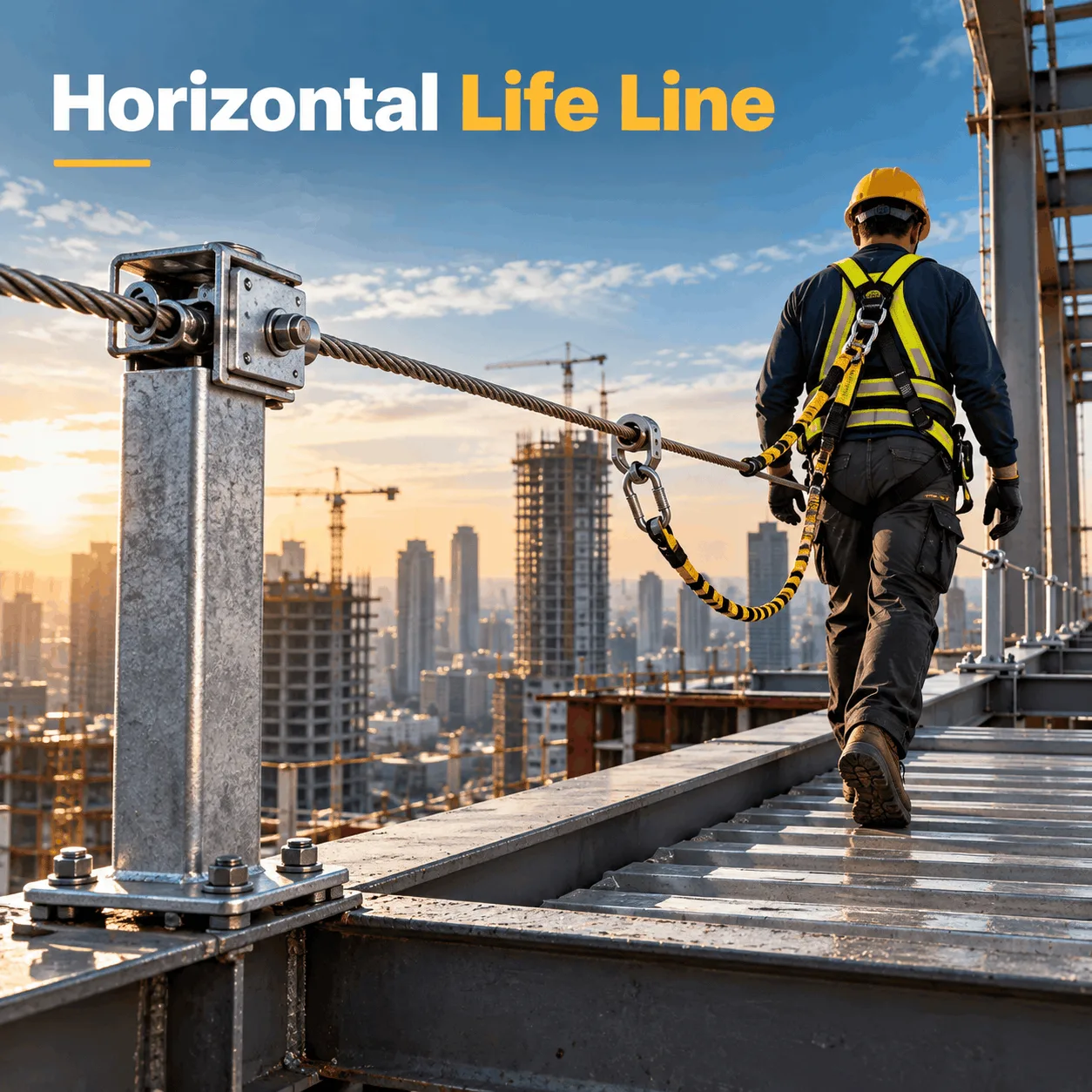
A Horizontal Life Line, also called a Horizontal Lifeline System, provides a horizontal anchorage route that helps workers move across a defined elevated work area while remaining connected via compatible fall-protection equipment.
Kawach Safe Gears India Pvt. Ltd. provides industrial fall-protection solutions for construction companies, factories, contractors, infrastructure companies, maintenance teams and other organisations across India.
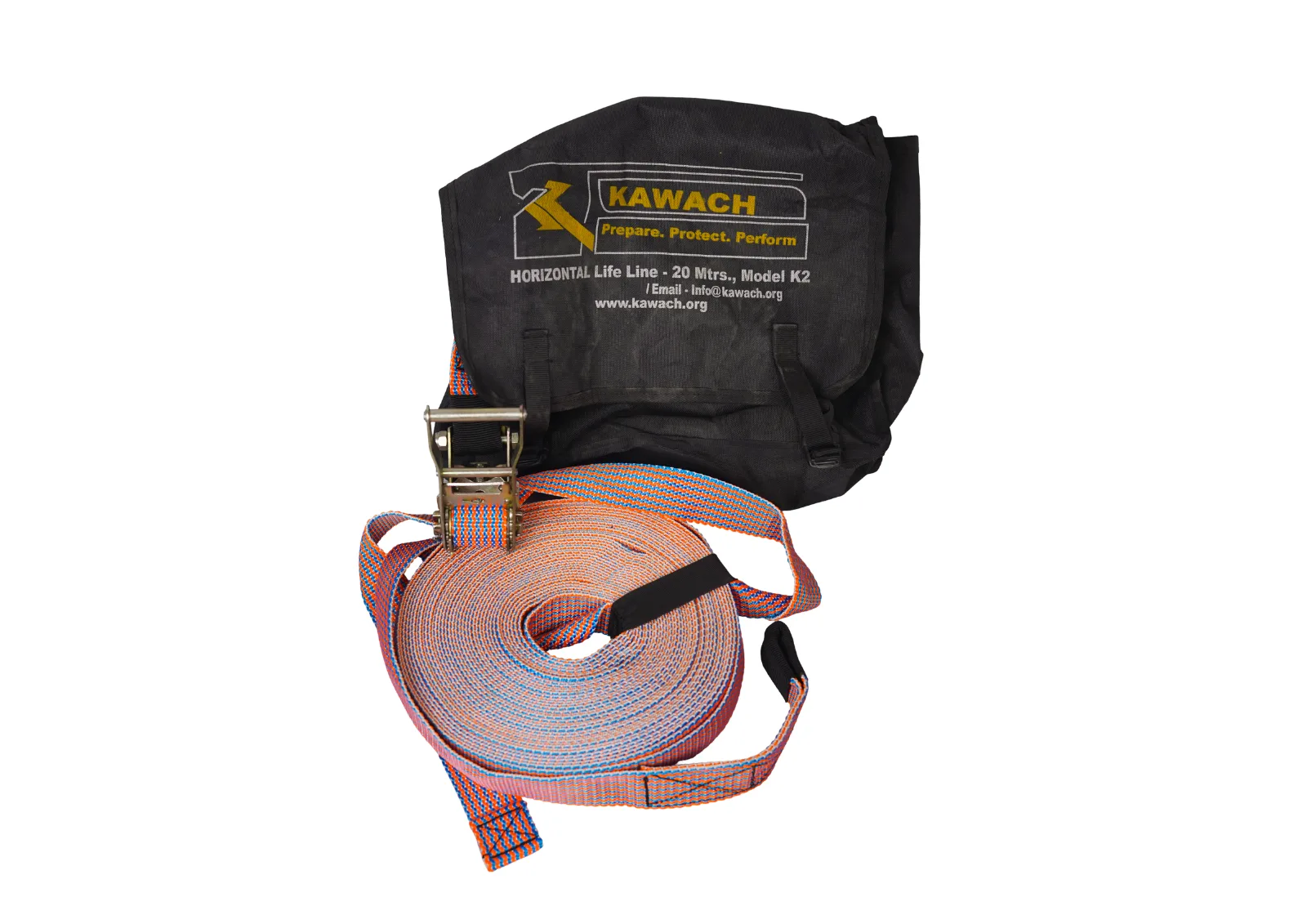
The current Kawach Horizontal Life Line category features the HL-K-2 Horizontal Anchorable Lifeline, manufactured from 30 mm polyester webbing and equipped with a ratchet tensioning arrangement. The system provides an adjustable working length of approximately 5-20 metres and is stated by Kawach to be tested and certified for simultaneous use by two users.
A Horizontal Life Line is an anchorage system extending horizontally between suitable supporting points.
Workers connect compatible fall-protection equipment to the lifeline so they can move along the required work zone without relying solely on a single stationary anchorage point.
A complete horizontal fall protection system may involve:
The lifeline itself is only one component. Effective protection depends on the entire system being correctly selected, installed, inspected and used.
The Kawach HL-K-2 is a portable Horizontal Life Line designed for applications that require temporary horizontal anchorage.
Kawach specifies that the system is manufactured from 30 mm polyester webbing and incorporates a ratchet tensioner to help tension the lifeline between two suitable supports. Both ends are provided with K-SSK112 auto-locking steel karabiners.
The complete assembly is supplied with a permanently attached carrying bag. A shoulder strap facilitates transport, while unused webbing can be stored inside the bag once the required span has been established.
Specification | Kawach HL-K-2 |
Product Type | Horizontal Anchorable Lifeline |
Product Model | HL-K-2 |
Webbing Material | Polyester |
Webbing Width | 30 mm |
Maximum Available Length | 20 metres |
Adjustable Working Length | Approx. 5–20 metres |
Tensioning System | Ratchet Tensioner |
End Connectors | Auto-Locking Steel Karabiners |
Karabiner Reference | K-SSK112 |
User Capacity | Tested & certified for two simultaneous users |
Storage | Permanently attached carrying bag |
Application | Horizontal work-at-height anchorage |
These specifications are based on Kawach’s currently published product information. Buyers requiring project-compliance documentation should obtain the latest technical datasheet and applicable product certificate before final approval or procurement.
Workers at height may need to travel several metres across a roof, beam, platform or elevated work zone.
Using only a fixed anchorage point can restrict movement. Frequent disconnection and reconnection may also introduce additional exposure if work is not properly planned.
A properly selected Horizontal Lifeline System can help create a controlled path for horizontal movement.
Workers can move through the approved working zone while remaining connected to the designated anchorage system.
A Horizontal Life Line can form part of a wider work-at-height safety plan that incorporates harnesses, connectors, anchorage, clearance assessment, rescue planning and training.
A webbing-based Temporary Horizontal Lifeline can be suitable where permanent infrastructure is not justified and the work location changes from project to project.
Kawach states that HL-K-2 is tested and certified for simultaneous use by two users. The stated user limit must never be exceeded.
Depending on the site risk assessment and approved system configuration, Horizontal Life Lines may be suitable for several industrial environments.
Temporary horizontal lifelines are commonly used in structural work, roofing, steel erection, fabrication and other elevated construction operations.
Technicians performing inspection, maintenance, HVAC work or other rooftop activities may require an appropriate horizontal anchorage arrangement.
Maintenance teams frequently work around elevated structural zones, machinery, platforms and plant infrastructure.
Roof inspections, repairs, utilities and building maintenance tasks can create fall hazards that require planned fall protection.
Workers performing structural assembly, fabrication, or maintenance may need to move horizontally between suitable approved anchor locations.
Bridges, utility structures, industrial infrastructure and other elevated locations can require specialised fall-protection arrangements.
Work around elevated equipment, structural supports and maintenance areas may require suitable fall-arrest or restraint systems.
Not every Horizontal Life Line System is designed for the same application.
Temporary systems are intended for project-based or changing work locations.
A portable webbing lifeline such as HL-K-2 can be moved between suitable worksites and configured within its approved length range.
Temporary systems can be useful for:
Permanent systems are typically designed for locations requiring repeated access.
They may incorporate engineered anchor posts, wire rope, energy absorbers, intermediate supports and travelling components.
Permanent systems normally require project-specific engineering, structural assessment and professional installation.
The choice between temporary and permanent protection should be made according to the site’s actual risk profile-not simply product price.
One of the most important decisions in work-at-height planning is determining whether the system will be used for fall restraint or fall arrest.
A fall-restraint arrangement aims to prevent the worker from reaching an unprotected edge or other position from which a fall could occur.
Where practical, preventing the fall exposure is generally preferable to managing the forces created after a fall begins.
A fall-arrest system is intended to stop a worker after a fall has started.
A proper fall-arrest assessment should consider:
Horizontal lifelines may deflect during a fall event. Therefore, lifeline deflection must be considered in addition to normal fall-clearance requirements during system planning.
A Horizontal Life Line should not simply be attached between two convenient structures.
Before installation, the responsible competent person should evaluate:
The proposed anchorage/support locations must be suitable for the loads associated with the intended fall-protection configuration.
Confirm the horizontal distance between supports.
HL-K-2 is published with a total available length of 20 metres and an adjustable working range of approximately 5 to 20 metres.
The permitted number of simultaneous users must be respected.
For HL-K-2, Kawach specifies two users simultaneously.
Measure the available distance below the work area.
The worker must not strike:
Workers travelling too far sideways relative to their connection arrangement may experience a pendulum or swing-fall effect.
Webbing and connecting equipment must be protected against inappropriate contact with sharp or abrasive edges.
A rescue plan should be established before work begins-not after an incident.
A trustworthy safety-equipment page should explain product limitations as clearly as benefits.
Do not use the Horizontal Life Line when:
When there is uncertainty about equipment condition or suitability, remove it from normal service until it has been evaluated.
Inspection is essential before using fall-protection equipment.
Look for:
Check:
Make sure:
Product identity and safety information should remain readable where required by the manufacturer’s inspection procedure.
A documented periodic inspection programme should also form part of the organisation’s fall-protection management system.
Before buying a Horizontal Life Line in India, ask:
✓ What horizontal span is required?
✓ How many workers will use the system?
✓ Is the requirement temporary or permanent?
✓ Will it be used for fall restraint or fall arrest?
✓ What structural anchor locations are available?
✓ What fall clearance is available?
✓ What type of full-body harness will be used?
✓ What lanyard or connector is required?
✓ Are sharp edges present?
✓ Is a rescue system available?
✓ What inspection procedure is required?
✓ What product-specific certification/documentation is available?
✓ Are workers trained to use the equipment?
Selecting equipment based on these factors is more responsible than purchasing solely on price.
Kawach positions its product development around the practical conditions found on Indian worksites.
The company’s history states that its journey began in 2011, with the Kawach brand officially launched in 2013, giving the business more than a decade of involvement in industrial PPE and workplace safety.
Kawach states that its manufacturing operations involve material sourcing, production and final quality checks.
Rather than focusing solely on supplying PPE, Kawach says its team guides proper product use and limitations.
Kawach states that hands-on guidance and on-site training are provided at the time of delivery to help users understand how to use safety equipment correctly.
The company also highlights continuing after-sales support for usage questions and product-related concerns.
Kawach’s certification page lists company-level credentials and testing references including MSME registration, ISO certification, BIS/ISI-related certification, CE certification and testing through Atharva Laboratories, which it identifies as NABL-certified. Buyers should still verify the certification applicable to the specific HL-K-2 model for their project requirement.
Work-at-height protection usually involves more than one piece of equipment.
Kawach’s fall-protection portfolio includes:
These related product categories allow organisations to evaluate compatible solutions for different fall hazards rather than relying on a single product.
Kawach supplies industrial safety equipment for PAN India requirements.
Companies, contractors and safety professionals can enquire about Horizontal Life Line requirements in regions including:
Delhi NCR, Delhi, Gurugram, Noida, Ghaziabad, Faridabad, Haryana, Rajasthan, Punjab, Uttar Pradesh, Gujarat, Maharashtra, Madhya Pradesh, Karnataka, Telangana, Tamil Nadu, West Bengal and other industrial regions across India.
For project enquiries, provide as much information as possible, including:
This helps create a more informed discussion about product selection.
Working at height should never depend on improvised anchorage or unverified safety equipment.
The right solution begins with understanding the hazard, evaluating anchorage, selecting compatible PPE, calculating available fall clearance, inspecting equipment and preparing an effective rescue procedure.
For contractors, factories, infrastructure projects, industrial plants and maintenance companies seeking a Horizontal Life Line manufacturer and supplier in India, Kawach offers the HL-K-2 Horizontal Anchorable Lifeline, along with a wider range of fall-protection and industrial safety equipment.
Contact Kawach Safe Gears India Pvt. Ltd. for Horizontal Life Line requirements, technical product information, bulk enquiries and work-at-height safety support across India.
Plan the work. Verify the anchorage. Inspect the equipment. Train the user. Protect every worker at height.
A Horizontal Life Line is an anchorage system installed horizontally across a defined work area. It enables workers using compatible fall-protection equipment to move along the protected zone while remaining connected to the designated safety system.
HL-K-2 is Kawach’s Horizontal Anchorable Lifeline manufactured from 30 mm polyester webbing and equipped with a ratchet tensioner and auto-locking steel karabiners.
Kawach states that HL-K-2 provides a total available length of 20 metres and can be configured for working lengths of approximately 5-20 metres.
According to Kawach’s published product information, HL-K-2 is tested and certified for simultaneous use by two users.
The lifeline uses 30 mm polyester webbing.
Subject to site assessment and system suitability, Horizontal Life Lines can be considered for construction sites, roofs, steel structures, industrial plants, manufacturing facilities, warehouses, maintenance areas and infrastructure projects.
A Horizontal Life Line supports movement primarily across a horizontal work zone. A vertical lifeline is designed for vertical movement, such as climbing and access applications.
Damaged fall-protection equipment should not be used in normal operations without evaluation in accordance with the manufacturer’s requirements. Cuts, tears, abrasion, damaged stitching or contamination can affect equipment integrity.
A Horizontal Life Line operates as part of a wider personal fall-protection arrangement. The appropriate harness, connector and other components must be selected based on the intended restraint or fall-arrest configuration.
Yes. Kawach meets industrial safety requirements across India and can be contacted for individual, bulk and project-based fall-protection needs.
WhatsApp us