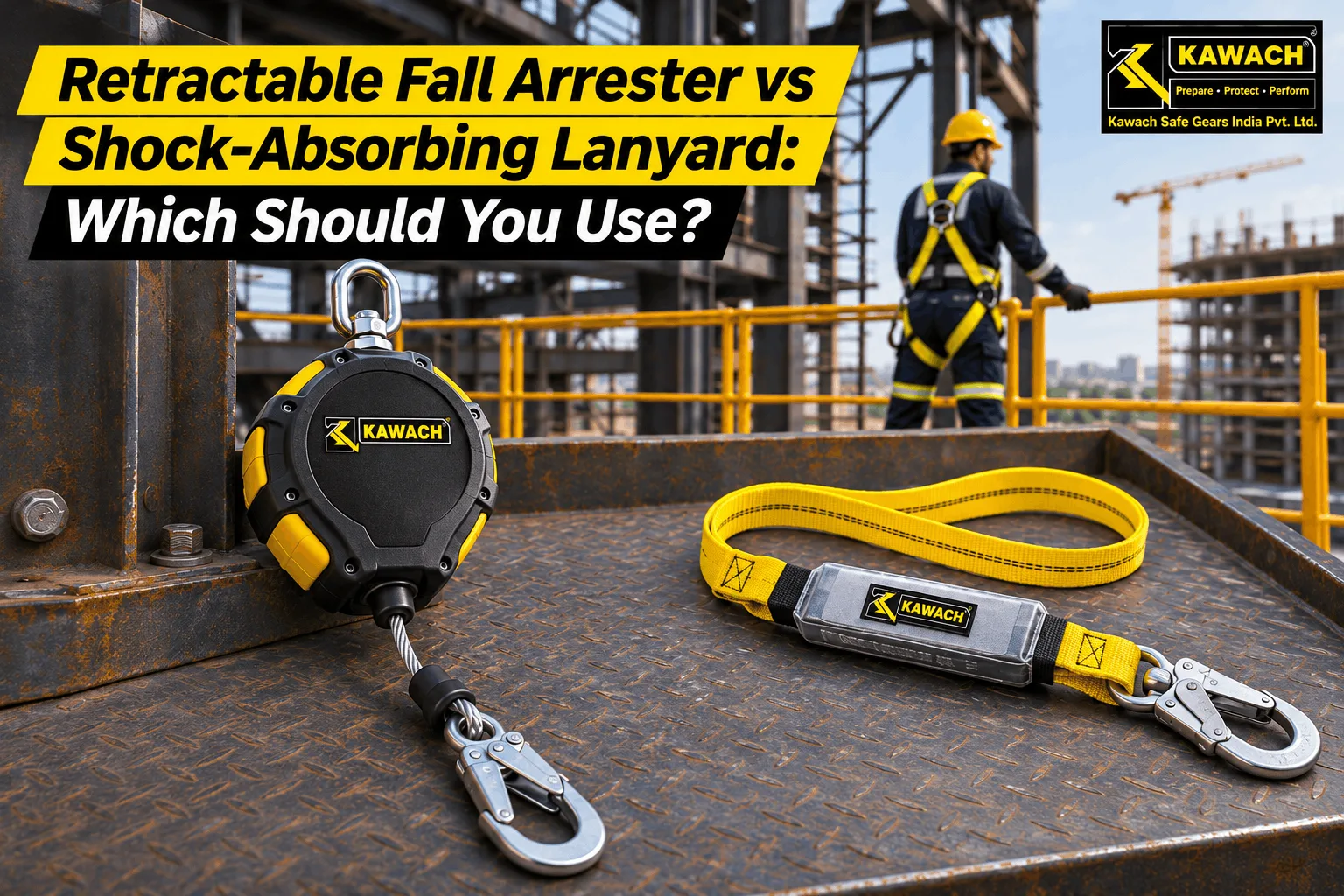
Choosing a connecting device for work at height is not about asking which product is universally “better”. A retractable fall arrester and an energy-absorbing lanyard manage movement and fall energy differently. The correct choice depends on the complete fall-protection system and the geometry of the work area.
OSHA describes personal fall-arrest systems as combinations of anchorage, body harness and connecting/deceleration components, and warns that components are not automatically interchangeable. For Indian users, the exact product documentation, applicable Indian requirements and site risk assessment must govern the final selection.
What is a retractable fall arrester?
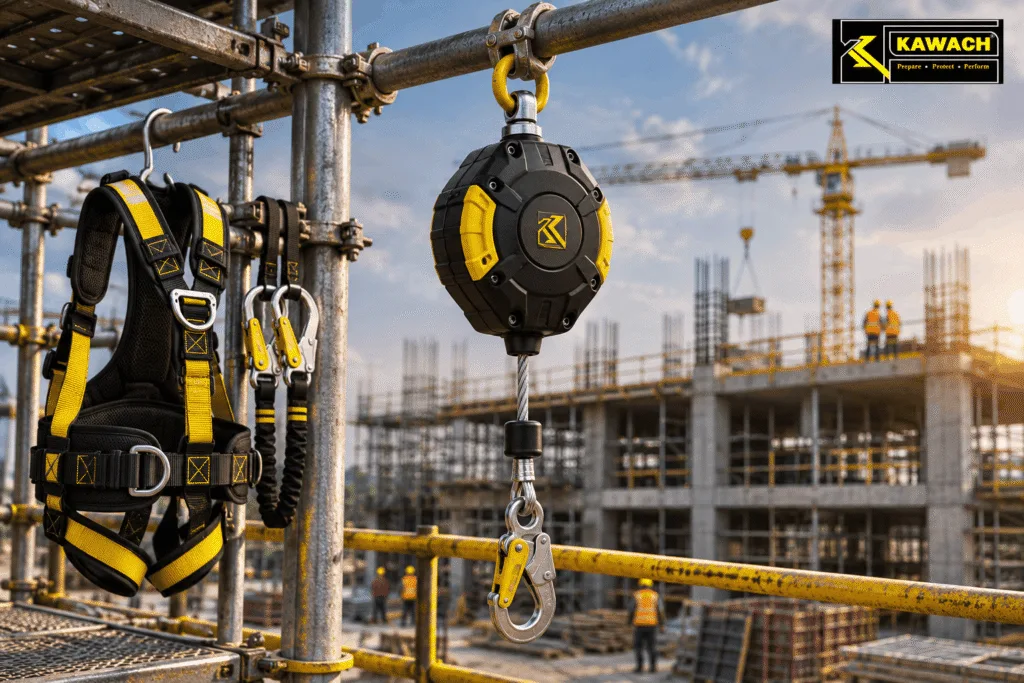
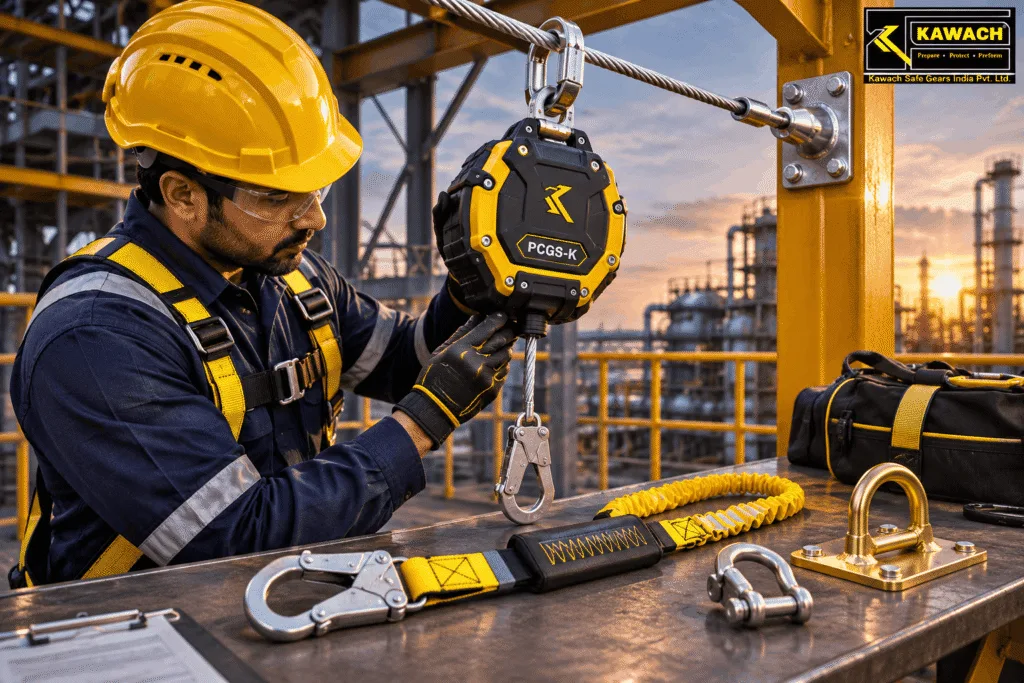
A retractable fall arrester-often called a self-retracting lifeline (SRL) or retractable block-contains a lifeline that extends as the worker moves away and retracts as the worker returns. During normal movement the mechanism permits controlled extension; during sudden fall-related acceleration it is designed to engage its locking/braking system.
Review Kawach Safe Gears India Pvt. Ltd. Retractable Fall Arresters for current model information.
What is a shock-absorbing lanyard?
A shock-absorbing or energy-absorbing lanyard is a fixed-length connecting element intended to connect a harness to an approved anchorage or lifeline arrangement. Its energy absorber is designed to deploy during a fall in the manufacturer-approved configuration, helping manage forces in the system.
Retractable fall arrester vs lanyard: comparison
| Factor | Retractable fall arrester | Shock-absorbing lanyard |
| Worker movement | Line automatically extends/retracts within the approved range. | Movement is limited by lanyard length and connection arrangement. |
| Slack management | Generally reduces loose line during normal movement. | Can create more slack depending on length and position. |
| Fall clearance | May reduce free-fall distance in some approved overhead configurations; actual clearance is model-specific. | Must allow for free fall, absorber deployment, harness movement, worker height and margin. |
| Anchorage sensitivity | Highly dependent on approved anchorage position, angle and edge conditions. | Also dependent on anchorage position and permitted free fall. |
| Inspection | Line, casing, connectors, retraction/locking function and indicators. | Webbing/rope, stitching, absorber pack, connectors and deployment indicator. |
| Complexity | Mechanical device; servicing/internal repair require authorised procedures. | Simpler component but still must be used only in approved combinations. |
| Typical fit | Repeated movement inside an approved work zone. | Fixed connection length where adequate clearance is available. |
Which option usually needs less fall clearance?
It is tempting to answer “the retractable block”, but the technically correct answer is to use the model-specific clearance calculation. An overhead SRL can begin arresting a fall quickly in many configurations, but clearance changes with device design, anchorage position, working angle, user weight, lifeline length and edge exposure. A shock-absorbing lanyard can require allowance for free fall, absorber deployment, harness movement, worker height and a safety margin.
Anchorage position can change the answer
A device approved only for overhead use should not be moved to foot level or a leading-edge application without explicit manufacturer approval. The same principle applies to lanyards: changing the anchorage position can increase free-fall distance or swing-fall risk.
When a retractable fall arrester may be the better fit
- The worker needs repeated movement away from and back toward an approved anchorage.
- The approved configuration benefits from automatic line retraction and reduced slack.
- The work zone and swing-fall risk can be controlled.
- The site has a suitable anchorage for the manufacturer-approved arrangement.
- The exact device is approved for the required orientation and edge conditions.
When a shock-absorbing lanyard may be the better fit
- A simple fixed connection suits the task.
- Adequate clearance is available for the approved configuration.
- The anchorage and harness point are compatible with the lanyard system.
- The worker does not need the travel range of an SRL.
- The site procedure and rescue plan support the arrangement.
What about twin-leg lanyards?
Twin-leg or forked lanyards can support movement between anchor points while maintaining a connection, but the hook-up method matters. Users must follow the lanyard and harness instructions. An unused leg should not be connected in a way that interferes with absorber function or creates an unapproved load path.
Inspection differences
Retractable fall arrester
- Casing cracks, deformation or missing fasteners.
- Cable/webbing cuts, broken wires, abrasion, kinks or contamination.
- Smooth extension and retraction.
- Correct locking response during the approved function test.
- Connector gate/lock operation and swivel condition.
- Fall/load indicator status where fitted.
- Current inspection/service status.
Shock-absorbing lanyard
- Webbing/rope cuts, abrasion, burns, chemical damage or hard spots.
- Broken or pulled stitching.
- Energy-absorber pack, cover and deployment indicator.
- Hooks/connectors for deformation, corrosion and proper closure.
- Labels and identity.
- Unauthorised knots, repairs or modifications.
What happens after a fall?
Fall-loaded equipment should be removed from service immediately and managed according to the manufacturer’s post-fall procedure. OSHA guidance similarly requires impacted personal fall-arrest components to be removed from service until inspected and found suitable by the appropriate competent/qualified person in its jurisdiction. Rescue planning is essential because arresting the fall is only the first part of the emergency response.
Do not select the connector before selecting the system
The strongest comparison is not “SRL versus lanyard”; it is “which complete system safely controls this task?” Start with the work-at-height hierarchy, work zone, anchorage, user, fall distance, nearby structures and rescue method. Then select compatible components.
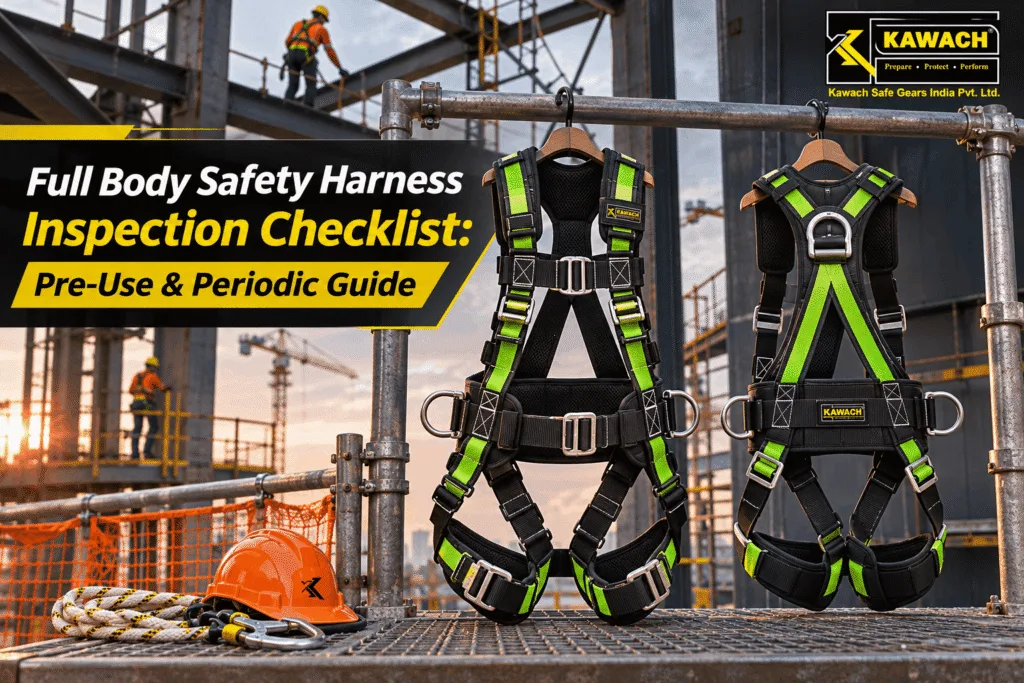
The worker’s body support should be an approved Full Body Safety Harness selected for the task.
For a broader overview, see the Fall Protection Equipment guide.
Frequently Asked Questions
Is a retractable fall arrester safer than a lanyard?
Not automatically. Safety depends on the complete approved system, anchorage, clearance, conditions, compatibility, inspection and training.
What is the main advantage of an SRL?
It can automatically extend and retract as the worker moves, reducing loose line and supporting greater movement within the approved area.
Does an SRL always need less clearance?
No universal claim should be made. Clearance is model- and configuration-specific; use the manufacturer’s calculation.
Can an SRL be anchored at foot level?
Only if the exact model and system are approved for that configuration. An overhead-only device must not be moved to foot level by assumption.
Can a standard SRL be used over a sharp leading edge?
Only if the product is specifically approved for the relevant leading-edge condition.
When should I use a shock-absorbing lanyard?
When the approved work setup, anchorage, movement need and available clearance suit a fixed-length energy-absorbing connection.
Can an SRL or lanyard be connected to any D-ring?
No. Use only the harness attachment point approved for that function and configuration.
What should happen after a fall?
Rescue the worker promptly, remove affected equipment from service, and follow the manufacturer’s post-fall procedure.