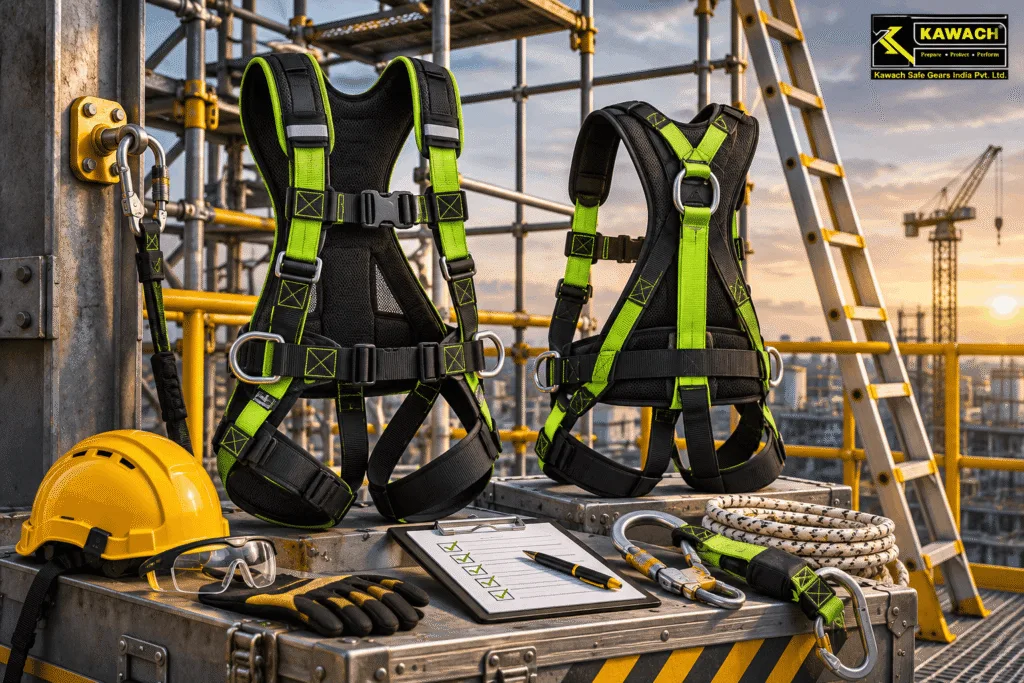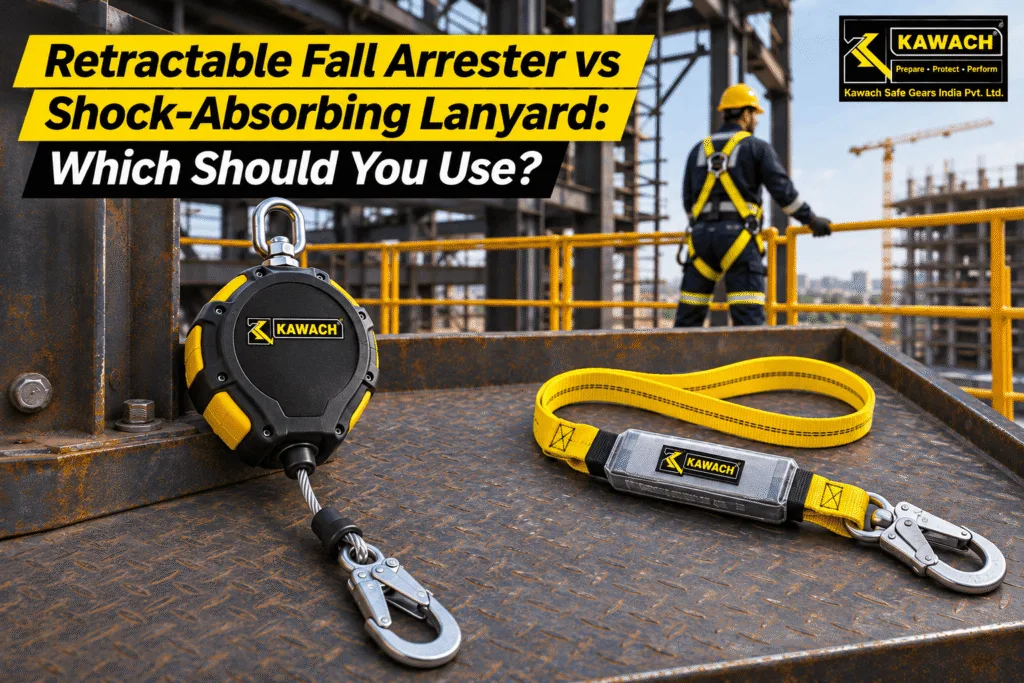
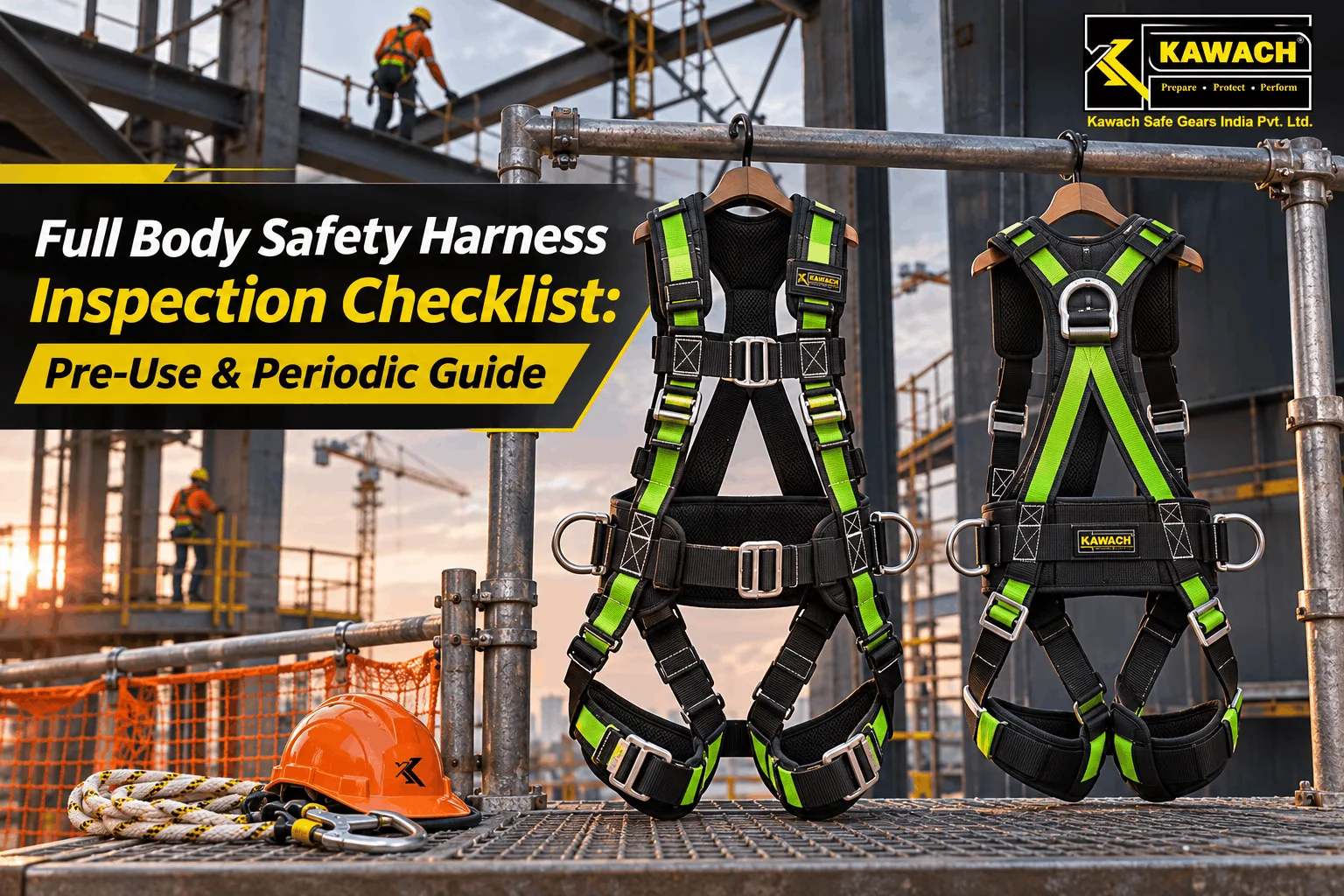
A full body safety harness can only perform as intended when it is correctly selected, fitted, connected and maintained. Inspection therefore needs to be treated as part of the fall-protection system, not as a quick formality before work starts.
In India, IS 3521 (Part 1):2021 covers full body harnesses used in personal fall-arrest systems. BIS published Amendment No. 1 and implementation guidance in 2025. International guidance such as OSHA also emphasises inspection, removal of defective components and rescue planning; these references are useful technical benchmarks but do not replace Indian requirements or model-specific instructions.
View the Kawach Safe Gears India Pvt. Ltd. Full Body Safety Harness range for current models.
First follow the work-at-height hierarchy
A harness is not the first answer to every work-at-height risk. Good practice is to avoid work at height where reasonably practicable, prevent falls with collective or restraint measures where possible, and use fall-arrest equipment where residual risk remains. A harness should be part of a planned system that also considers anchorage, connectors, clearance, training and rescue.
Pre-use harness inspection: 10 steps
| Inspection area | What to check |
| Identity and label | Confirm model, serial/batch details, marking, inspection status and retirement information are legible. |
| Webbing | Inspect both sides for cuts, fraying, glazing, burns, chemical attack, paint, pulled fibres or unusual stiffness. |
| Stitching | Check load-bearing stitch patterns for broken, cut, loose or missing threads. |
| D-rings / attachment points | Look for cracks, distortion, sharp edges, corrosion, heavy wear or unauthorised modification. |
| Buckles / adjusters | Confirm buckles operate smoothly, lock correctly and are not bent, cracked or excessively worn. |
| Connectors | Check hook/carabiner closure, locking function, deformation, corrosion and compatibility. |
| Energy absorber / lanyard | Inspect webbing, stitching, absorber pack and deployment indicators where supplied as an assembly. |
| Contamination | Look for acids, solvents, cement, oils, welding damage or other harmful substances. |
| Fit / adjustment | Confirm straps can be adjusted securely without twisting or improvised knots. |
| Inspection history | If history is unknown, inspection overdue or a fall is suspected, quarantine the equipment. |
When must a harness be removed from service?
- After it has been subjected to fall-arrest loading, unless the manufacturer-approved process specifically allows evaluation and return to service.
- When cuts, burns, severe abrasion, chemical damage, excessive stretching or damaged stitching are found.
- When D-rings, buckles or other hardware are distorted, cracked, heavily corroded or do not operate correctly.
- When identity/traceability information is unreadable.
- When the inspection status is overdue under the applicable programme.
- When unauthorised repairs, drilling, painting, knotting or modifications are found.
- When service history is unknown and continued suitability cannot be verified.
Pre-use inspection vs periodic inspection
A pre-use check is performed by the user before wearing the equipment. A periodic detailed inspection is a formal examination at intervals defined by the manufacturer, applicable requirements, the site procedure and severity of use. Harsh environments may justify more frequent formal inspections.
How to fit a full body harness correctly
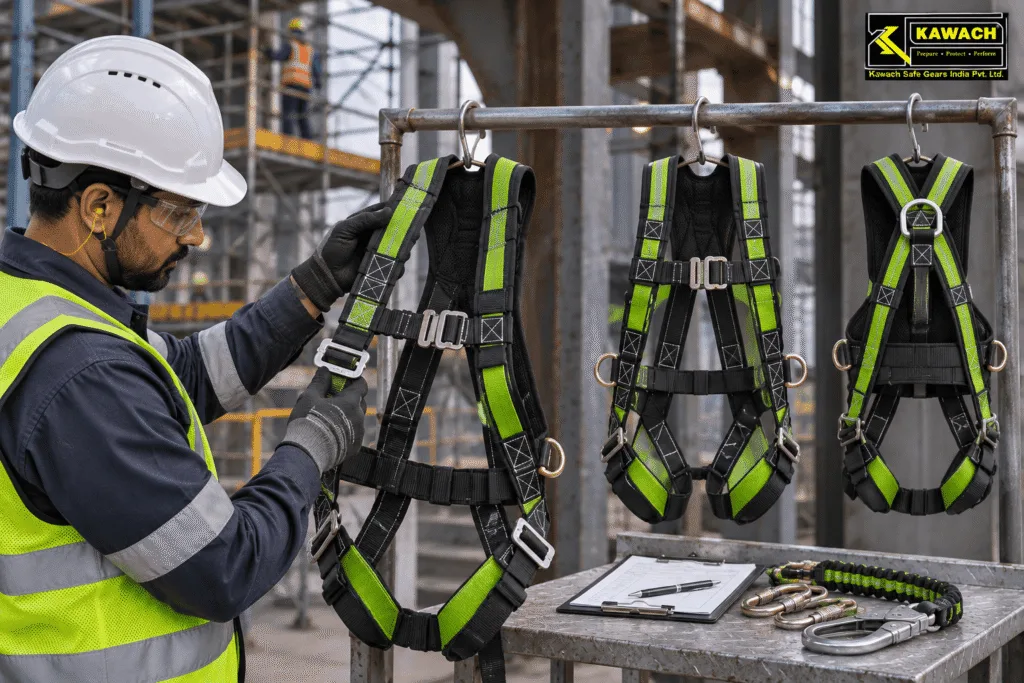
1. Hold the harness by the designated upper section so webbing hangs naturally.
2. Identify shoulder and leg sections before wearing.
3. Put on the harness without twisted straps.
4. Fasten leg, chest and other buckles in the sequence specified by the manufacturer.
5. Adjust so the harness is secure without restricting normal movement.
6. Confirm the designated fall-arrest attachment point is correctly positioned for the approved configuration.
7. Use trained supervision or a buddy check where the site procedure requires it.
More D-rings do not make a harness automatically safer. Different points may be intended for fall arrest, work positioning, climbing or rescue. Use only the attachment point approved for the task.
Fall clearance, swing fall and rescue
A harness arrests a fall only as part of a compatible system. The employer must also ensure enough clear distance below the worker, control swing-fall risk, use a suitable anchorage and maintain a practical rescue method. A worker left suspended after a fall remains in an emergency.
For connecting-device options, review Retractable Fall Arresters.
For a broader system overview, see the Kawach Fall Protection Equipment guide.
Frequently Asked Questions
How often should a full body harness be inspected?
Inspect before use. Formal periodic inspections should follow the manufacturer’s instructions, applicable requirements and site conditions. Harsh use may require shorter intervals.
Can a harness be reused after a fall?
Remove fall-loaded equipment from service immediately. Any return to service should follow the manufacturer-approved procedure and competent evaluation.
What are common harness defects?
Cuts, abrasion, burns, chemical damage, broken stitching, distorted/corroded hardware, faulty buckles, missing labels and unauthorised repairs.
Can a worker write a name on the webbing?
Only if the manufacturer permits the marking method and location; some inks or solvents can damage fibres or obscure labels.
Which D-ring should be used for fall arrest?
Use the attachment point designated by the manufacturer for fall arrest. Do not assume every D-ring has the same purpose.
Is a harness enough for work at height?
No. A system also needs suitable anchorage, compatible connecting equipment, sufficient clearance, training, inspection and rescue planning.
What if the label cannot be read?
Quarantine the harness if essential identity, standard, inspection or traceability information cannot be verified.
Does Kawach supply full body harnesses?
Kawach Safe Gears India Pvt. Ltd. lists multiple harness models; verify the current datasheet and certificate scope before purchase.