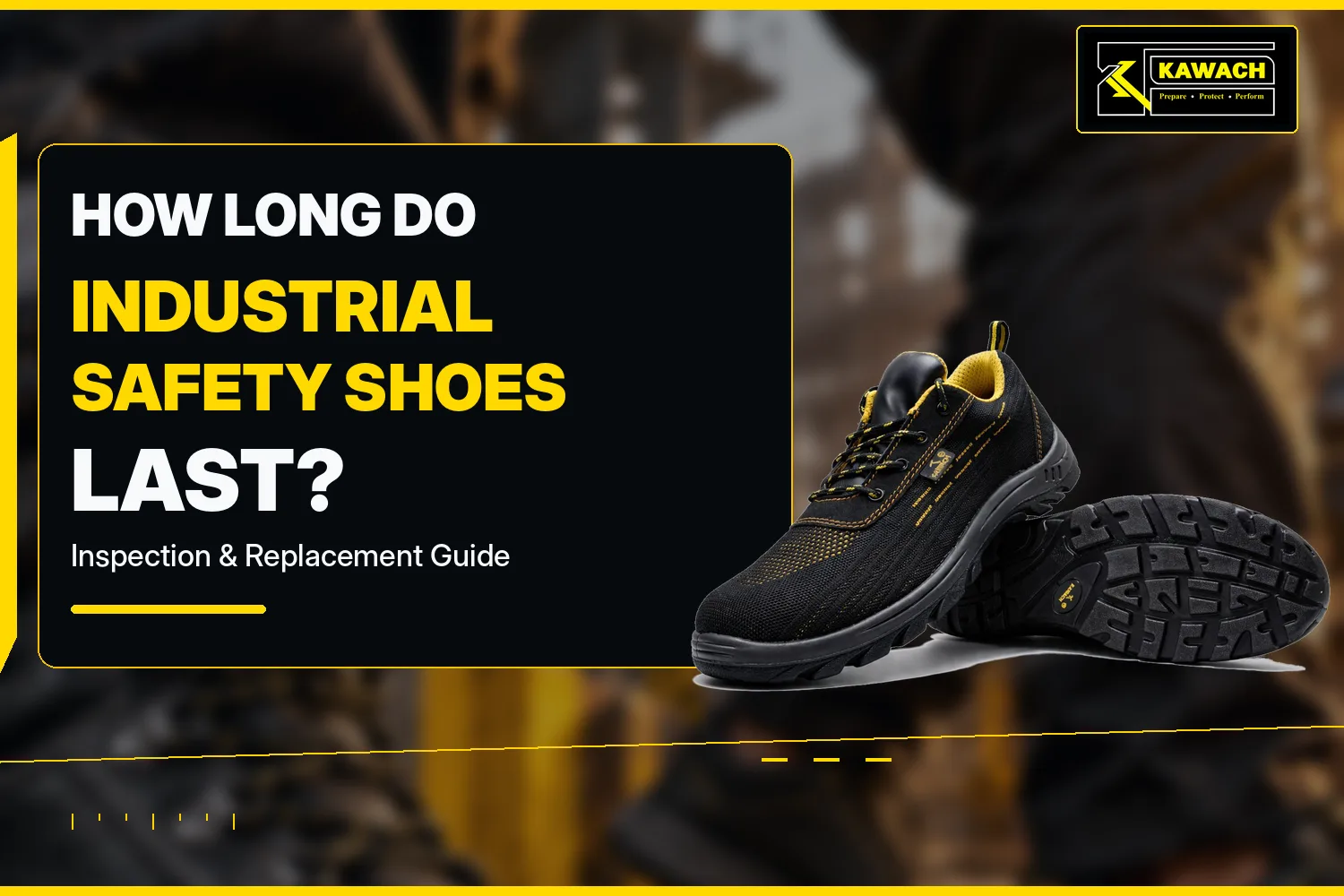
A common procurement question is: “How many months should safety shoes last?” A calendar alone cannot reliably decide whether industrial footwear is still fit for use. Two workers can receive the same model on the same day and wear it at very different rates because their tasks, floor conditions, walking distance and exposure differ.
For current footwear options, see the Industrial Safety Shoes range from Kawach Safe Gears India Pvt. Ltd.
There is no universal replacement date
Safety shoes should be managed using condition, usage and workplace risk rather than a fixed rule such as “replace every six months”. A lightly used pair in a clean indoor area may remain serviceable longer than footwear exposed daily to rough concrete, swarf, moisture, oils, chemicals or heat. Always follow the model-specific care and retirement instructions supplied with the footwear.
What shortens the life of safety footwear?
- Long daily walking distances on abrasive floors.
- Dragging the toe while kneeling or working close to the floor.
- Chemical, oil, fuel or solvent exposure beyond documented model resistance.
- Repeated wetting without correct drying.
- Heat, welding spatter or hot surfaces.
- Poor fit that creates abnormal creasing or heel movement.
- Aggressive cleaning chemicals or improper drying.
- Storage in direct sun, high heat, moisture or contaminated areas.
- Using one shoe model for hazards it was not selected to handle.
12-point safety-shoe inspection checklist
| Inspection point | What to check |
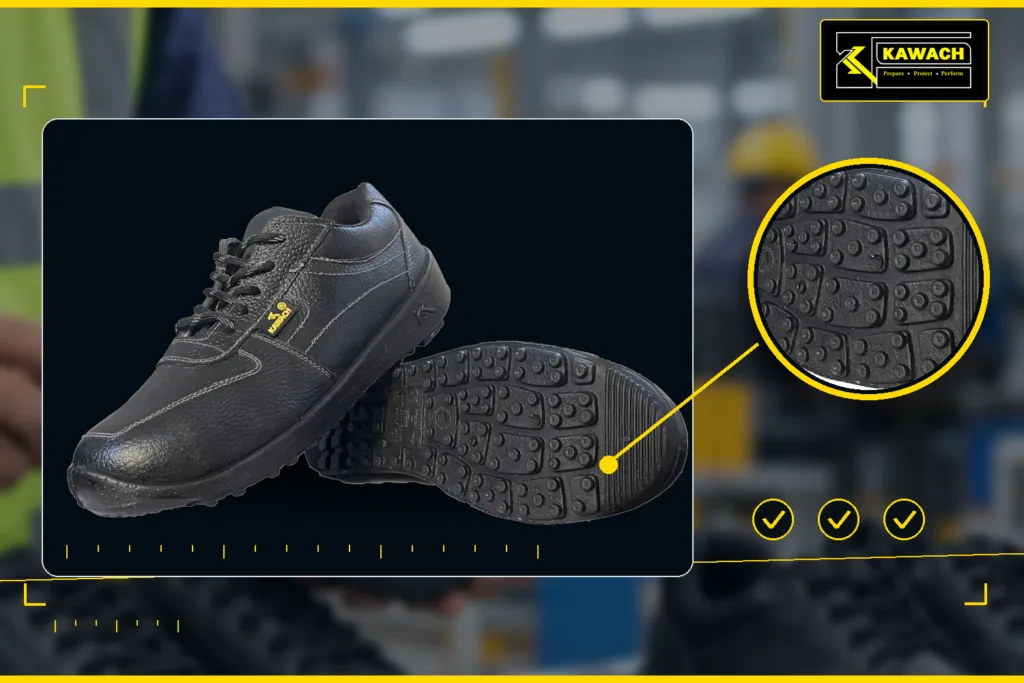
| Outsole tread | Severe smoothing, uneven wear, missing tread or damage that can reduce stability. |
| Sole-to-upper bond | Opening, separation, cracking or gaps around the sole edge. |
| Toe area | Deep cuts, crushing, deformation or damage around the protective-toe region. |
| Upper material | Tears, deep cracking, burns, punctures or chemical damage. |
| Stitching | Broken, loose or separating seams. |
| Heel structure | Collapse, instability or unusual movement. |
| Laces/fasteners | Damaged laces, eyelets, hooks or closure systems. |
| Insole/footbed | Compression, damage or contamination; replace only as permitted by the manufacturer. |
| Lining | Severe wear or holes that expose rough edges. |
| Contamination | Oils, chemicals, cement or metal fragments that cannot be safely removed. |
| Marking/identity | Model and traceability information remain legible where required. |
| Overall fit/function | Shoe still fits securely and has not changed shape significantly. |
Replace safety shoes immediately when…
- The sole is separating from the upper or the shoe has lost structural stability.
- The protective toe area is visibly crushed, deeply damaged or exposed.
- Cuts, burns or chemical damage penetrate the upper or sole.
- Tread is severely worn for the surface on which the worker operates.
- A puncture or sharp object has compromised the sole.
- A significant impact event may have compromised protection.
- The manufacturer’s retirement criteria are reached.
- The model identity or condition is uncertain and the risk cannot be safely assessed.
Can a shoe look fine but still need review?
Yes. Not every problem is obvious from a quick glance. Internal compression, contamination, cushioning breakdown or changes in fit can affect performance or comfort. Worker reports of new heel movement, pressure at the toe area, loss of grip or structural change should be investigated rather than ignored.
How to extend service life without compromising safety
1. Issue the correct model for the actual hazard and floor condition.
2. Use the correct size and confirm fit during trial.
3. Clean according to manufacturer instructions rather than with harsh solvents.
4. Dry wet footwear naturally unless another method is specifically permitted.
5. Keep footwear away from uncontrolled high heat.
6. Remove embedded debris from the tread.
7. Use replacement insoles or laces only when compatible with the model instructions.
8. Track recurring failures by model and department so the next procurement specification improves.
Build a workplace replacement system, not a guess
For larger workforces, record issue date, model, department, replacement date and reason for retirement. Over time, this becomes first-party performance data showing which footwear constructions work best in your own conditions. This type of evidence is more useful than repeating a generic industry lifespan.
Does lightweight safety footwear wear out faster?
Not automatically. Lower mass is not proof of lower durability, and heavier footwear is not proof of longer service life. Compare the actual construction, model documentation and workplace performance.
For comfort-focused options, see Lightweight Safety Shoes.
Use inspection findings to improve procurement
If one department repeatedly retires footwear because of outsole wear while another sees upper cuts or moisture damage, the next purchase should address those different failure modes. That is more useful than issuing one model to every department.
For model selection by work requirement, use the Best Safety Shoes in India page.
Frequently Asked Questions
How long do industrial safety shoes last?
There is no single lifespan for every worker. Service life depends on use, surface, environment, care, fit and construction. Inspect condition and follow model-specific retirement guidance.
Should safety shoes be replaced every six months?
Not as a universal rule. A fixed schedule can retire serviceable footwear too early or leave heavily damaged footwear in use too long.
Can worn tread make safety shoes unsafe?
Severe tread wear can reduce stability or grip on the intended surface. Review the shoe when tread becomes heavily worn, uneven or damaged.
What if the sole starts separating?
Remove the footwear from use and replace or evaluate it according to the manufacturer’s instructions.
Can a damaged protective-toe shoe still be used?
A visibly crushed, exposed or damaged protective-toe area should be removed from service unless the manufacturer can verify continued fitness.
How should wet safety shoes be dried?
Follow the manufacturer’s care instructions and avoid uncontrolled high heat that may damage adhesives, uppers or sole materials.
Should employers keep replacement records?
For larger workforces, yes. Issue and retirement records can improve PPE procurement and identify recurring failure patterns.
Do lightweight safety shoes wear out faster?
Not automatically. Durability depends on design, materials, use and environment, not simply weight.