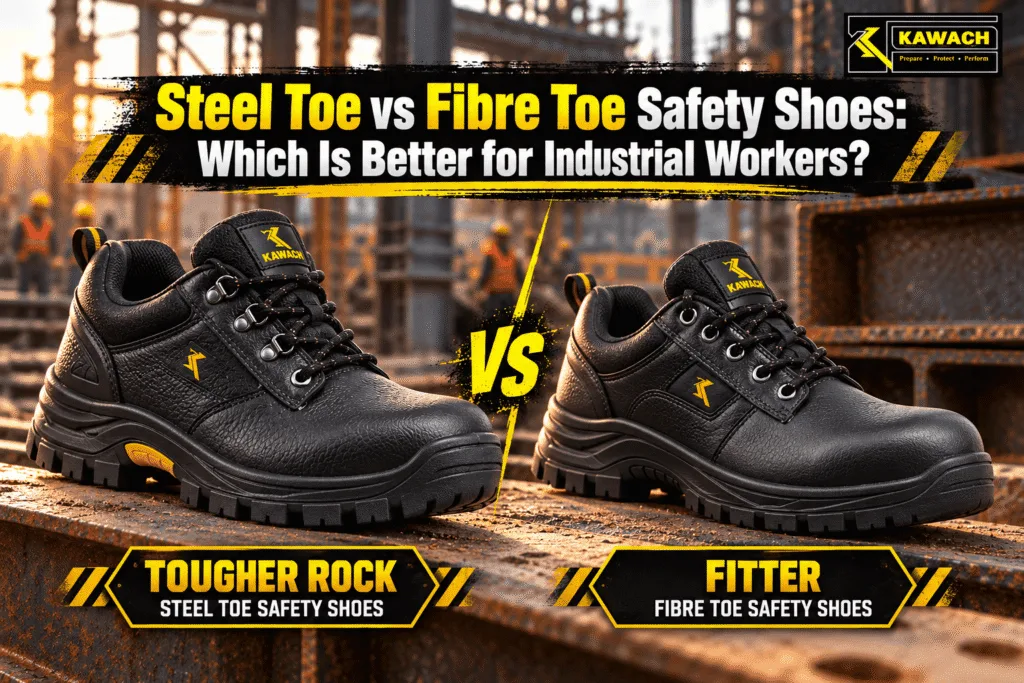
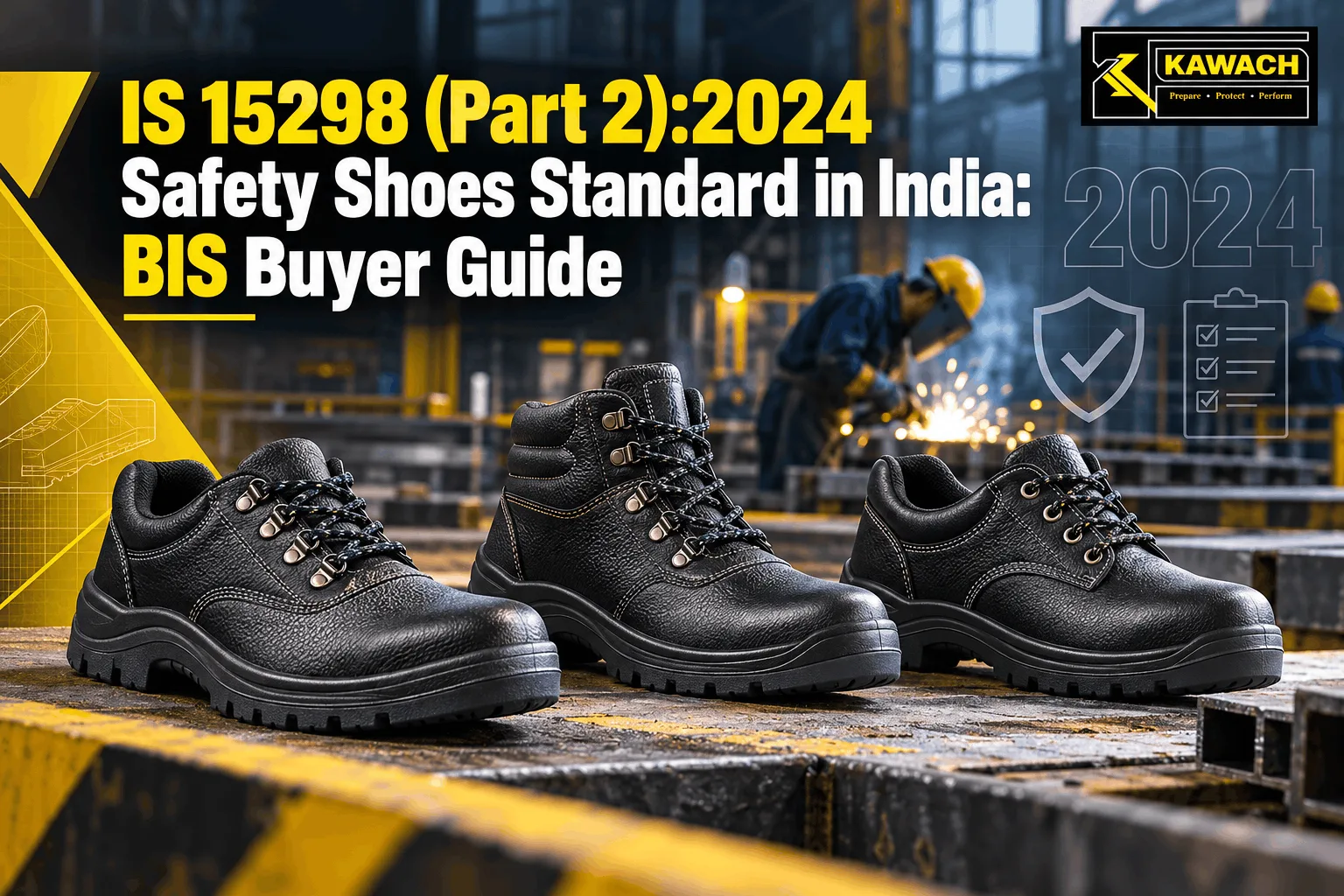
Industrial safety shoes should be selected for defined workplace hazards, not simply because a shoe looks strong. For Indian procurement teams, EHS managers and contractors, the standard named on the footwear and the evidence supporting it are therefore central to a technically sound purchase.
The Bureau of Indian Standards (BIS) product manual identifies IS 15298 (Part 2):2024 as the Indian Standard for Personal Protective Equipment – Part 2: Safety Footwear. The revised edition is based on ISO 20345:2021 with Indian modifications. BIS implementation guidance issued in January 2025 states that the 2016 edition was revised to the 2024 edition and sets the transition to the revised standard.
If you are comparing current Kawach models, start with the Industrial Safety Shoes category and then verify the model-specific documents before finalising a bulk order.
What does IS 15298 (Part 2):2024 cover?
The standard applies to safety footwear as a complete product. That distinction matters: a steel or fibre toe cap is only one component. Toe material alone cannot prove that the complete footwear satisfies every applicable safety-footwear requirement. Buyers should review the whole shoe, its marking and the documentation for the exact model.
BIS product documentation also addresses matters such as materials, sampling, grouping and conformity-assessment controls. For a buyer, the practical takeaway is simple: connect the exact model being purchased to its current datasheet, applicable standard, licence/certificate scope and relevant test evidence.
Why the 2024 revision matters for procurement
Standards change as terminology, testing and technical requirements evolve. Tender documents, product pages and purchase specifications should therefore avoid copying an outdated standard reference indefinitely. The safest approach is to verify the current model documentation before every major procurement exercise and update website copy when the evidence changes.
BIS, ISI, ISO and CE: do not treat them as the same thing
| Term | What it generally refers to | Buyer action |
| BIS | Bureau of Indian Standards, India’s national standards body. | Verify the exact licence/certificate scope and product marking. |
| IS / Indian Standard | The technical standard number and edition, e.g. IS 15298 (Part 2):2024. | Confirm the edition applicable to the exact model. |
| ISI Standard Mark | A conformity mark used under BIS certification schemes where applicable. | Do not rely on a logo image alone; verify licence and scope. |
| ISO | International standardisation framework. IS 15298 (Part 2):2024 is based on ISO 20345:2021 with modifications. | Use the applicable Indian requirement when procuring for India. |
| CE | A product conformity marking used for applicable European-market requirements. | Do not describe a company generically as “CE certified”; verify the exact product declaration. |
What should buyers check besides the standard number?
- Protective toe-cap type and documented impact/compression performance.
- Upper material and construction, including properties relevant to the workplace.
- Outsole material, tread design and slip-related performance where documented.
- Oil, fuel, chemical, water or heat-related properties only where the exact model has evidence.
- Antistatic or electrical properties only where the complete footwear has model-specific documentation.
- Fit, size availability, flexibility, lining/insole comfort and worker feedback during a sample trial.
- Product marking, batch/traceability details and certificate/test documents that apply to the supplied model.
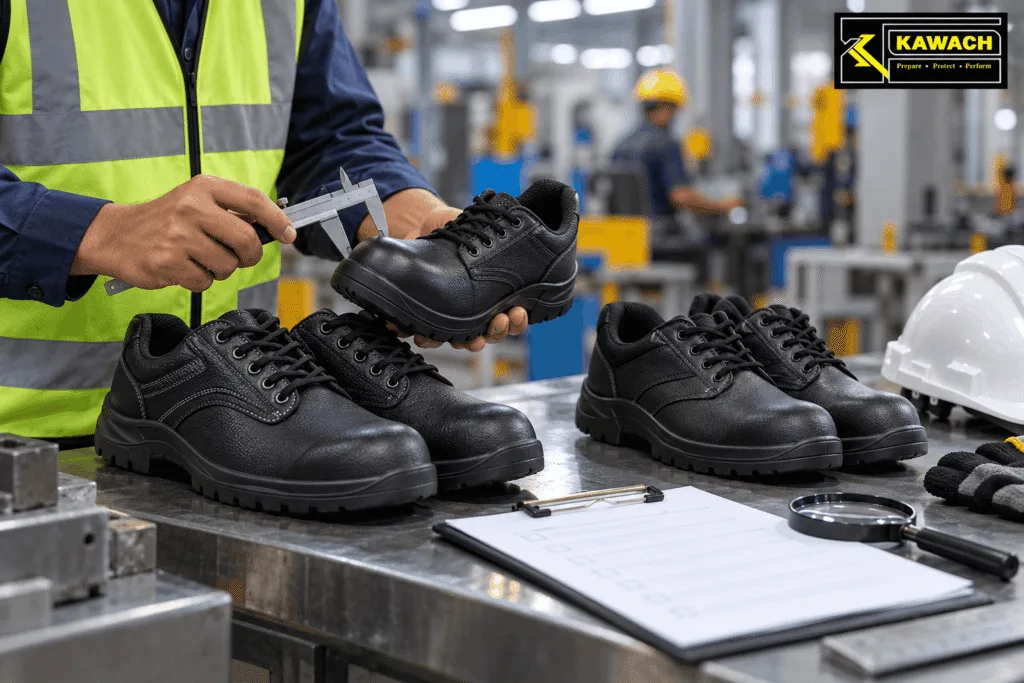
10-point safety-shoe procurement checklist
1. Define the actual workplace hazards before choosing a shoe.
2. Identify the protection features required by the risk assessment.
3. Ask for the exact model name/code rather than only a catalogue photograph.
4. Verify the applicable IS standard and edition stated for that model.
5. Check the BIS licence/certificate scope or other applicable conformity document.
6. Compare toe, outsole, upper, size, weight and documented resistance properties.
7. Run a wearer trial with employees from the relevant department.
8. Collect an accurate size distribution before placing a bulk order.
9. Agree how incoming batches will be checked against the approved sample/specification.
10. Keep the current model documents with procurement and EHS records.
What documents should a professional supplier provide?
- Current product datasheet for the exact model.
- Applicable BIS licence/certificate or conformity document and scope.
- Relevant test report or test summary where disclosure is permitted.
- Product marking/label photograph or physical sample.
- Material and construction specification.
- Size chart and fitting guidance.
- Care, inspection, storage and replacement instructions.
- Batch/traceability information for supplied goods.
Kawach Safe Gears India Pvt. Ltd. should make these documents easy to locate from the relevant product and category pages. A buyer should not have to assume that a certificate displayed on a general Certifications page automatically applies to every shoe in the range.
How to verify claims such as 200J, antistatic or electrical resistance
Safety-footwear performance claims should be model-specific. A steel toe cap does not by itself make the complete shoe electrically protective. Likewise, “antistatic”, “chemical resistant” or “oil resistant” should not be used as blanket range claims unless the exact footwear model has supporting evidence for the claimed property and application.
How Kawach Safe Gears India Pvt. Ltd. should present compliance online
- Use one specification-table format for every footwear model.
- Show the exact standard edition and only documented properties.
- Provide a downloadable technical datasheet for each main model.
- Link each product to the relevant certificate/evidence rather than displaying broad logos alone.
- Use real product, label, QC and testing photographs where appropriate.
- Name a real technical reviewer on standards-led content.
- Show a “last technically reviewed” date and update the article when evidence changes.
Which Kawach page should rank for commercial safety-shoe searches?
This article should support the commercial category, not compete with it. “Industrial Safety Shoes” should primarily belong to the Safety Shoes category. “Best Safety Shoes in India” should belong to the comparison page, while “Lightweight Safety Shoes” should belong to the dedicated lightweight landing page.
Browse the Industrial Safety Shoes range for current models.
For selection by use case, compare the Best Safety Shoes in India page.
For comfort-focused requirements, review Lightweight Safety Shoes.
Frequently Asked Questions
What is IS 15298 (Part 2):2024?
It is the current Indian Standard for safety footwear and is a modified adoption of ISO 20345:2021. Buyers should verify the exact model, marking and conformity documentation.
Does a steel toe automatically mean the shoe complies with IS 15298?
No. Compliance relates to the complete footwear against the applicable requirements; the toe cap is only one component.
What should I ask a safety-shoe supplier for?
Ask for the model-specific datasheet, applicable licence/certificate scope, relevant test documentation, marking information, size/fit guidance and care/inspection instructions.
Are all Kawach safety shoes covered by one certificate?
Do not assume that. Kawach Safe Gears India Pvt. Ltd. should confirm the exact document and scope that applies to the model being purchased.
Can safety shoes be selected only by price?
No. Start with hazards, required protection, verified documentation and fit; compare price after the technical requirement is defined.
Are antistatic and electrical-protection claims the same?
No. They concern different electrical characteristics. Use only the property documented for the exact model and intended application.
How often should product documentation be reviewed?
Review it whenever a standard, certificate, product construction or model specification changes and before major procurement exercises.