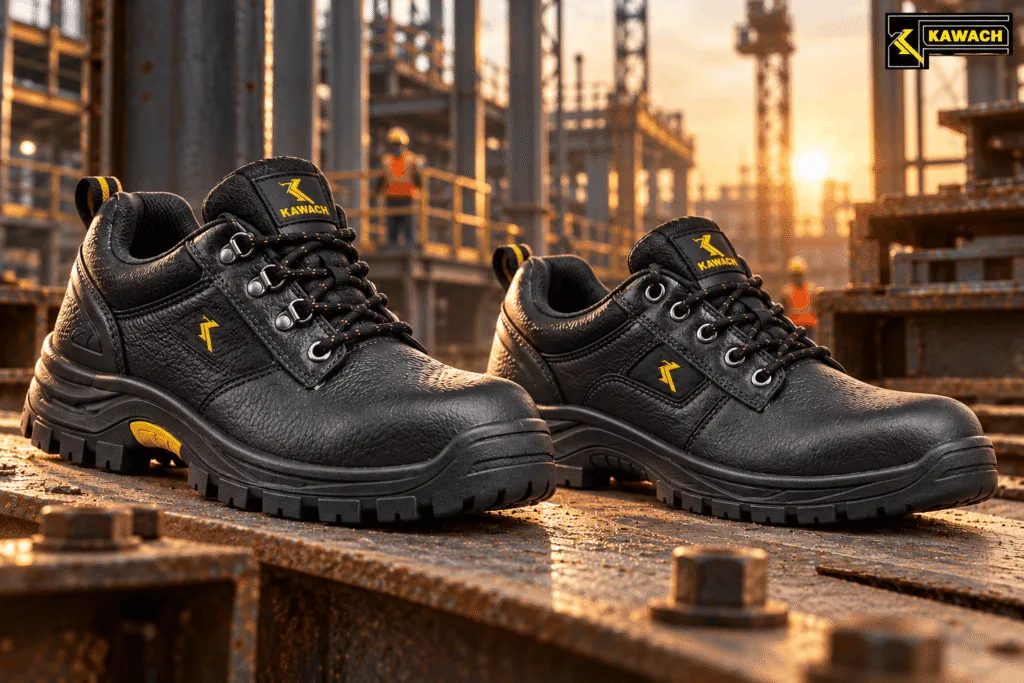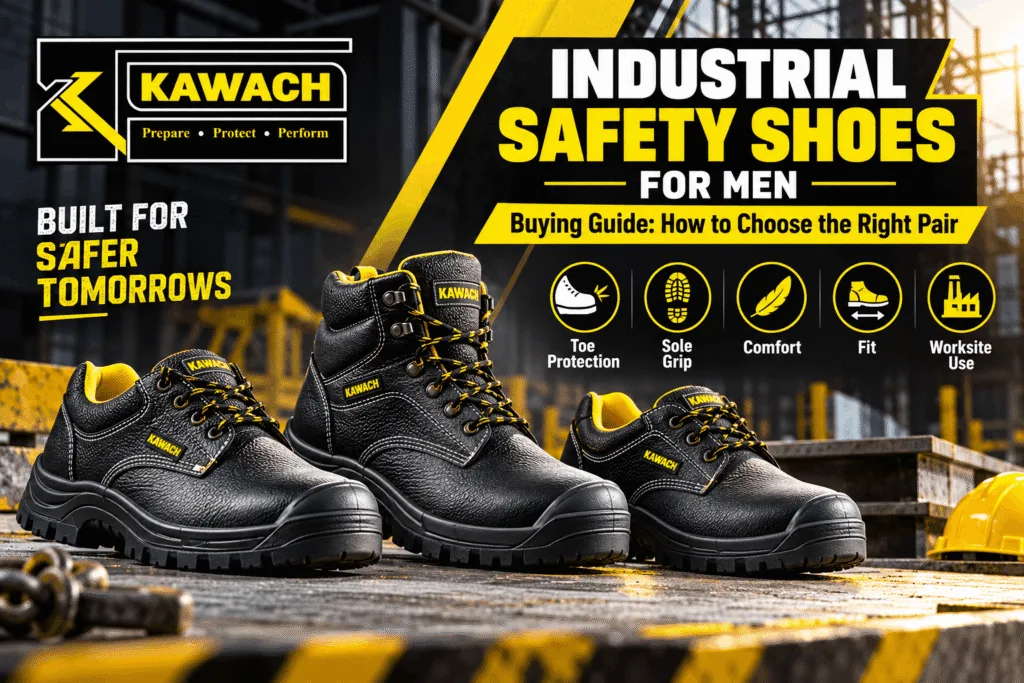
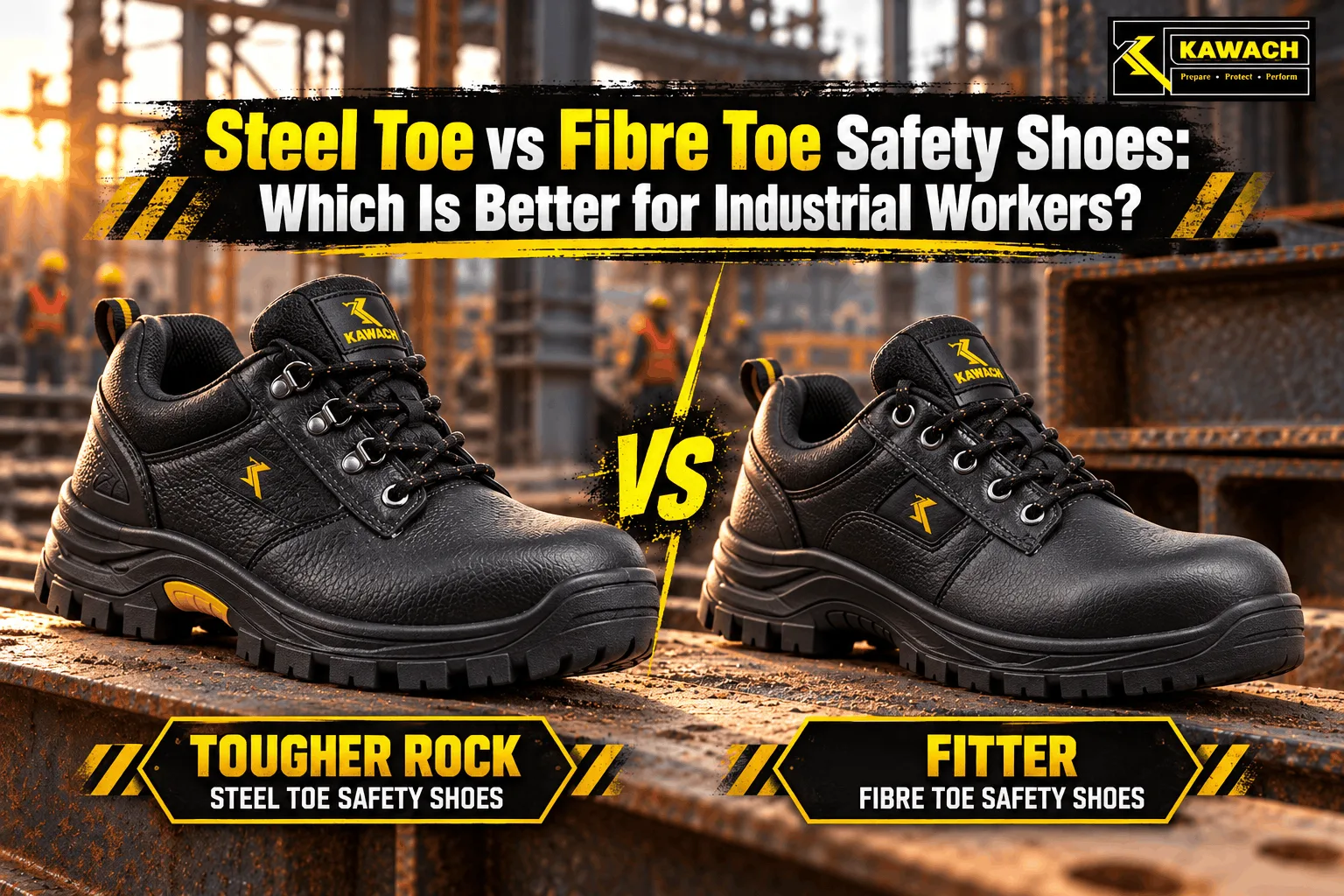
Steel toe and fibre toe safety shoes can both provide appropriate industrial protection when the complete footwear is designed, tested and selected for the job. The difference lies in toe-cap materials, which can influence weight, heat transfer and practical selection.
Neither type is automatically safer, lighter or electrically insulating.
For factories, warehouses, construction sites and engineering teams, the most useful question is not simply “steel or fibre?” It is: which tested shoe meets our workplace hazards, fits our workers and provides the required documented protection?
This guide from Kawach Safe Gears Pvt. Ltd. explains the comparison and shows how to evaluate actual Kawach models before a workforce purchase.
Steel Toe vs Fibre Toe: Quick Comparison
| Buying factor | Steel toe safety shoes | Fibre toe safety shoes |
| Toe-cap material | Metallic steel | Non-metallic fibre-based or reinforced material |
| Impact and compression | Depends on the tested footwear | Depends on the tested footwear |
| Weight | Depends on complete shoe design | May reduce toe-cap component weight; total weight varies |
| Thermal behaviour | Steel conducts heat and cold more readily | Toe cap generally has lower thermal conductivity |
| Metal detection | Metallic cap may trigger a detector | Cap is usually non-metallic; other shoe components may still contain metal |
| Electrical-shock protection | Not established by the steel cap | Not established by the fibre cap |
| Comfort and fit | Depends on full shoe design and sizing | Depends on full shoe design and sizing |
Bottom line: Compare approved performance, complete-shoe weight, fit and worksite hazards – not just the material used in the toe cap.
What Are Steel Toe Safety Shoes?
Steel toe safety shoes contain a protective steel cap in the forefoot. The cap is incorporated into footwear intended to help protect the toes from specified impact and compression hazards, such as tools, handled components or materials that may accidentally strike the foot.
Steel toe construction is common in manufacturing, engineering, construction and material-handling applications. But a steel cap alone does not establish that a shoe has puncture protection, slip resistance, water resistance or electrical insulation. Those are separate properties of the complete footwear.
What Are Fibre Toe Safety Shoes?
Fibre toe safety shoes use a non-metallic protective cap, often made with reinforced fibre or another suitable composite construction. Exact materials vary by manufacturer and model.
Non-metallic caps may offer a different weight and thermal profile from steel caps. That makes them worth evaluating for workers who walk frequently or for applications where a metallic toe cap is not preferred.
However, a fibre toe cap does not guarantee a lightweight shoe. The leather or fabric upper, outsole, insole, hardware and size all affect the weight of the finished footwear. It also does not, by itself, prove that the shoe is safe for electrical work.
1. Protection: Is Steel Stronger Than Fibre?
The relevant measure is whether the complete safety shoe meets the applicable protection requirements. In India, the revised safety-footwear standard is IS 15298 (Part 2):2024, based on ISO 20345:2021 with Indian modifications. The Bureau of Indian Standards (BIS) issued implementation guidance for this revision with an implementation deadline of 22 January 2025.
A commonly specified protective-toe impact rating is 200 joules (200J). This describes a prescribed laboratory impact-energy test; it does not mean the footwear can hold a 200 kg load or prevent injury in every accident. Toe compression is evaluated separately.
Both steel and fibre-based toe caps may be used in shoes designed to meet the relevant tests. Buyers should obtain the exact model’s current licence and product-marking details, classification and supporting test records rather than infer compliance from the material alone.
Official reference: BIS implementation circular for IS 15298 (Part 2):2024.
2. Weight: Are Fibre Toe Shoes Always Lighter?
No. A non-metallic cap may reduce component weight in some designs, but the finished pair can still be heavier if it uses a thicker upper, additional padding, a different sole or more hardware.
For a fair comparison, weigh the complete shoes at the same size and state whether the measurement is for one shoe or one pair. Ideally, the company should publish a size-matched measurement and its method. Without measured data, avoid declaring any model the “lightest.”
Workers on long walking shifts should also assess heel security, toe clearance, footwear width, cushioning and outsole flexibility. The lightest option may not be the most comfortable for every person.
For more detail, read Kawach’s Lightweight Safety Shoes for Long Working Hours guide.
3. Electrical Safety: Does Fibre Toe Mean Electrical Insulation?
No. Non-metallic toe-cap material is not proof of electrical-shock protection. A shoe may contain other conductive components, and electrical performance depends on the complete tested construction and use conditions.
Likewise, the presence of a steel toe does not by itself determine whether the full footwear is suitable or unsuitable for a particular electrical task.
Crucially, antistatic footwear is not the same as electrically insulating footwear. Antistatic designs serve static-charge-control purposes under specified conditions; electrical-shock hazards require an appropriately rated and tested protective system.
For electrical maintenance or possible exposure to energised equipment, the employer should obtain model-specific electrical documentation and make the selection through a competent risk assessment. Do not rely on a catalogue phrase such as “electrical safety toe cap.”
4. Heat, Cold and Metal Detection
Steel generally conducts heat and cold more readily than non-metallic fibre-based materials. That may influence toe-area feel in particular environments, but actual thermal comfort depends on the lining, upper, insulation, moisture and complete design.
A non-metallic cap may also be relevant where site security uses metal detectors. However, a fibre toe does not make an entire shoe metal-free: eyelets, shanks and other components may still contain metal. Any metal-free requirement should be confirmed for the full model.
Neither toe-cap material alone establishes protection against molten metal, hot contact, extreme cold or another specialist hazard.
5. Which Toe Cap Is Better for Different Workplaces?
Construction: Both may be considered when the selected model meets the site’s required protection. Sharp underfoot debris, wet conditions and heavy materials may demand additional tested features beyond a toe cap.
Manufacturing and engineering: Compare the required toe protection together with outsole traction, oil exposure, fit and actual work activity. Neither construction is the universal factory choice.
Warehousing and logistics: Frequent walking makes overall weight and fit relevant, but impact protection and floor conditions still come first. A representative wearer trial can help.
Electrical maintenance: Select for the specific electrical hazard using complete-footwear test evidence, not a steel-versus-fibre assumption.
Mining and heavy industry: Assess underfoot penetration, terrain, abrasion and site PPE rules in addition to toe impact and compression performance.
6. Kawach Product Examples: Fitter and Active
Kawach’s published specifications provide two useful examples of different toe-cap materials. These illustrate construction choices; they are not a controlled test proving one toe material performs better.
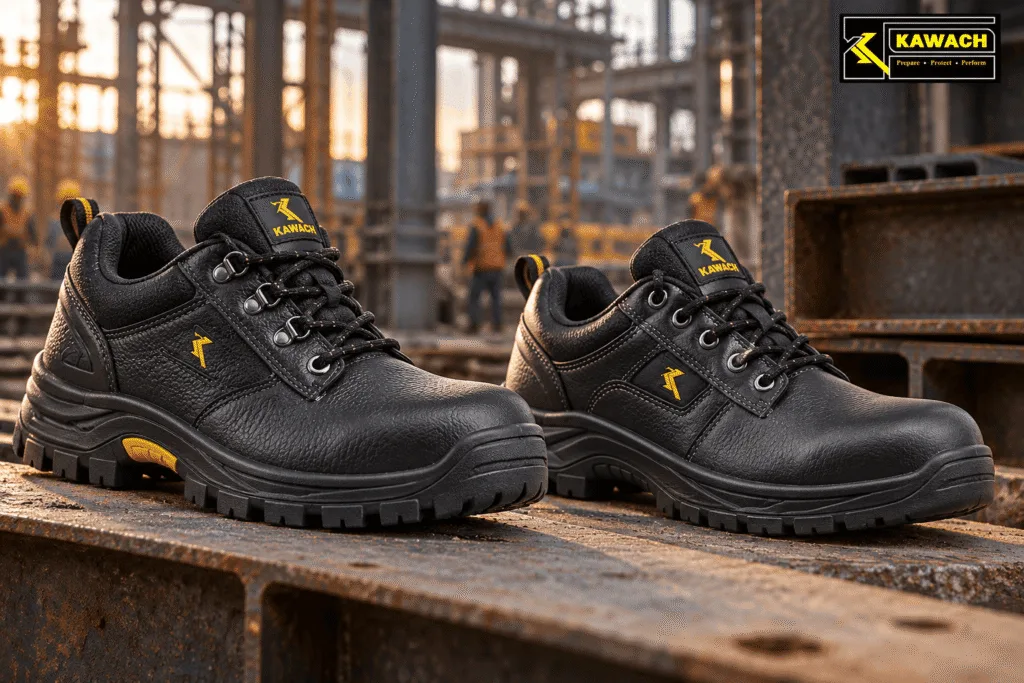
Fitter Safety Shoes – Fibre Toe
The Fitter product page lists a fibre toe cap with 200J impact resistance, split-dye cross-leather upper, mesh lining, EVA insole, single-density PU outsole and sizes 5-11.
Fitter may be relevant when a non-metallic toe is a purchasing preference. The site’s additional electrical-performance statements require verification against the exact current model and intended application; do not treat the fibre cap itself as proof of electrical insulation.
Active Safety Shoes – Steel Toe
The Active product page lists a steel toe cap with 200J impact resistance, full-grain leather upper, moulded EVA insole with mesh, single-density PU outsole and sizes 5-12.
Active is a steel-toe option to evaluate when those material and fit characteristics meet the purchasing requirements. It should not be presented as providing electrical protection merely because of its steel cap.
Which Kawach Model Should You Choose?
Fitter and Active differ in more than toe-cap material. Compare their size availability, uppers, insoles, footwear fit and current technical documents. Explore the complete Kawach Industrial Safety Shoes range to shortlist other models.
Buying Checklist for EHS and Procurement Teams
Before placing a workforce order:
Identify hazards: falling objects, compression, sharp debris, contaminated floors, moisture, chemicals, heat and electrical risks.
Specify required protection: identify applicable footwear classes, tested features and site rules.
Compare complete models: assess toe cap, upper, sole, fit, ankle coverage and weight at an identical size.
Review evidence: ask for the correct current BIS licence and marking information, where applicable, plus supporting model-specific records.
Run a fitting trial: check toe room, heel stability and normal movement with work socks.
Confirm the order: collect size-wise quantities, delivery requirements and approved product specifications.
This approach is more defensible than assuming that one toe-cap material is always the “best safety shoe.”
Our Experience in Industrial Safety Footwear
At Kawach Safe Gears Pvt. Ltd., we believe footwear selection starts with the actual workplace rather than the assumption that steel must always be stronger or fibre must always be lighter. A warehouse worker who walks most of the day may need a different combination of fit and materials from a construction employee working on rough ground.
In our approach to industrial footwear guidance, we distinguish between the material used in a toe cap and the tested performance of the complete shoe. We also explain practical limitations: antistatic is not electrical insulation, and a 200J toe rating does not cover every possible workplace hazard.
We have prepared this guide to help workers, EHS managers, safety officers, contractors and procurement teams compare protection, comfort and documentation before choosing a model. We encourage buyers to obtain the latest product records, assess fit with intended users and follow the site’s PPE requirements.
For approved model details or bulk industrial footwear enquiries, visit the Industrial Safety Shoes category or contact Kawach.
Kawach Safe Gears Pvt. Ltd. Phone: +91 97118 70298
Email: info@kawach.org
Frequently Asked Questions
Can fibre toe safety shoes provide 200J protection?
Yes, a fibre toe can be part of a complete shoe specified for 200J impact protection. Confirm the exact model’s test evidence and product marking.
Are fibre toe shoes lighter than steel toe shoes?
Sometimes, but not always. Compare the weight of complete shoes in the same size. Toe-cap material alone is insufficient evidence.
Are fibre toe shoes safe for electrical work?
Not automatically. The full footwear needs the appropriate tested electrical performance for the intended hazard.
Do steel toe shoes protect against electric shock?
A steel toe cap does not establish electrical-shock protection. Refer to the complete model’s electrical rating and workplace requirements.
Which toe cap is better for construction or factories?
Either may be suitable when the complete footwear meets the job’s requirements. Evaluate impact and compression protection, floors, exposure and fit.
Which Kawach shoes illustrate each type?
Fitter lists a 200J fibre toe, while Active lists a 200J steel toe. Check current specifications before procurement.