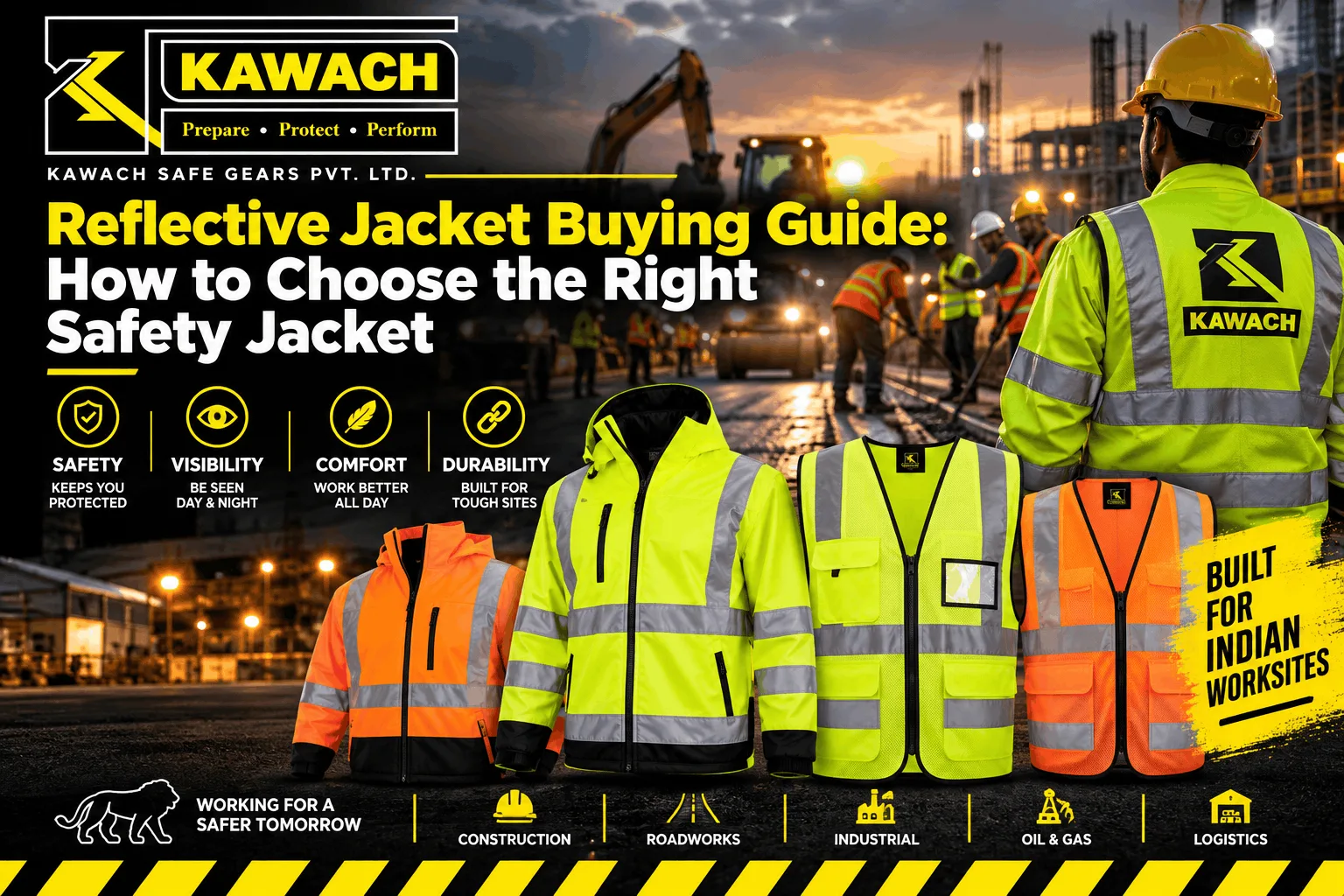
A worker standing beside a highway at night, a warehouse employee walking near a moving forklift, or a construction professional working around heavy machinery has one critical safety requirement in common: they need to be seen clearly and early. A Reflective Jacket is a vital safety tool that enhances reliability and trust, ensuring workers are visible and protected in workplace environments.
A reflective jacket, also known as a high-visibility jacket, hi-vis safety jacket, reflective safety vest, industrial safety jacket, construction safety jacket, road safety jacket, or worker safety vest, is designed to make the wearer more noticeable in daytime, low-light and night-working conditions.
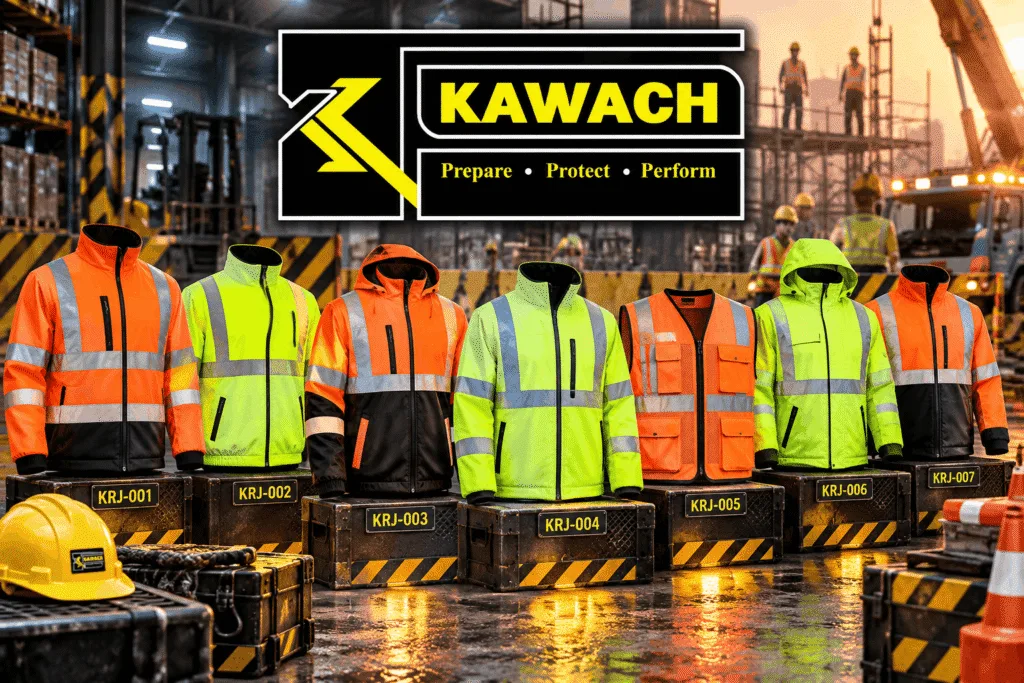
At Kawach Safe Gears India Pvt. Ltd., reflective jackets are designed around real industrial requirements such as visibility, worker movement, comfort, long working hours and the demands of Indian worksites. Kawach’s reflective-jacket range currently includes KRJ-001 to KRJ-007, serving different workplace and procurement needs.
Choosing the right reflective jacket involves understanding fabric GSM, reflective tape and design, empowering buyers to make informed safety decisions.
This guide explains all of them.
What Is a Reflective Jacket?
A Reflective Jacket is high-visibility workwear designed to improve a worker’s conspicuity around vehicles, machinery, traffic and low-light environments.
It generally combines:
- High-visibility or fluorescent background material
- Retroreflective strips or tape
- A workplace-focused garment design
- Suitable closures and fitting
- Functional features such as pockets or ID holders
Fluorescent material helps the wearer stand out against the surrounding environment, especially in daylight and low-light conditions. Retroreflective material works differently: when light from a vehicle headlamp falls on it, much of it is reflected toward the source, helping the wearer stand out to the driver.
This distinction is important because fluorescence and reflectivity are not the same thing.
Understanding standards such as IS 15809 and ISO 20471 is crucial, as they ensure that jackets meet safety requirements, giving buyers confidence in their choices. Many workplace incidents involve people and machines operating in the same area.
Workers may be exposed to:
- Trucks and commercial vehicles
- Forklifts
- Cranes
- Excavators
- Loaders
- Material-handling equipment
- Road traffic
- Industrial machinery
A worker wearing ordinary clothing can become difficult to distinguish against equipment, dust, warehouse interiors or dark surroundings.
A high-visibility reflective jacket creates a stronger visual contrast, making workers easier to spot.
This is especially valuable during:
Night shifts: Reflective tape becomes more visible when illuminated by vehicle headlights or work lights.
Road and highway work: Employees may operate only within metres of moving vehicles.
Warehousing: Forklifts and workers regularly share operational zones.
Construction: Heavy machinery, trucks and changing site conditions create visibility challenges.
Railway and infrastructure work: Work can continue during early mornings, evenings and restricted-light conditions.
A reflective jacket should, however, be part of a wider safety programme. It does not replace adequate lighting, traffic management, machine controls, worker training or other task-specific PPE.
How Does Reflective Tape Work?
One of the most important parts of a reflective safety jacket is its reflective material.
Retroreflective material is engineered to return incident light broadly toward its source. If a vehicle’s headlights illuminate a worker’s reflective strips, the returned light can make those strips much more conspicuous to the driver.
This can be simplified as:
Vehicle Headlight → Reflective Tape → Light Returned Toward Source → Worker Becomes Easier to Detect
Kawach uses different tape configurations across its reflective-jacket range. For example, KRJ-001 specifies 2-inch Glass-Prismatic/Bead reflective tape, while KRJ-006 and KRJ-007 specify 2-inch 3M reflective tape.
The appropriate tape and garment configuration should be selected based on actual workplace risks and procurement requirements. For example, KRJ-001 uses 2-inch Glass-Prismatic/Bead tape, while KRJ-006 and KRJ-007 specify 2-inch 3M reflective tape, ensuring optimal visibility in different environments.
Understanding GSM in Reflective Jackets
GSM means grams per square metre and indicates the weight of the fabric.
It is an important consideration when choosing a reflective jacket.
Kawach Safe Gears India Pvt. Ltd. offers lightweight designs such as KRJ-001 at 60–90 GSM, while models such as KRJ-003, KRJ-006 and KRJ-007 use 120 GSM polyester construction.
A lighter garment may be preferred for hot environments and prolonged wear, while a more substantial 120 GSM jacket may suit buyers looking for a heavier construction.
Higher GSM does not automatically mean ‘safer.’ When selecting a reflective jacket, consider how fabric weight (GSM), visibility features, tape performance and garment design collectively address workplace hazards and comfort needs.
Kawach Reflective Jacket Range: Key Specifications
Kawach Safe Gears India Pvt. Ltd. currently lists seven reflective-jacket models, from KRJ-001 to KRJ-007.
Here are examples from the range:
| Kawach Model | Fabric/GSM | Closure | Reflective Tape | Key Features |
| KRJ-001 | Polyester, 60–90 GSM | Velcro | 2-inch Glass-Prismatic/Bead | ID/tool pockets, logo customization |
| KRJ-003 | Polyester, 120 GSM | Velcro | 2-inch Glass-Prismatic/Bead | Three-side closing, pockets, customization |
| KRJ-006 | Polyester, 120 GSM | Zipper | 2-inch 3M tape | ID/tool pockets, logo customization |
| KRJ-007 | Polyester, 120 GSM | Zipper | 2-inch 3M tape | Two front pockets, configurable to buyer requirements |
KRJ-001 is offered in fluorescent green, orange, blue and yellow, uses a one-sided closing design and is available in sizes S–XXL.
KRJ-003 uses a three-sided Velcro closure with 120 GSM polyester and 2-inch reflective tape.
KRJ-006 combines a 120 GSM polyester construction, zipper closing and 2-inch 3M reflective tape, with pockets and logo customization options.
KRJ-007 also uses 120 GSM polyester, a zipper closure and 2-inch 3M tape and includes two front pockets that can be adjusted according to buyer requirements.
This gives procurement teams options instead of forcing the same safety jacket into every work environment.
Reflective Jacket Safety Standards: What Buyers Should Know
Technical standards matter when high-visibility clothing is being purchased for industrial, tender, compliance or safety-critical applications.
IS 15809:2017
In India, IS 15809:2017 covers High-Visibility Warning Clothing.
The Bureau of Indian Standards product documentation includes requirements for background material, retroreflective material and garment design and testing. The standard recognizes different garment types and Class 1, Class 2 and Class 3 classifications. BIS also published amendments to IS 15809:2017, with implementation dates in 2025.
For procurement teams, understanding how to verify compliance with standards like IS 15809:2017 and ISO 20471 is essential. Define the specific standard, type, class and review certification documentation to ensure the jacket meets safety requirements and aligns with your organization’s risk assessment and safety protocols.
ISO 20471
ISO 20471:2013 specifies requirements for high-visibility clothing intended to visually signal a person’s presence to operators of vehicles and mechanised equipment in daylight and under headlight illumination in darkness.
As of October 2026, ISO lists ISO 20471:2013 as the published standard while a revision is under development.
Where compliance is required, purchasers should verify the specific jacket model, test reports and certification documentation rather than assuming that every product supplied by a certified company automatically carries all certifications.
How to Choose the Right Reflective Jacket
Selecting a reflective jacket should begin with the hazard, not with colour or price.
1. Identify the Working Environment
Ask where the employee will work:
- Highway or roadside
- Construction project
- Warehouse
- Manufacturing plant
- Logistics hub
- Railway project
- Mining area
- Airport
- Industrial facility
The risk around a warehouse forklift is different from that posed by high-speed road traffic.
2. Determine Day and Night Visibility Requirements
Workers operating mainly during daylight may have different requirements from employees working around headlights, vehicle traffic or night construction.
Both fluorescent and reflective background materials should be considered.
3. Check the Reflective Tape
Evaluate:
- Tape type
- Tape width
- Placement
- Required standard
- Condition after repeated use
Kawach offers models with 2-inch reflective tape in accordance with its verified KRJ specifications.
4. Choose an Appropriate Fabric Weight
For long outdoor shifts in warm Indian conditions, comfort can directly affect whether workers keep PPE on.
Kawach Safe Gears India Pvt. Ltd. offers 60–90 GSM and 120 GSM configurations across its range, allowing buyers to select according to application and comfort requirements.
5. Check Closure Design
Different models use Velcro or zipper closures.
A zipper can provide a secure front closure, while Velcro may allow quick on and off. The correct configuration depends on the task and worker movement.
6. Consider Functional Requirements
Some employees need more than visibility.
Supervisors, technicians and site personnel may benefit from:
- ID-card holders
- Tool pockets
- Front pockets
- Company branding
- Department identification
- Different colour coding
Kawach lists configurable pockets and logo customization on several KRJ models.
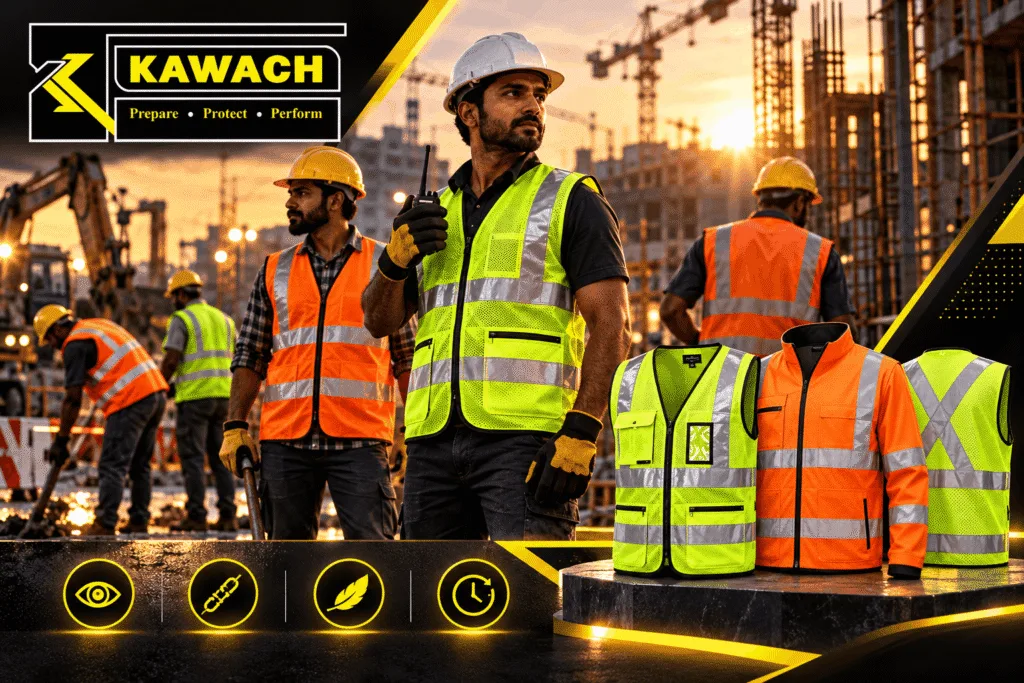
Quick Reflective Jacket Procurement Checklist
Before placing a bulk order, a safety manager or procurement professional should check:
- What hazards are workers exposed to?
- Will the jacket be used during the daytime, at night, or both?
- Which high-visibility standard or class is required?
- What GSM fabric is suitable?
- What reflective tape specification is required?
- Which colour is appropriate for the worksite?
- Is Velcro or zipper closure preferred?
- Are pockets or ID-card holders required?
- What size distribution is needed?
- Is company logo customization required?
- What certification or test documentation must accompany the order?
- How will garments be inspected and replaced during use?
This checklist helps organisations move from simply “buying jackets” to specifying safety workwear according to actual operational needs.
Which Industries Use Reflective Jackets?
Construction & Infrastructure
Construction professionals work around cranes, trucks, excavators, loaders and equipment movement. A construction reflective jacket makes workers more noticeable across busy sites.
Highways and Road Maintenance
Road workers may operate close to traffic during daylight and darkness. High-visibility garments form an important part of the wider road-work safety system.
Warehousing & Logistics
Warehouses have frequent forklift, pallet, loading-bay and transport movement. Reflective safety vests can help operators identify pedestrians within operational areas.
Manufacturing
Factories use high-visibility workwear for production teams, maintenance staff, visitors, supervisors and employees working around material-handling equipment.
Railways & Metro Projects
Track, maintenance and infrastructure personnel often work in areas containing moving equipment and changing visibility conditions.
Mining
Large machinery and challenging lighting environments can increase the importance of worker conspicuity.
Airport Ground Operations
Ground crews operate around service vehicles and other moving equipment, making visibility an important operational consideration.
A Practical Example: Choosing by Risk, Not Price
Consider two employees.
Worker A works inside a warehouse during the day, operating forklifts.
Worker B works on highway maintenance during night operations.
Both may need high-visibility clothing, but their exposure is not identical.
The warehouse team may prioritize lightweight wear, comfort and clear pedestrian identification. The road-maintenance team may require a higher-visibility specification based on traffic speed, darkness, viewing distance and applicable safety requirements.
This demonstrates an important PPE principle:
The “best reflective jacket” is not one universal model. It is the garment that matches the hazard, environment and required safety specification.
Kawach’s Manufacturing and Quality Approach
Kawach states that its manufacturing unit in Bawana, Delhi, enables the company to remain involved from material sourcing through production and final checks. According to the company, its manufacturing approach focuses on durability, comfort and dependable protection for Indian industrial and construction environments.
Kawach also states that its production process employs quality controls and that its team provides hands-on guidance and on-site training at delivery to help clients understand proper use and product limitations.
The brand’s journey began with identifying PPE and safety-awareness gaps in 2011 and Kawach was officially launched in 2013 with a focus on manufacturing control, quality and compliance.
For professional purchasers, these operational capabilities matter because bulk PPE requires consistent specifications, quality control, product availability and technical support, not just a competitive unit price.
Certifications and Trust
Kawach’s certification page lists company-level credentials and testing references, including ISO certification, BIS/ISI-related certification, CE certification and testing through Atharva Laboratories, which Kawach identifies as NABL-certified.
However, responsible procurement requires an important distinction:
Company certifications and individual product certifications are not automatically interchangeable.
If a tender, project or HSE policy requires a particular standard, buyers should ask for documentation that specifically covers the model and configuration being purchased.
This is particularly important with safety products because technical compliance should be verified rather than assumed.
How to Maintain a Reflective Safety Jacket
A reflective jacket cannot perform effectively forever if it becomes damaged, dirty or poorly maintained.
Inspect jackets regularly for:
- Torn or peeling reflective tape
- Excessive dirt, oil or paint
- Damaged fluorescent fabric
- Loose stitching
- Broken zipper or Velcro
- Poor fit
- Missing or damaged pockets
- Reduced overall visibility
Follow the care instructions supplied with the specific garment.
If reflective material becomes heavily damaged or the garment can no longer provide the required conspicuity, it should be assessed for replacement.
Reflective Jackets Designed for Indian Worksites
Indian worksites combine heat, dust, long shifts, outdoor exposure and demanding industrial conditions.
Kawach says these realities influence how it designs, tests and supplies its safety equipment, with an emphasis on durability, comfort and usability.
The ability to select between lightweight and 120 GSM designs, alternative closures, pocket configurations and customizable branding can therefore be useful for organisations deploying large teams.
Reflective Jacket Supplier for PAN India Requirements
Large organisations often operate across several states rather than at a single project location.
Kawach states that it supports reflective jackets and PPE requirements across major industrial markets, including Delhi NCR, Noida, Gurugram, Mumbai, Pune, Ahmedabad, Surat, Bengaluru, Chennai, Hyderabad, Kolkata, Jaipur, Lucknow and Indore.
For construction companies, infrastructure contractors, warehouses, manufacturing facilities, logistics businesses and industrial buyers, centralized PPE sourcing can help maintain consistent specifications across teams.
Buyers looking for a Reflective Jacket Manufacturer in India, a reflective jacket supplier, an industrial safety jacket supplier, or a bulk reflective vest supplier can discuss model selection, size requirements, pockets, colour configurations and customization requirements with Kawach before procurement.
Why Choose Kawach Reflective Jackets?
Kawach combines product choice with manufacturing and workplace-safety experience.
Depending on the KRJ model selected, buyers can access:
- 60–90 GSM and 120 GSM polyester options
- 2-inch reflective tape configurations
- Glass-Prismatic/Bead reflective material on selected models
- 3M reflective tape on selected models
- Velcro and zipper closures
- Fluorescent colour options
- S–XXL sizing on verified models
- ID-card and tool-pocket configurations
- Custom logo options
- Bulk procurement support
More importantly, Kawach positions itself not simply as a product seller but as an industrial safety manufacturer that provides guidance and support for workplace use.
Visibility Should Be Specified, Not Assumed
A Reflective Jacket may look like a simple piece of workwear, but its selection should involve careful safety decisions.
The buyer needs to consider where the worker operates, when the garment will be worn, what vehicles or machinery are present, how visible the employee needs to be, which standard applies, what fabric weight is comfortable and which reflective configuration suits the risk.
That is the difference between buying a fluorescent vest and building high-visibility workwear into a professional safety programme.
Kawach Safe Gears India Pvt. Ltd. offers a range of Reflective Jackets for construction, industrial, logistics, infrastructure, road work and workplace visibility requirements, with multiple GSM, tape, closure and customization options.
For bulk Reflective Jackets, customized safety jackets, or PAN-India industrial requirements, connect with Kawach to select a configuration based on your workforce, work environment and required safety specifications.
Make visibility intentional. Make workplace safety visible with Kawach.
Frequently Asked Questions About Reflective Jackets
1. What is a Reflective Jacket used for?
A Reflective Jacket is used to increase a worker’s visibility around vehicles, machinery, traffic and low-light environments. It is commonly used in construction, logistics, road work, factories and infrastructure projects.
2. How does a reflective jacket work?
Its high-visibility background helps the wearer stand out, while retroreflective tape returns light toward its source, making the wearer more noticeable when illuminated by headlights or other lights.
3. What does GSM mean in a reflective jacket?
GSM means grams per square metre and indicates fabric weight. Kawach offers verified models ranging from 60–90 GSM to 120 GSM.
4. Which Kawach Reflective Jacket uses 3M tape?
Kawach KRJ-006 and KRJ-007 list 2-inch 3M reflective tape in their product specifications.
5. Which reflective jacket is suitable for construction workers?
The appropriate jacket depends on the construction environment, lighting conditions, equipment movement and the required safety standard. Buyers should perform a risk assessment rather than choosing solely on price.
6. Are Reflective Jackets useful only at night?
No. High-visibility background materials can improve daytime conspicuity, while retroreflective material is especially useful when illuminated by headlights or artificial lighting.
7. Can Kawach Reflective Jackets be customized?
Yes. Selected Kawach KRJ models offer logo customization and adjustable pocket configurations according to buyer requirements.
8. What safety standard applies to high-visibility clothing in India?
IS 15809:2017 covers High-Visibility Warning Clothing in India. Organisations should verify the exact type, class and product documentation required for their application.
9. How often should a reflective jacket be replaced?
There is no universal replacement period. Jackets should be inspected regularly and replaced when the reflective material, fluorescent fabric, closures, fit, or garment condition no longer meets the intended safety requirements.
10. Does Kawach supply Reflective Jackets across India?
Kawach supports industrial and bulk PPE requirements across multiple major cities and industrial regions in India.