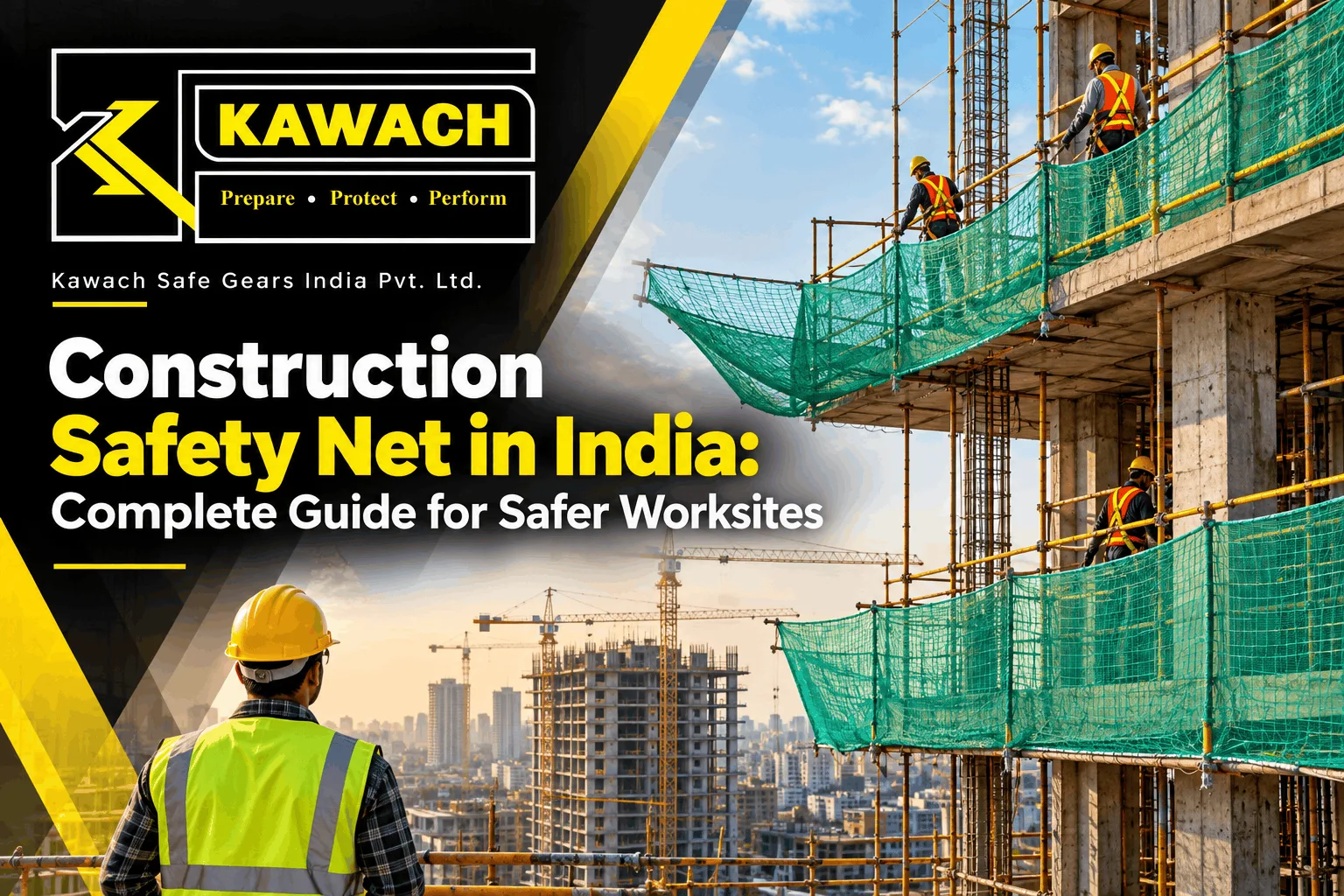
A construction site may look well-managed from ground level, but the risk changes completely when workers move several floors above it.
Steel sections are being erected. Façade teams are working near building edges. Tools are moving between levels. Contractors are standing on scaffolding, roofs and temporary platforms.
In this environment, one slip, a dropped tool, or an incorrectly protected opening can create a serious hazard.
This is why choosing the right Safety Net for Construction should be treated as an engineering and workplace-safety decision-not simply as a matter of purchasing a roll of mesh.
A professionally selected Construction Safety Net can be an important part of a work-at-height safety system by helping to protect against personnel falls, falling material, or both, depending on the net’s intended design and specifications.
For safety managers, EPC contractors, construction companies, procurement teams and industrial project owners across India, the important question is therefore not:
“Which Safety Net is cheapest?”
It is:
“Which Safety Net is actually suitable for our hazard, installation and working conditions?”
Kawach Safe Gears India Pvt. Ltd. currently lists six safety-net models-K-SN-01, K-SN-02, K-SN-03, K-SN-04, K-SN-05 and K-SN-06-as part of its industrial safety portfolio.
This detailed guide explains what a Safety Net is, its types, applications, materials, standards, installation, inspection, common mistakes and the 12 factors businesses should check before buying one.
What Is a Safety Net?
A Safety Net is a protective netting system used in areas where people or objects may fall from height.
Industrial Safety Nets can be designed for different purposes, including:
- Personnel fall protection
- Falling-object containment
- Construction debris control
- Scaffolding protection
- Building-edge protection
- Industrial maintenance
- Infrastructure construction
- Structural erection
The Bureau of Indian Standards describes IS 11057:1984 as the Indian Standard for industrial safety nets made from artificial fibres, intended to catch personnel and/or falling debris.
This distinction is important because a net intended only to contain lightweight construction debris should not automatically be assumed suitable for arresting a worker’s fall.
Safety Net vs Debris Net: They Are Not Automatically the Same
One of the most important things a buyer should understand is the difference between a Fall Protection Safety Net and a Debris Safety Net.
A personnel fall-protection net must withstand the forces generated when a human body impacts the system.
A debris net may primarily be intended to catch or contain objects such as:
- Construction fragments
- Small tools
- Packaging
- Loose materials
- Dust and lightweight debris
Some projects may use a combination of a larger structural mesh and a finer containment mesh.
Therefore, never choose a Building Safety Net simply because two products look similar in photographs.
The application and tested performance matter more than appearance.
12 Things to Check Before Buying a Safety Net
1. Define What the Net Must Protect Against
Start with the hazard.
Ask:
Is the primary risk a worker falling?
Are tools or construction debris falling?
Is protection needed underneath a work platform?
Does the building require perimeter containment?
Is the net required around scaffolding?
Different hazards may require completely different Industrial Safety Net configurations.
2. Check the Applicable Safety Standard
Standards should be checked before price comparison.
For industrial Safety Nets in India, IS 11057:1984 – Specification for Industrial Safety Nets provides an important technical reference. BIS documentation covers material and construction considerations for industrial safety nets.
Projects may also have their own consultant, client, tender or contractor specifications.
The applicable requirement should therefore be confirmed by the project’s competent safety professional.
3. Choose the Correct Mesh Size
Mesh size matters because different applications require different levels of containment.
A larger mesh may suit one application, while a finer mesh may be required to control smaller objects.
Do not assume that a smaller mesh automatically means a better personnel fall-arrest system. Net performance depends on the entire construction, including ropes, joints, border rope, materials, anchorage and the tested configuration.
4. Examine Rope Material and Diameter
The mesh rope and border rope are essential parts of the net.
For example, Kawach’s K-SN-01 is published as a single-layer Safety Net with:
- Dimensions: 10 m × 5 m
- Mesh: 25 mm × 25 mm
- Mesh rope: 2 mm polypropylene rope
- Border rope: 12 mm polypropylene rope
- Two-metre lengths are provided at all four corners
Kawach also states that K-SN-01 conforms to IS 11057:1984 and that its border/tie rope is tested in accordance with IS 5175.
These are the kinds of specifications professional buyers should examine rather than looking only at the net’s overall size.
5. Understand Single-Layer and Double-Layer Safety Nets
A single-layer safety net may be suitable for specific applications where a single net construction meets the project requirements.
A Double Layer Safety Net combines two layers, often allowing a primary safety mesh to work with a finer containment layer.
Double-layer configurations may be useful where a construction site requires additional control over smaller falling debris.
The right configuration should always be determined through risk assessment and technical specifications.
6. Consider the Installation Location
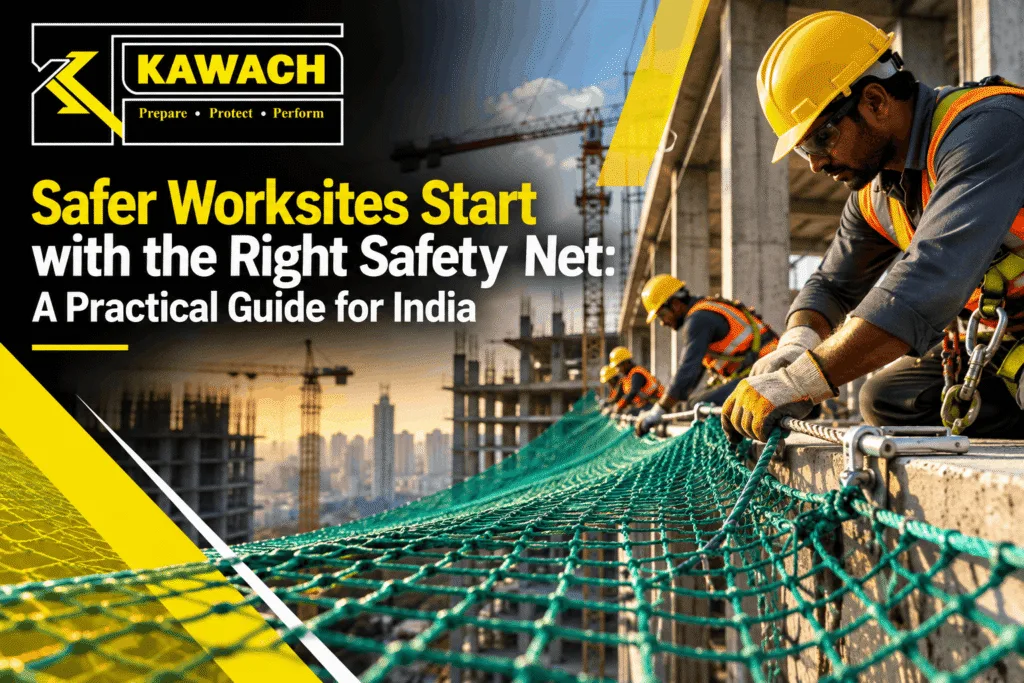
A Horizontal Safety Net is generally installed beneath an elevated working area.
Typical applications may include:
- Structural work
- Roof installation
- Industrial maintenance
- Large openings
- Elevated construction zones
A Vertical Safety Net may instead be positioned around:
- Scaffolding
- Open building sides
- Construction perimeters
- Building façades
The same net should not automatically be used in every orientation without confirming that its intended design and installation instructions support that application.
7. Evaluate Anchorage and Supporting Structure
A strong Safety Net attached to an unsuitable structure can still create an unsafe system.
Installation planning should evaluate:
- Structural support
- Fixing locations
- Attachment arrangement
- Net positioning
- Possible fall path
- Required clearance
- Surrounding hazards
The complete supporting arrangement must be capable of handling the expected loading.
This is why Safety Net installation should be planned by competent personnel rather than treated as ordinary temporary netting work.
8. Check Available Fall Clearance
A net needs room to deflect when arresting a fall.
If equipment, structural steel, concrete floors or other objects are located too close beneath the net, a falling person could potentially contact those objects despite being caught by the net.
Safety planning should therefore consider the net’s installation height, potential deflection and clearance underneath.
9. Assess Exposure to Indian Worksite Conditions
A Safety Net used outdoors in India may face:
- Intense sunlight
- Rain
- Dust
- Heat
- Moisture
- Chemical exposure
- Abrasion
- Rough construction surfaces
Material should therefore be selected based on the actual environment.
Common materials associated with safety or containment net systems include polypropylene, HDPE and other suitable synthetic fibres, depending on product design and intended application.
10. Verify Manufacturer Quality and Documentation
For safety equipment, supplier credibility matters.
Kawach describes its approach as involving control over materials, manufacturing processes and product quality checks. Its company history states that its workplace-safety journey began in 2011 and that the KAWACH brand was formally launched in 2013.
Kawach’s certification page also publishes company-level credentials, including ISO, BIS/ISI, CE and laboratory testing references. Buyers should still ask for the specific certificate, technical sheet and conformity documentation applicable to the individual Safety Net model being purchased, rather than assuming a company-level certification automatically applies to every model.
That distinction is an important part of responsible safety procurement.
11. Ask About Inspection, Training and Correct Use
Buying safety equipment is only the first step.
Kawach’s Training Cell publishes programmes covering:
- PPE awareness
- Fall protection
- Working-at-height guidance
- Equipment inspection
- Fall hazards and precautions
- Height rescue
- Live demonstrations
The company states that training includes practical sessions using actual safety equipment.
This matters because even appropriate safety equipment can fail to provide the expected protection if it is incorrectly installed, inspected, or used.
12. Never Select a Safety Net on Price Alone
Searching for the Safety Net price in India is natural, but the price should come after technical suitability.
Cost may vary depending on:
- Net dimensions
- Mesh dimensions
- Rope diameter
- Material
- Border rope
- Single or double-layer construction
- Containment layer
- Quantity
- Customisation
- Testing requirements
- Project specifications
For professional procurement, comparing only price per square metre can hide important differences between products.
Common Safety Net Mistakes Safety Teams Should Watch For
Even a good product can become ineffective when selected or managed incorrectly.
Common site-level mistakes to watch for include:
Using a Debris Net as a Personnel Safety Net
Fine containment mesh may look protective, but personnel fall protection equipment requires a system intended for that purpose.
Incorrect Fixing
Loose, inconsistent or inappropriate fixing points can affect net performance.
Ignoring Clearance
Installing a net too close to a lower obstruction can reduce the available space for safe deflection.
Allowing Debris to Accumulate
Construction material caught in a net adds weight and may affect future performance.
Continuing to Use Damaged Netting
Cuts, broken ropes, damaged border sections, chemical exposure or abrasion should never simply be ignored.
No Inspection After an Impact
A net that has been involved in a significant fall or impact should be handled in accordance with the manufacturer’s instructions and site safety procedures before being returned to service.
Buying Only by GSM, Colour or Size
Safety performance cannot be judged only by how heavy or thick the net appears.
Safety Net Inspection Checklist
A structured inspection programme should look for:
Mesh condition: cuts, broken cords, abrasion and deterioration.
Border rope: damage, wear and insecure connections.
Attachment points: loose or altered connections.
Environmental damage: excessive UV, chemical, heat or moisture exposure.
Debris: materials accumulated inside the net.
Modifications: unauthorized cutting, repairs or site alterations.
Identification: readable model and inspection information where applicable.
Inspection frequency should follow the manufacturer’s instructions, workplace conditions and applicable site procedures.
Kawach Safe Gears India Pvt. Ltd. Net Range
Kawach currently lists the following products in its Safety Net category:
| Kawach Model | Product Category |
| K-SN-01 | Safety Net |
| K-SN-02 | Safety Net |
| K-SN-03 | Safety Net |
| K-SN-04 | Safety Net |
| K-SN-05 | Safety Net |
| K-SN-06 | Safety Net |
The exact model should be chosen based on its current technical data sheet, intended application, project specification and relevant conformity documentation.
For K-SN-01 specifically, Kawach also publishes customization options for design, net size, mesh pattern and rope material according to buyer requirements.
Why Choose Kawach as a Safety Net Manufacturer in India?
Choosing a Safety Net Manufacturer in India should involve more than finding a supplier capable of sending material to the project.
Safety buyers also need:
- Technical product information
- Application guidance
- Quality-controlled manufacturing
- Safety documentation
- Inspection guidance
- Training support
- Broader fall-protection expertise
Kawach positions itself as an industrial safety manufacturer rather than only a product trader. Its published approach combines manufacturer-controlled production with site-focused product selection and practical training.
Its wider height-safety range also includes Full Body Harnesses, Horizontal Lifeline Systems, Anchorage Lifelines, Retractable Fall Arresters, Rescue Kits and Rock Chair solutions.
That broader product ecosystem is useful because a Safety Net should rarely be considered the only control required for work at height.
A Safety Net Is Part of a Complete Fall Protection System
A professional work-at-height strategy may include:
- Guardrails
- Safe working platforms
- Safety Nets
- Full Body Harnesses
- Lifeline Systems
- Anchorage Systems
- Retractable Fall Arresters
- Suitable helmets
- Rescue equipment
- Worker training
- Inspection procedures
- Emergency rescue planning
The exact control measures depend on the risk assessment.
A Safety Net provides an additional layer of protection; it does not remove the need for proper work-at-height planning.
Safety Net Solutions Across PAN India
Demand for Construction Safety Nets and Industrial Safety Nets in India extends across high-rise construction, factories, power projects, infrastructure, warehouses, industrial maintenance and engineering projects.
Kawach states that it supports safety requirements across regions, including Delhi-NCR, Haryana, Uttar Pradesh, Rajasthan, Punjab, Maharashtra, Gujarat, Karnataka, Telangana andhra Pradesh, Tamil Nadu, Madhya Pradesh, Bihar and West Bengal.
This PAN-India requirement is important for EPC companies and contractors working across multiple project locations, as product specifications and documentation need to be consistent from site to site.
Before Requesting a Safety Net Quote, Share These Details
To receive a more relevant recommendation, provide the Safety Net Manufacturer or supplier with:
- Project type
- Intended net application
- Personnel fall or debris requirement
- Working height
- Required dimensions
- Installation orientation
- Supporting structure
- Required mesh specification
- Quantity
- Environmental conditions
- Client/tender standard
- Project location
Providing these details is more useful than simply asking, “What is your Safety Net price?”
Final Thoughts: Start With the Hazard, Not the Net
Choosing the right Safety Net for Construction requires more than selecting a mesh size from a catalogue.
The buyer should understand the hazard, determine whether personnel or debris protection is needed, review the materials and construction, check applicable standards, confirm anchorage and clearance, inspect certification documents and establish a proper installation and maintenance process.
For projects seeking an Industrial Safety Net Manufacturer or Safety Net Supplier in India, Kawach offers multiple Safety Net models, along with a range of fall-protection products, technical guidance and practical safety training.
The most important buying principle is simple:
Do not choose the net first. Identify the hazard first-then select the net designed to control it.
Need a Safety Net for Your Construction or Industrial Project?
Contact Kawach Safe Gears India Pvt. Ltd. for Construction Safety Nets, Industrial Safety Nets, Building Safety Nets, Debris Safety Nets and complete work-at-height safety solutions across India.
Share your application, working height, required size, project specification, quantity and location so the appropriate product and documentation can be reviewed before purchase.
Kawach Safe Gears India Pvt. Ltd. – Protection That Never Fails.
Frequently Asked Questions About Safety Nets
1. What is a Safety Net used for in construction?
A Safety Net is used as part of protection against hazards involving workers or materials falling from elevated areas. Depending on its design, it may be used for personnel fall protection, containment of falling debris, or other construction safety requirements.
2. What is the difference between a Construction Safety Net and a Debris Safety Net?
A Construction Safety Net intended for personnel protection must address the forces associated with a person’s fall. A Debris Safety Net is primarily intended to contain falling material. Buyers should verify the product’s intended and tested application before use.
3. Which is the best Safety Net for construction?
There is no single Safety Net suitable for every project. Selection depends on working height, hazard type, mesh requirements, supporting structure, installation location, applicable standards and whether personnel or debris protection is required.
4. What is IS 11057:1984?
IS 11057:1984 is the Bureau of Indian Standards specification covering Industrial Safety Nets made from artificial fibres for applications involving personnel and/or falling debris.
5. What is the mesh size of Kawach K-SN-01?
Kawach publishes K-SN-01 with a 25 mm × 25 mm mesh, a 2 mm polypropylene mesh rope, a 12 mm polypropylene border rope and standard dimensions of 10 m × 5 m.
6. Can the Safety Net size be customised?
For K-SN-01, Kawach states that the design, size, mesh pattern and rope material can be customized according to the buyer’s requirements. Project-specific requirements should be discussed before ordering.
7. How often should a Safety Net be inspected?
Safety Nets should be inspected according to the manufacturer’s instructions, site conditions, frequency of use and workplace safety procedures. Additional inspection may be necessary after a significant impact or change in installation.
8. Can a Safety Net replace a Full Body Harness?
Not automatically. Safety Nets and personal fall-protection equipment perform different functions. A project’s risk assessment should determine whether harnesses, lifelines, guardrails, Safety Nets or a combination of controls is required.
9. Does Kawach provide Safety Nets across India?
Kawach states that it supports industrial and construction safety requirements across multiple states and regions in India, making its Safety Net solutions relevant for PAN-India projects.
10. What information should I provide when buying a Safety Net?
Share your project type, working height, intended application, required dimensions, personnel/debris protection requirement, supporting structure, quantity, applicable standards and delivery location. These details help the supplier recommend a more technically appropriate solution.