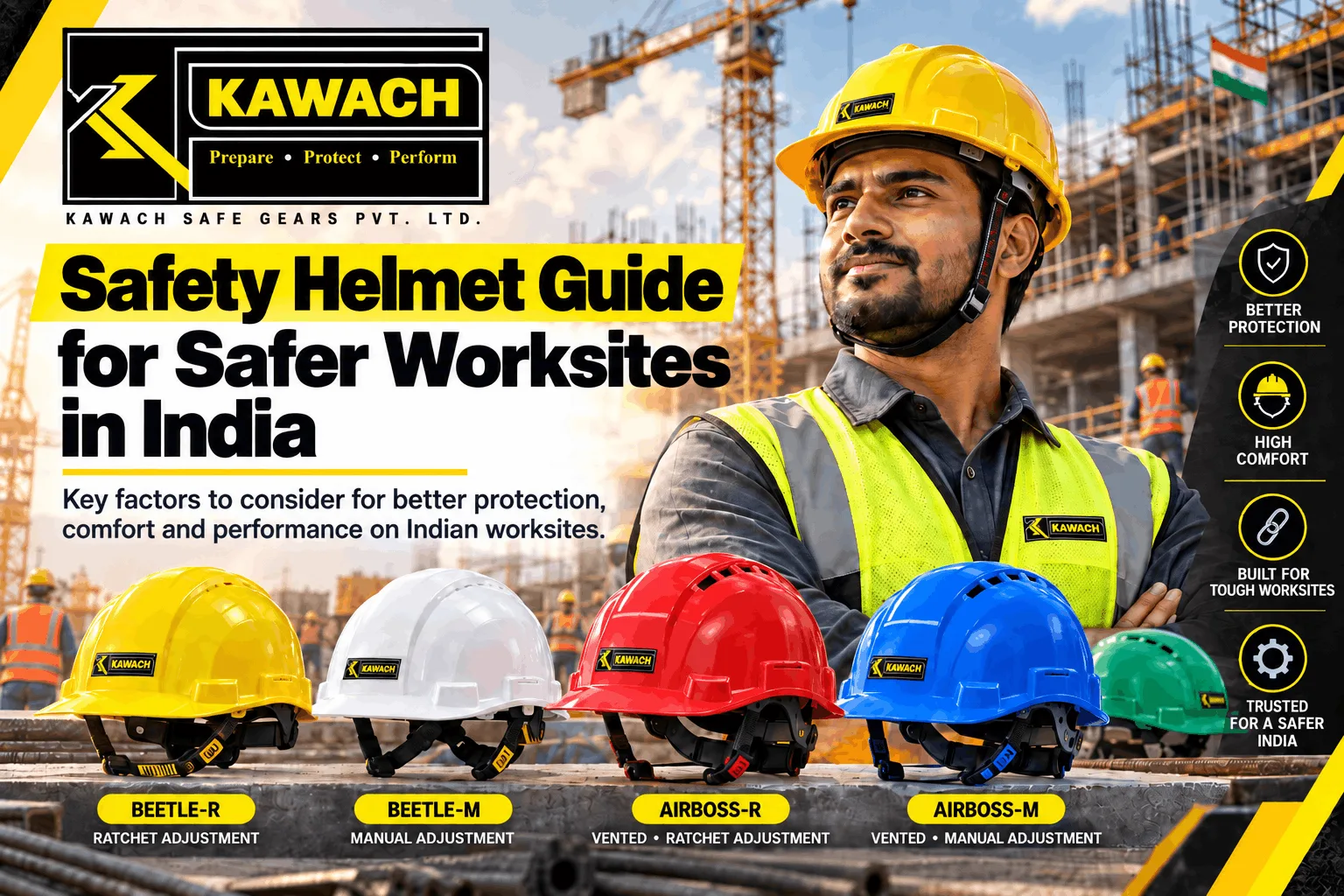
A tool falling from scaffolding, an unexpected collision with an overhead beam, moving industrial equipment or loose construction material can turn into a serious workplace incident within seconds. This is why a Safety Helmet is much more than a compulsory piece of PPE-it is a critical part of a workplace head-protection system.
However, simply wearing a helmet does not automatically mean a worker has adequate protection.
A construction worker exposed to falling objects, a maintenance technician working around machinery and an electrical professional working near energized systems may face very different hazards. The correct industrial safety helmet, therefore, needs to be selected based on the work environment, applicable safety requirements, fit, comfort and actual risk.
At Kawach Safe Gears India Pvt. Ltd., safety equipment is developed to meet practical Indian workplace conditions, with a focus on protection, comfort, proper application and industrial use.
This complete Safety Helmet buying guide explains how industrial helmets work, their key components, applicable Indian safety standards, Kawach Safety Helmet models, selection criteria, pricing factors, maintenance, common buying mistakes and the questions procurement and EHS teams should ask before placing an order.
What Is a Safety Helmet?
A Safety Helmet is a type of personal protective equipment (PPE) designed to protect a worker’s head against workplace hazards such as impact, falling objects and other risks for which the helmet has been designed and tested.
It is commonly known as an industrial safety helmet, construction helmet, protective helmet, PPE helmet or hard hat.
An industrial helmet is not simply a hard plastic shell. Effective head protection typically depends on several parts working together.
| Safety Helmet Component | Primary Function |
| Outer shell | Provides the external protective barrier |
| Internal suspension/cradle | Helps maintain clearance and distribute forces |
| Headband | Helps position the helmet securely |
| Adjustment mechanism | Allows the helmet to fit different head sizes |
| Chin strap | Helps retain the helmet during movement where required |
| Sweatband | Supports wearer comfort |
| Ventilation | May improve airflow where the helmet design and hazard permit |
The relationship between the shell and suspension system is particularly important. The internal space between the helmet and the head helps the overall helmet system manage impact rather than allowing the shell to sit directly against the skull.
Why Is a Safety Helmet Important for Workers?
Workplace head hazards exist across construction, manufacturing, infrastructure, engineering, warehousing, utilities, power, maintenance, mining and other industries.
A worker may be exposed to falling tools, construction debris, overhead structures, machinery, industrial components, material-handling equipment or accidental impact.
DGFASLI notes that PPE protection depends on proper selection, use and performance in actual operation, reinforcing the point that simply issuing equipment is not enough.
A Safety Helmet should therefore form part of a wider risk-control programme rather than being treated as a substitute for engineering controls, safe operating procedures or worker training.
How Does an Industrial Safety Helmet Work?
When an object strikes a helmet, the protective system aims to reduce the damaging force that reaches the wearer’s head.
The outer shell provides the first barrier, while the internal suspension helps maintain clearance and distribute impact forces through the helmet system.
The exact protective performance depends on the helmet design and the standard against which it has been tested.
This is why businesses should avoid choosing a Safety Helmet for workers based only on appearance, colour or price.
Why HDPE Is Used in Industrial Safety Helmets
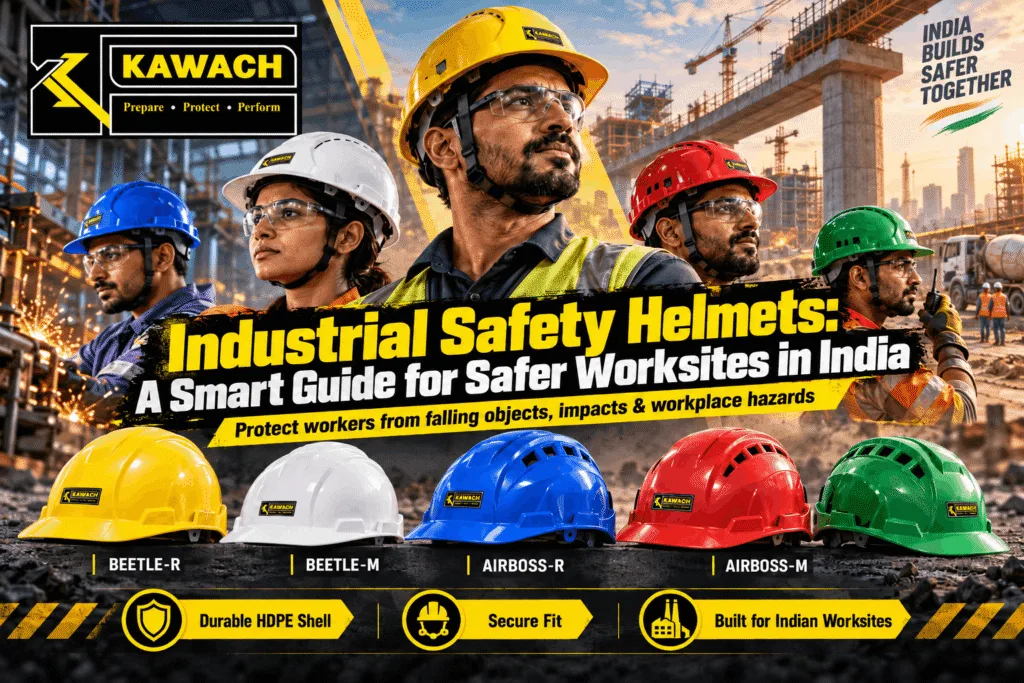
HDPE Safety Helmets are widely used for industrial head protection because high-density polyethylene offers a useful combination of durability, manageable weight and suitability for molded protective shells.
Kawach’s current Beetle-R, Beetle-M, Airboss-R and Airboss-M Safety Helmet models all use HDPE (High-Density Polyethylene) shells.
Material alone, however, should never determine purchasing decisions. Shell shape, suspension, size, fit, testing, adjustment and intended application also matter.
Safety Helmet Standards in India: Understanding IS 2925
For organisations buying an industrial Safety Helmet in India, IS 2925 is an important reference standard.
DGFASLI currently lists IS 2925:1984 for Safety Helmets and identifies testing areas, including design and construction; head clearance and wearing height; shock absorption resistance; penetration resistance; flammability resistance; water absorption; heat resistance; and corrosion resistance of applicable metal parts.
These tests illustrate why professional PPE purchasing should go beyond asking, “Does the helmet look strong?”
Procurement teams should request the relevant product specification and applicable certification or test documentation for the exact model being purchased.
Kawach’s corporate certification information lists ISO, ISI/BSI, CE and testing through an NABL-certified laboratory. However, buyers should verify which certification or test documentation applies to the selected helmet model, rather than assuming that every corporate credential applies equally to every product.
That distinction is particularly important for specialised work such as electrical applications.
Kawach Safety Helmet Range
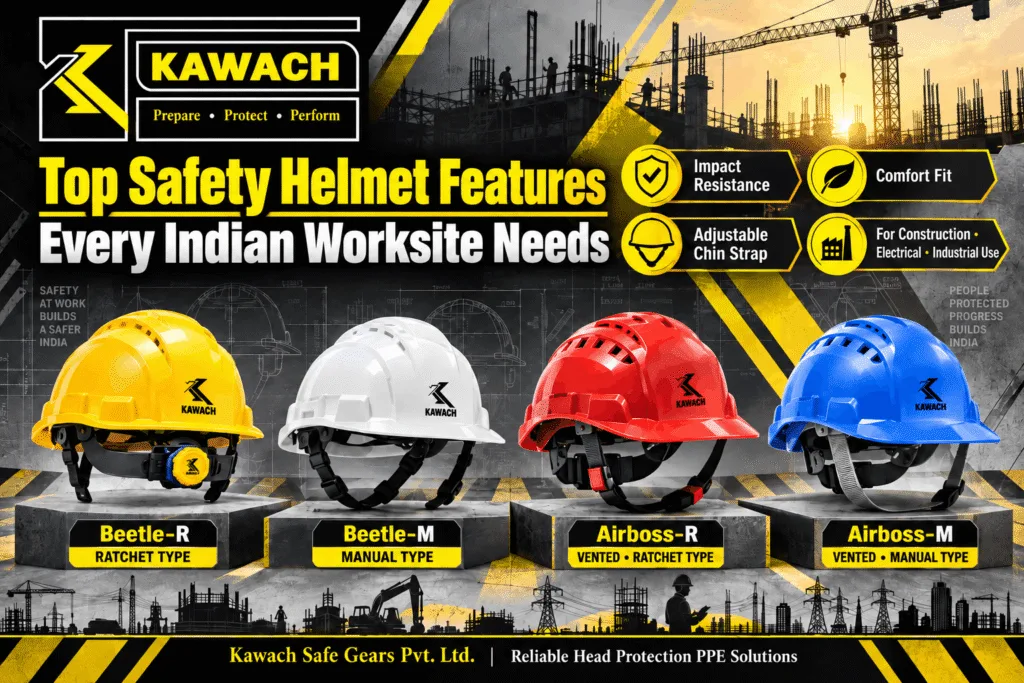
Kawach currently lists four primary Safety Helmet models-Beetle-R, Beetle-M, Airboss-R and Airboss-M.
| Kawach Model | Adjustment | Shell | Size | Weight | Key Feature |
| Beetle-R | Ratchet | HDPE | 540–590 mm | 300 g | Triple-corrugated shell |
| Beetle-M | Manual | HDPE | 540–590 mm | 300 g | Lightweight manual adjustment |
| Airboss-R | Ratchet | HDPE | 540–590 mm | 365 g | Ventilation + ratchet system |
| Airboss-M | Manual | HDPE | 540–590 mm | 345 g | Ventilation + manual adjustment |
All four models currently list adjustable chin straps and are available in White, Yellow, Red, Blue and Green.
Beetle-R Safety Helmet
The Beetle-R is a ratchet Safety Helmet weighing approximately 300 g. Kawach lists a triple-corrugated HDPE shell, a soft, non-irritant fabric headband and an adjustable chin strap. The ratchet system makes it particularly convenient for workers who need quick-fit adjustments during the working day.
Beetle-M Safety Helmet
The Beetle-M uses the same listed 540–590 mm size range and 300 g HDPE construction but incorporates a manual adjustment system. It can suit organisations looking for a straightforward industrial head-protection configuration.
Airboss-R Safety Helmet
The Airboss-R combines ratchet adjustment with ventilation holes, a triple-corrugated HDPE shell, a soft headband and an adjustable chin strap. Kawach lists its weight at approximately 365 g.
Airboss-M Safety Helmet
The Airboss-M combines ventilation with manual adjustment. Its listed size range is 540–590 mm, with an HDPE shell and a weight of approximately 345 g.
Ratchet Safety Helmet vs Manual Safety Helmet
A common buying decision is whether to choose a ratchet or a manual adjustment system.
A ratchet Safety Helmet can be useful where workers frequently adjust their helmets or want quick fit control during long shifts.
A manual Safety Helmet offers a simpler adjustment mechanism and may work well where helmet size does not need frequent adjustment.
Neither should automatically be considered “better.” The right choice depends on the workforce, the task, the frequency of adjustment, comfort expectations and procurement requirements.
Which Kawach Safety Helmet Should You Choose?
The following comparison can make selection easier:
| Requirement | Model Feature to Consider |
| Quick fit adjustment | Beetle-R or Airboss-R |
| Manual adjustment | Beetle-M or Airboss-M |
| Lower listed weight | Beetle-R or Beetle-M |
| Ventilation required | Airboss-R or Airboss-M |
| Ratchet + ventilation | Airboss-R |
| Manual + ventilation | Airboss-M |
This table is a starting point, not a substitute for workplace hazard assessment. Ventilated helmets, for example, should only be used where the workplace hazard and applicable safety requirement allow that helmet configuration.
How to Choose the Right Safety Helmet
The best Safety Helmet in India is not necessarily the most expensive model or the one with the most features. The appropriate helmet is the one whose design, tested performance, fit and application match the worker’s actual hazards.
Start by identifying whether workers face falling-object risks, machinery impact, overhead obstructions, electrical exposure, work at height, high temperatures, outdoor conditions or other site-specific hazards.
Then evaluate shell construction, suspension, comfort, head size, chin-strap requirements and adjustment.
For long working hours, ergonomics matter. A technically suitable helmet that employees constantly loosen, tilt or remove because of poor fit can reduce the effectiveness of the PPE programme.
DGFASLI specifically identifies ergonomic design, comfort during use, quality, reliability and suitability for tropical conditions among considerations relevant to PPE.
How to Wear a Safety Helmet Correctly
Proper wear is just as important as proper purchasing.
The wearer should first inspect the shell, suspension and chin strap for visible damage. The helmet should then be positioned securely and level on the head. Adjust the headband until the helmet feels stable without creating excessive pressure. Where the work requires helmet retention, fasten and correctly adjust the chin strap.
The helmet should not move excessively when the wearer turns or bends.
Workers should not reverse the helmet unless the specific product design and manufacturer’s instructions permit it.
They should also avoid placing objects between the suspension and the head, as this may interfere with the protective system.
7 Common Safety Helmet Buying Mistakes
- Buying only on price: A low Safety Helmet price means little if the helmet does not suit the intended hazard.
- Assuming every helmet offers identical protection: Different designs and certifications may apply to different workplace risks.
- Ignoring worker fit: Poor fit can lead to improper wear or frequent removal.
- Assuming ventilation is always better: Ventilation can improve comfort but may not be appropriate for every hazard or specialised application.
- Ignoring the suspension system, the protective system is more than just the outer shell.
- Using unapproved accessories or modifications: Drilling, cutting or attaching incompatible equipment can compromise the helmet.
- Keeping an impacted helmet in service because it looks normal: A significant impact can impair performance even when external damage is not obvious.
Safety Helmet Price in India: What Determines the Cost?
There is no single Safety Helmet price that applies to every industrial requirement.
Pricing can vary depending on shell construction, adjustment mechanism, suspension, ventilation, chin-strap configuration, applicable testing and certification, order quantity, branding requirements and specialised application.
For industrial procurement, the correct question is therefore not:
“Which helmet is cheapest?”
It is:
“Which helmet provides the appropriate documented protection and usability for our workers?”
Bulk buyers should request technical specifications alongside commercial quotations so purchasing decisions can consider both safety and cost.
Safety Helmet Colour Codes: What Do the Colours Mean?
White, yellow, red, blue and green helmets are frequently used on industrial and construction projects to help distinguish roles such as workers, engineers, safety personnel, supervisors or visitors.
However, businesses should not assume that a single colour always denotes the same job role across all sites.
Helmet colour allocation may depend on the organisation’s EHS policy, contractor requirements, or a project-specific safety plan.
Kawach currently offers its four listed helmet models in White, Yellow, Red, Blue and Green, allowing organisations to implement their own documented colour management system.
Safety Helmet Inspection, Cleaning and Maintenance
Before every use, workers should visually inspect the helmet for cracks, deformation, deep scratches, damaged straps, broken adjustment components, deterioration or contamination.
Cleaning should follow the helmet manufacturer’s instructions. Harsh solvents, aggressive chemicals and unapproved cleaning agents should be avoided because some substances can affect protective materials.
Helmets should also be stored away from excessive heat, direct sunlight and conditions that can deform or degrade the shell.
Never drill holes, cut the shell, modify suspension components or attach accessories unless they are specifically compatible with the helmet.
When Should a Safety Helmet Be Replaced?
There is no universal replacement interval that should automatically be applied to every industrial Safety Helmet.
Replacement depends on the manufacturer’s guidance, helmet age, UV exposure, heat, chemicals, storage conditions, frequency of use, suspension system condition and impact history.
A helmet that has experienced a significant impact should be removed from service according to the manufacturer’s instructions, even if no obvious external damage is visible.
Visible cracks, shell deformation, brittle material, damaged suspension, or failed adjustment components are also reasons to remove the helmet from service.
Can a Regular Safety Helmet Be Used for Electrical Work?
Not automatically.
Electrical environments can involve specialised hazards. A general construction Safety Helmet or a ventilated helmet should not be assumed to provide electrical protection.
Where electrical risks exist, the employer should select an appropriately designed and tested helmet for the applicable hazard and verify the relevant product documentation.
This is another reason certification should be checked at the exact product-model level.
Safety Helmet for Work at Height
Workers performing tower work, scaffolding, maintenance or other work-at-height activities may require secure head protection together with a properly selected fall-protection system.
A Safety Helmet with a chin strap can help improve retention where required, but the helmet is only one part of the safety system.
Depending on the work, additional PPE may include a full-body harness, anchorage lifeline, horizontal lifeline, retractable fall arrester, safety shoes, gloves and a reflective jacket.
PPE items should be selected as compatible with the system rather than as unrelated products.
Why Choose Kawach Safe Gears India Pvt. Ltd.?
Kawach positions itself as an industrial PPE manufacturer focused on practical workplace conditions rather than equipment supply alone.
The company states that it maintains control over materials, production processes and testing, uses a risk-assessment approach when recommending safety equipment and provides usage guidance and training with equipment delivery.
Kawach’s Training Cell covers PPE selection, proper use, ergonomics, fall-protection practices, inspection and practical worksite safety through live demonstrations, practical sessions and classroom-based guidance.
Practical Kawach Safety Approach
Experience from real workplaces shows why PPE procurement should consider worker usability alongside technical requirements. A helmet that is difficult to adjust, unsuitable for the environment or uncomfortable during long shifts may not be used consistently.
That is why Kawach’s stated approach includes risk assessment, ergonomics, practical training and workplace application in addition to product supply.
Safety Helmet Manufacturer and Supplier Across India
Organisations operating across multiple cities often require consistent specifications, bulk availability of PPE and dependable procurement support.
As a Safety Helmet manufacturer and supplier in India, Kawach serves industrial and construction requirements across India, including major markets such as Delhi NCR, Gurugram, Noida, Ghaziabad, Faridabad, Jaipur, Chandigarh, Lucknow, Ahmedabad, Surat, Mumbai, Pune, Hyderabad, Bengaluru, Chennai, Kolkata, Bhubaneswar, Kochi and other industrial locations.
Kawach’s current Safety Helmet category specifically positions its head-protection solutions for businesses across India and highlights bulk industrial supply.
Safety Helmet Buying Checklist for Procurement Teams
Before placing a bulk order, procurement managers and EHS teams should confirm the workplace hazard, intended application, applicable standard, model-specific test or certification documentation, helmet size, adjustment type, chin-strap configuration, ventilation requirement, compatibility with other PPE, inspection guidance and manufacturer support.
For specialised risks such as electrical work or complex work-at-height environments, always obtain application-specific technical guidance rather than relying on assumptions.
Final Thoughts: Buy Protection, Not Just a Helmet
A Safety Helmet may appear to be one of the simplest pieces of PPE, but effective head protection depends on much more than a hard shell.
Material, suspension, fit, size, adjustment, ventilation, chin-strap design, certification, inspection, maintenance and correct use all matter.
For employers, contractors, industrial buyers and safety professionals, the goal should therefore not simply be to buy Safety Helmets at the lowest price.
The goal should be to choose the right industrial Safety Helmet for the right worker, workplace and hazard.
Kawach Safe Gears India Pvt. Ltd. offers Beetle-R, Beetle-M, Airboss-R and Airboss-M helmet options for industrial and construction applications, backed by a broader approach to PPE selection, manufacturing control and safety training.
Looking for Safety Helmets for workers, factories, construction sites or bulk industrial requirements across India? Contact Kawach Safe Gears India Pvt. Ltd. for product specifications, model selection, applicable certification information and bulk PPE enquiries.
Frequently Asked Questions About Safety Helmets
1. What is a Safety Helmet used for?
A Safety Helmet is PPE designed to reduce the risk of head injury from applicable workplace hazards such as falling objects and impact. The exact level and type of protection depend on the helmet design and tested performance.
2. Which Safety Helmet is best for construction workers?
There is no single helmet that is best for every construction worker. The right helmet should be selected based on site hazards, applicable standards, fit, comfort, suspension, chin-strap requirements and environmental conditions.
3. What material is used in Kawach Safety Helmets?
Kawach currently lists HDPE (High-Density Polyethylene) as the shell material for Beetle-R, Beetle-M, Airboss-R and Airboss-M.
4. What is a ratchet Safety Helmet?
A ratchet Safety Helmet uses a ratchet adjustment system that allows the wearer to conveniently tighten or loosen the headband. Kawach’s Beetle-R and Airboss-R use ratchet adjustment.
5. Which Kawach Safety Helmets have ventilation?
Kawach lists ventilation holes on its Airboss-R and Airboss-M models. Buyers should confirm that a ventilated design is appropriate for the specific workplace hazard before selection.
6. What is IS 2925 for Safety Helmets?
IS 2925 is an Indian standard relating to industrial Safety Helmets. DGFASLI currently lists testing areas including shock absorption, penetration resistance, flammability resistance, heat resistance and other design and performance requirements.
7. How often should a Safety Helmet be replaced?
Replacement should follow the manufacturer’s specific guidance and take into account age, use, environmental exposure, condition and impact history. A significantly impacted or damaged helmet should be removed from service as instructed by the manufacturer.
8. Can I drill holes in a Safety Helmet for ventilation?
No unapproved structural modification should be made to a Safety Helmet. Drilling or cutting the shell may affect its protective performance. Use a helmet designed with ventilation where appropriate.
9. Can an industrial Safety Helmet be used for electrical work?
Only use a helmet appropriate for the applicable electrical hazard. Do not assume that every industrial or construction helmet provides electrical protection. Verify model-specific technical and certification information.
10. Does Kawach supply Safety Helmets across India?
Yes. Kawach positions its Safety Helmet and industrial PPE solutions for businesses, contractors and industrial organisations across India, including bulk PPE requirements.