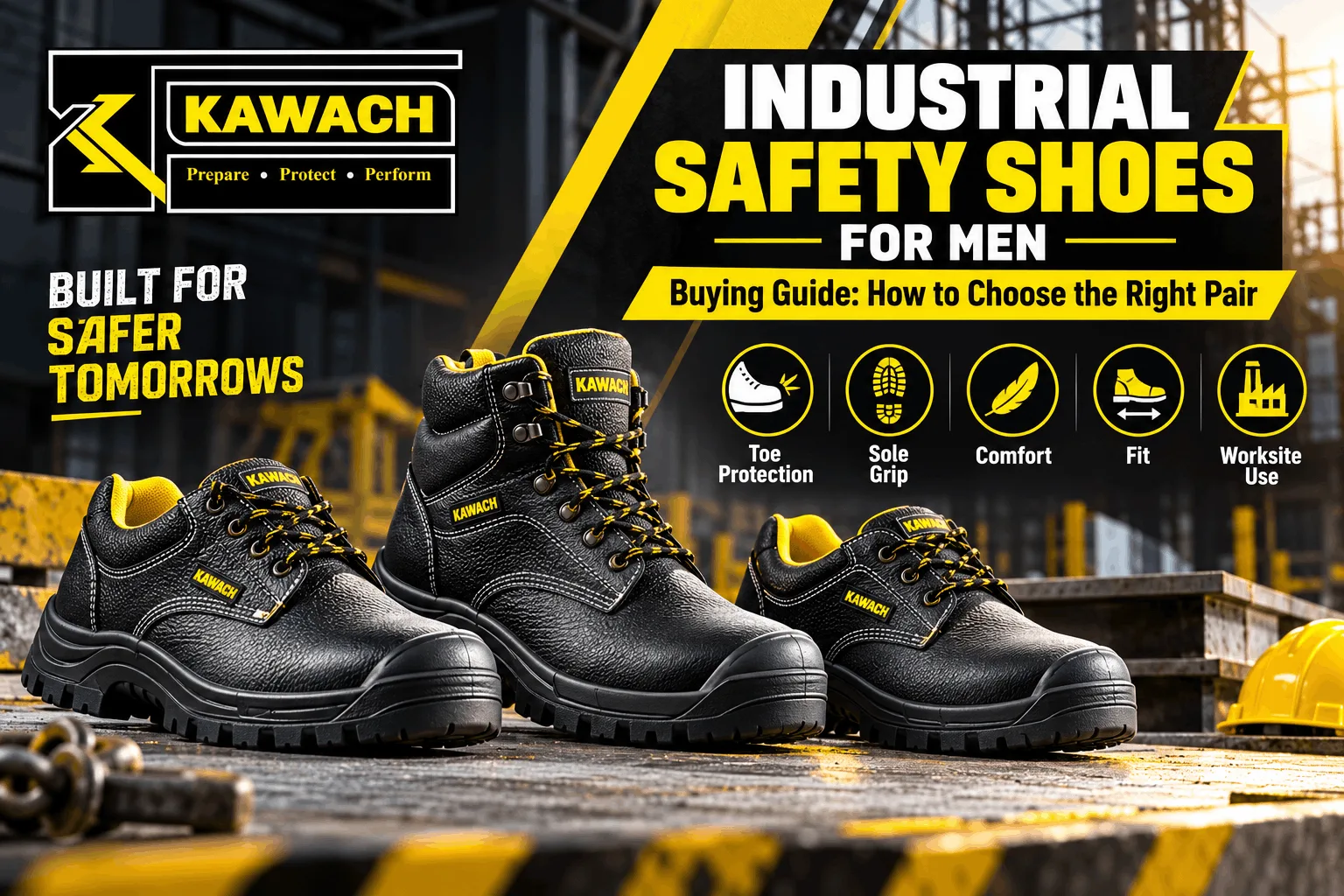
Industrial Safety Shoes for Men: Fit and Sizing Guide
Choosing industrial safety shoes for men involves more than selecting the usual shoe number. The correct fit depends on foot length, width, toe clearance, heel security and the socks worn during work.
An incorrectly fitted safety shoe may create pressure around the toes, allow excessive heel movement or become uncomfortable during long shifts.
This guide explains how to assess industrial footwear fit and compare designs for different work activities. Buyers can then explore available sizes and specifications in the Kawach Industrial Safety Shoes collection.
Why Do Men Need Industrial Safety Shoes at Work?
Feet remain exposed throughout a working shift. A single dropped tool, an unstable load, a slippery patch, a sharp piece of debris, or a damaged floor surface can create a safety risk.
Appropriate industrial footwear can help reduce the severity or likelihood of certain foot injuries, improve traction and provide additional stability and support to workers who spend long hours standing or walking.
The need becomes particularly important in workplaces involving:
- Construction and infrastructure
- Manufacturing and assembly
- Engineering and fabrication
- Warehousing and logistics
- Automotive facilities
- Mining and heavy industry
- Oil and gas operations
- Utilities and electrical maintenance
- Facility management
- Government and institutional projects
Safety footwear, however, should never be considered a replacement for good housekeeping, hazard control, worker training, machine guarding, or other necessary PPE. Kawach similarly positions safety footwear as one element of a wider workplace safety system.
What Makes Industrial Safety Shoes Different from Normal Shoes?
The major difference is purpose.
Regular shoes are primarily made for daily walking, appearance and general comfort. Industrial Safety Shoes for Men are designed to address workplace risks and performance requirements.
Depending on the exact model, industrial footwear may include a protective toe cap, a slip-resistant outsole, an energy-absorbing heel, antistatic properties, a water-repellent upper, or resistance to selected oils and chemicals.
This distinction matters because not every safety shoe provides every form of protection.
For example, a comfortable warehouse safety shoe should not automatically be selected for an electrician or chemical-processing worker without checking its technical specifications.
Understand the Hazard Before Choosing the Shoe
One of the most common mistakes in industrial PPE procurement is selecting the same footwear for every worker at the same company.
A warehouse operator and electrical maintenance technician may work inside the same facility but face very different hazards.
A better method is to match footwear characteristics with the actual risk, giving you control over your safety and peace of mind.
| Workplace Condition | Safety Shoe Features to Consider | What Buyers Should Verify |
| Falling tools/materials | Protective toe cap | Documented impact rating |
| Oily or wet flooring | Slip- and oil-resistant outsole | Suitability for actual floor conditions |
| Long walking shifts | Lower weight and cushioning | Fit, flexibility and comfort |
| Construction sites | Durable upper, grip, ankle coverage | Terrain and impact risks |
| Wet environments | Water-repellent upper | Model-specific water resistance |
| Electrical work | Verified electrical properties | Exact test/documentation |
| Chemical exposure | Compatible upper/outsole | Resistance to the specific chemical |
| Heavy industry | Durable construction and toe protection | Complete model specification |
This hazard-first approach makes the buying decision more useful than simply searching for the heaviest or most expensive pair of shoes.
What Does 200J Toe Protection Mean?
Toe protection is one of the most important factors in industrial footwear.
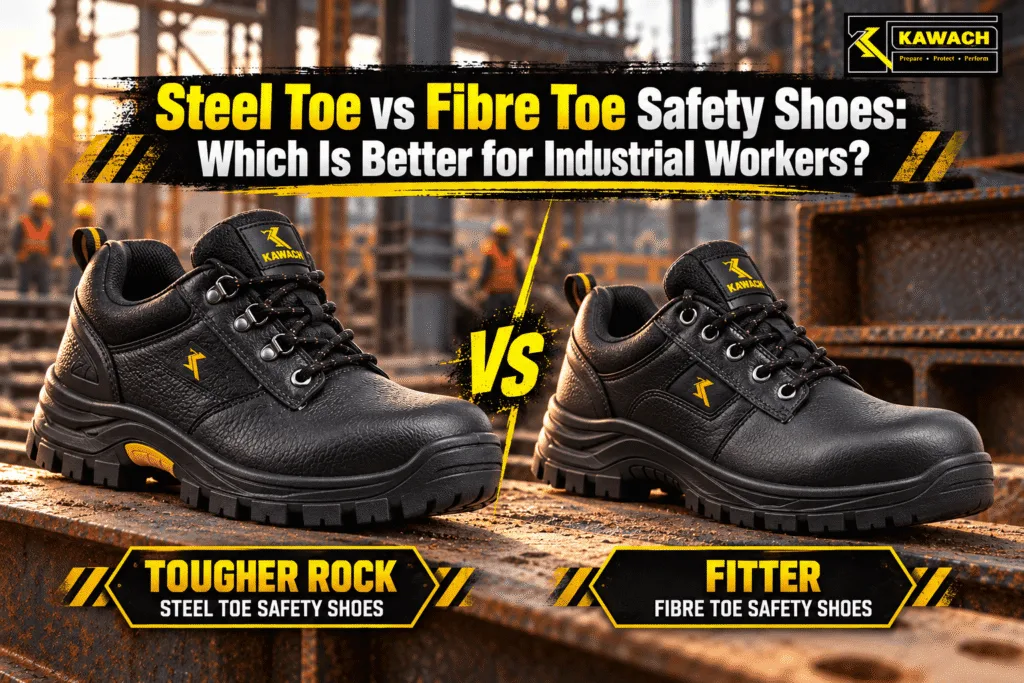
Some Kawach models use steel toe caps designed for impact resistance up to 200 joules. For example, Kawach Tougher Rock lists a 200J steel toe cap, along with a full-grain leather upper, a PU outsole, an EVA sheet insole and a mesh lining.
Its documented features also include antistatic properties, a water-repellent upper, oil- and chemical-resistant sole, slip resistance and energy absorption-Kawach lists applications including construction, mining, manufacturing, oil and gas and road-safety environments.
For buyers, however, seeing the words “steel toe” is not enough. It is essential to verify the actual impact rating and technical specifications of the model being ordered to ensure proper protection.
BIS Standards Matter When Buying Safety Footwear
Safety-related claims should be supported by recognised standards wherever applicable.
The Bureau of Indian Standards currently identifies IS 15298 (Part 2):2024, Personal Protective Equipment – Part 2: Safety Footwear, based on ISO 20345:2021 with modifications. The revised standard replaced the earlier 2016 version.
BIS testing under this standard covers areas such as footwear construction, toe protection, upper-outsole bonding and other relevant safety-footwear characteristics.
Kawach Tougher Rock, for example, states conformity with BIS Standard IS 15298 (Part 2). Kawach also publishes information about its ISO, BIS/ISI, CE and laboratory-related certifications.
For procurement teams, certification should be checked on a model-by-model basis rather than assuming that every shoe in an entire product range carries the same certification, ensuring you can trust the safety of your purchase.
Steel Toe or Fibre Toe: Which Is Better?
There is no universal winner. Selection depends on the application.
Steel-Toe Safety Shoes
Steel-toe footwear is widely used in construction, fabrication, engineering, manufacturing and material-handling environments where impact protection is important.
Steel-toe caps are durable and established for industrial applications, but the buyer should still consider overall weight, fit, outsole characteristics, upper construction and working conditions.
Fibre or Composite-Toe Safety Shoes
Fibre and composite alternatives can reduce metal content and may help produce Lightweight Safety Shoes for applications where worker mobility is important.
However, one important safety rule is often misunderstood:
A non-metallic toe cap does not automatically mean the shoe is electrically protective.
Electrical properties must be verified from documentation for the exact model being selected. This distinction is especially important for electricians, utility workers and maintenance teams.
Why Lightweight Safety Shoes Matter for Long Shifts
Workers in warehouses, manufacturing units, inspection teams, logistics operations and large plants may walk several kilometres during a working day.
Footwear weight, therefore, affects practical usability.
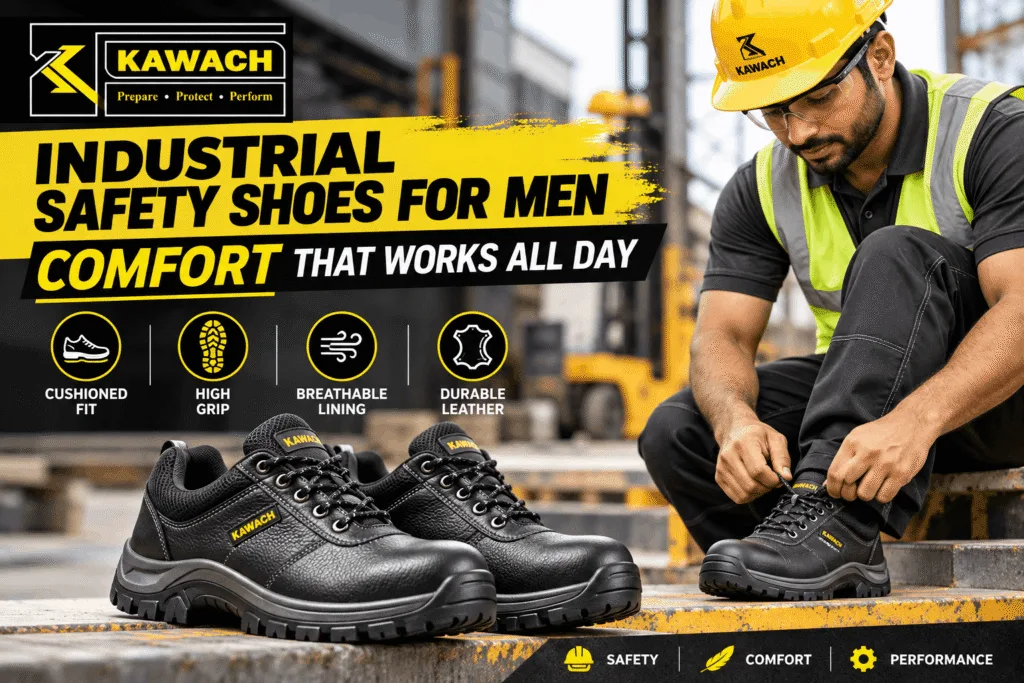
Lightweight Safety Shoes can improve mobility and comfort, particularly for employees who are constantly moving, climbing stairs, or standing for extended periods.
Modern lightweight designs may combine PU sole construction, breathable uppers, cushioned insoles, or lighter toe-cap technologies.
But weight should never become the only buying criterion.
The ideal lightweight shoe is not simply the lightest product available. It provides the required workplace protection while reducing unnecessary weight.
This is particularly important for employers because uncomfortable PPE may reduce consistent acceptance among wearers.
Low-Ankle vs High-Ankle Industrial Safety Shoes
Ankle height should also match the job.
Low-ankle footwear generally provides greater freedom of movement and can work well in warehouses, inspection teams, assembly units and on relatively even factory floors.
High-ankle footwear provides additional coverage and may be preferred for outdoor work, engineering, construction, maintenance and rough surfaces.
However, ankle height alone does not make a shoe safer. Fit, stability, outsole, flexibility and workplace conditions must all be assessed together.
How to Select the Best Safety Shoes in India
Searching for the Best Safety Shoes in India can produce dozens of models and brands. Instead of treating “best” as a universal ranking, businesses should use a repeatable selection process.
Start with the workplace risk assessment. Identify whether employees face impact, compression, slippery flooring, oils, chemicals, heat, moisture, electrical risks or uneven terrain.
Next, assess the toe cap, outsole, upper material and required ankle height.
Then examine comfort. Workers may wear industrial footwear for eight hours or longer, so cushioning, breathability, flexibility and fit are operational issues-not cosmetic extras.
Finally, verify applicable standards and technical documents before approving bulk procurement.
For larger requirements, Kawach recommends testing representative samples and collecting worker feedback on fit, weight, flexibility, heat, grip and comfort before finalising the complete order.
How Should Industrial Safety Shoes Fit?
Protection will not compensate for badly fitting footwear.
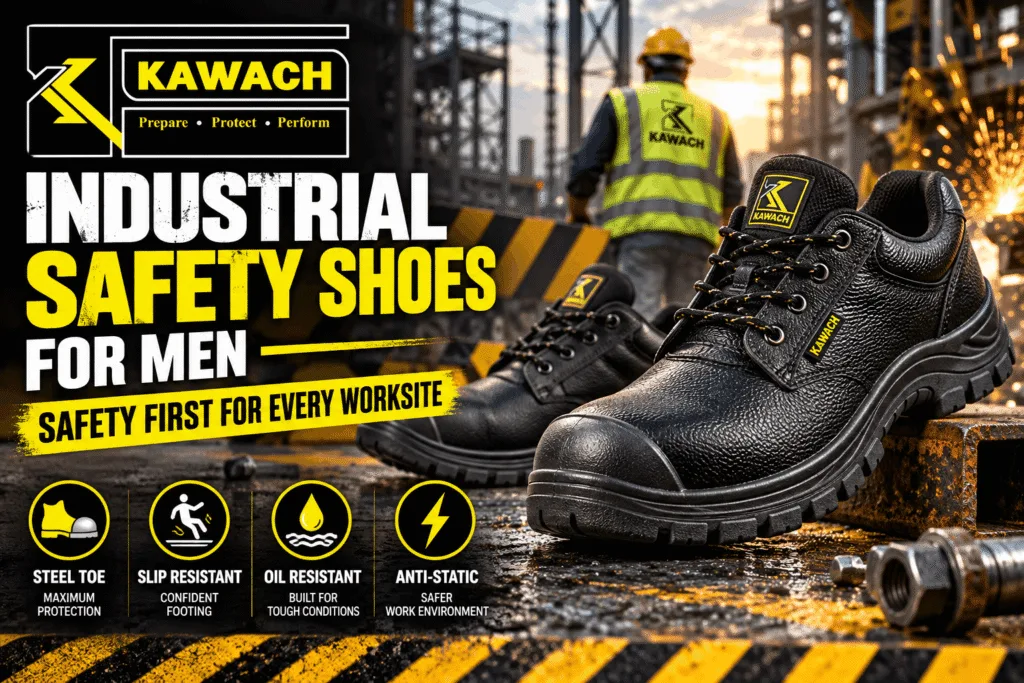
A shoe that is too tight can cause toe pressure and discomfort, while oversized footwear can lead to excessive heel movement and instability.
When checking the correct safety shoe size, workers should use the socks normally worn at work, check for adequate toe room, assess heel movement, walk in the shoe and confirm that the width does not create excessive side pressure.
For bulk procurement, employers should create an employee-wise size list instead of estimating shoe sizes.
A sample fitting before a major order can also identify differences between standard footwear sizing and a particular safety shoe model.
Kawach Safety Shoe Options for Different Workplaces
Kawach currently lists multiple safety footwear models, including Tougher Rock, Tougher, K-111, Fitter, Boss, AirBoss, Active and Force.
The range allows businesses to consider different footwear configurations rather than treating every industrial job as identical.
Tougher Rock, for instance, uses full-grain leather with a listed thickness of 1.8–2.0 mm, a mesh lining, a single-density PU outsole, an EVA sheet insole and a 200J steel toe cap. Sizes are listed from 5 to 12.
That model-level information is important because serious PPE procurement should be based on actual specifications rather than broad brand claims.
What Kawach Has Learned from Indian Worksite Requirements
Kawach’s industrial safety journey dates back to 2011 and the KAWACH brand was launched in 2013. The company says its products are developed for practical Indian working conditions, including long hours, heat, dust, moisture and demanding industrial environments.
A useful principle emerging from this experience is that a single footwear specification should not automatically be applied across all departments.
Procurement teams should consider the industry, working surface, impact or compression risk, moisture, oil and chemical exposure, ankle requirement, shift duration, size distribution and delivery location before finalising footwear. Kawach uses these factors when discussing industrial footwear requirements with businesses.
This moves procurement away from a catalogue-only decision toward actual workplace suitability.
How Kawach Approaches Safety Shoe Quality
Product quality involves more than the toe cap.
Good industrial footwear should show consistent construction, appropriate upper-to-sole bonding, secure stitching, a stable heel, suitable outsole tread, correctly positioned lining and insole, consistent sizing and documentation that clearly identifies product specifications.
Kawach operates a manufacturing unit in Bawana, Delhi and states that it remains involved from material sourcing through production and final quality checks. The company also highlights large-scale production capability, testing for practical working conditions and manufacturer-controlled quality processes.
This manufacturing involvement is an important trust signal for companies evaluating an industrial footwear supplier.
Why Businesses Consider Kawach for Industrial Safety Shoes
Kawach’s value proposition extends beyond selling a pair of shoes.
The company combines manufacturer-controlled production with product-selection support, bulk-supply planning, training at delivery and after-sales assistance. Its published approach emphasises suitability for Indian worksites and helping clients understand product use and limitations.
For procurement departments, contractors and plant managers, these factors matter because selecting PPE requires technical information, consistent supply and support-not just a low purchase price.
Instead of describing any product as universally “the best,” Kawach focuses on identifying footwear suited to the actual workplace requirements. That is a more responsible approach to workplace safety.
PAN-India Industrial Safety Shoe Requirements
Industrial safety footwear is required across India’s major construction, manufacturing, warehousing, infrastructure, mining and engineering centres.
Kawach supports enquiries for industrial safety equipment from Delhi-NCR and other locations across India.
Businesses can therefore discuss bulk requirements for Delhi, Gurugram, Noida, Ghaziabad, Faridabad, Jaipur, Mumbai, Pune, Ahmedabad, Surat, Bengaluru, Chennai, Hyderabad, Kolkata and other industrial locations, subject to product availability and delivery requirements.
For organisations operating multiple plants or projects, standardised product selection and planned size distribution can also simplify PPE procurement.
When Should Industrial Safety Shoes Be Replaced?
Safety footwear should be inspected regularly rather than replaced only when it is no longer wearable.
Replacement should be considered when the tread becomes excessively worn, the sole begins to separate from the upper, stitching fails, the upper cracks or tears, the toe area becomes damaged or deformed, the shoe no longer fits securely, or exposure has damaged its materials.
A significant impact or uncertainty about the shoe’s protective performance is also a reason to remove the footwear from service.
There is no universal replacement period because service life varies with the working surface, usage intensity, environment, exposure and maintenance.
Bulk Buying Checklist for Industrial Safety Shoes
Before requesting a quotation, a procurement team should ideally have the worksite location, worker roles, main hazards, quantities, required sizes, ankle-height preference, shift conditions, applicable technical requirements and expected delivery schedule ready.
Providing this information enables a safety footwear manufacturer to recommend more relevant options.
It also reduces the risk of purchasing hundreds of pairs based solely on price, only to later discover that the chosen model is uncomfortable or unsuitable for part of the workforce.
Protect Every Step with Kawach Industrial Safety Shoes
Choosing Industrial Safety Shoes for Men is not simply about meeting a PPE checklist. The footwear must match the worker, workplace and hazard while remaining practical enough for consistent daily use.
Whether your team requires steel-toe footwear, Lightweight Safety Shoes, industrial work shoes for factories, safety footwear for construction, or bulk PPE for projects across India, Kawach Safe Gears India Pvt. Ltd. can help evaluate requirements based on actual working conditions.
Kawach combines industrial safety expertise, manufacturer-controlled production, technical product guidance, bulk-supply capability, delivery training and after-sales support for Indian businesses.
Planning a bulk safety-shoe requirement?
Share your industry, worksite hazards, number of workers, required sizes, working conditions and delivery location with the Kawach team.
Kawach Safe Gears India Pvt. Ltd.
Phone: +91 97118 70298
Email: info@kawach.org
Frequently Asked Questions
1. What are Industrial Safety Shoes for Men?
Industrial Safety Shoes for Men are protective workplace footwear designed for environments involving hazards such as falling objects, rolling materials, slippery floors, oils, moisture and industrial debris. Their exact protection depends on the model.
2. Which are the Best Safety Shoes in India?
There is no single safety shoe that is best for every workplace. The most suitable choice depends on workplace hazards, toe protection, floor conditions, outsole, comfort, ankle height and applicable technical standards.
3. What does 200J mean in safety shoes?
A 200J rating refers to a defined impact-protection level for the toe area. Several industrial safety shoe designs use protective toe caps tested to this level. Buyers should verify the documented rating for the exact model.
4. Are Lightweight Safety Shoes suitable for factory workers?
Yes, when their documented protection matches the factory’s hazards. Lightweight footwear can be useful for workers who walk or stand for long periods, but the required safety performance should never be sacrificed merely to reduce weight.
5. Are steel-toe shoes better than fibre-toe shoes?
Neither is automatically better for every application. Steel toe caps are widely used for heavy industrial protection, while fibre or composite options may provide advantages such as reduced weight. Selection should depend on the job and documented performance.
6. Can safety shoes be used for electrical work?
Only footwear with appropriately verified electrical properties should be selected for electrical hazards. Buyers should never assume that a non-metallic toe automatically provides electrical protection.
7. Should construction workers wear high-ankle safety shoes?
High-ankle footwear can provide additional ankle coverage and may suit many construction environments, but the correct choice depends on terrain, work activity, hazards, fit and required protection.
8. How should companies select sizes for bulk safety-shoe orders?
Prepare an employee-wise size list and, where possible, conduct sample fittings. Workers should check toe space, internal width, heel movement, flexibility and comfort while wearing their normal work socks.
9. Does Kawach manufacture industrial safety shoes?
Kawach operates a manufacturing facility in Bawana, Delhi and remains involved in material sourcing, production and final quality checks for its range of safety equipment.
10. Does Kawach support bulk Industrial Safety Shoes requirements across India?
Yes. Kawach supports bulk industrial footwear requirements and enquiries from Delhi-NCR and other locations across India. Businesses can share their industry, hazards, quantities, size distributions and delivery requirements to receive suitable product guidance.