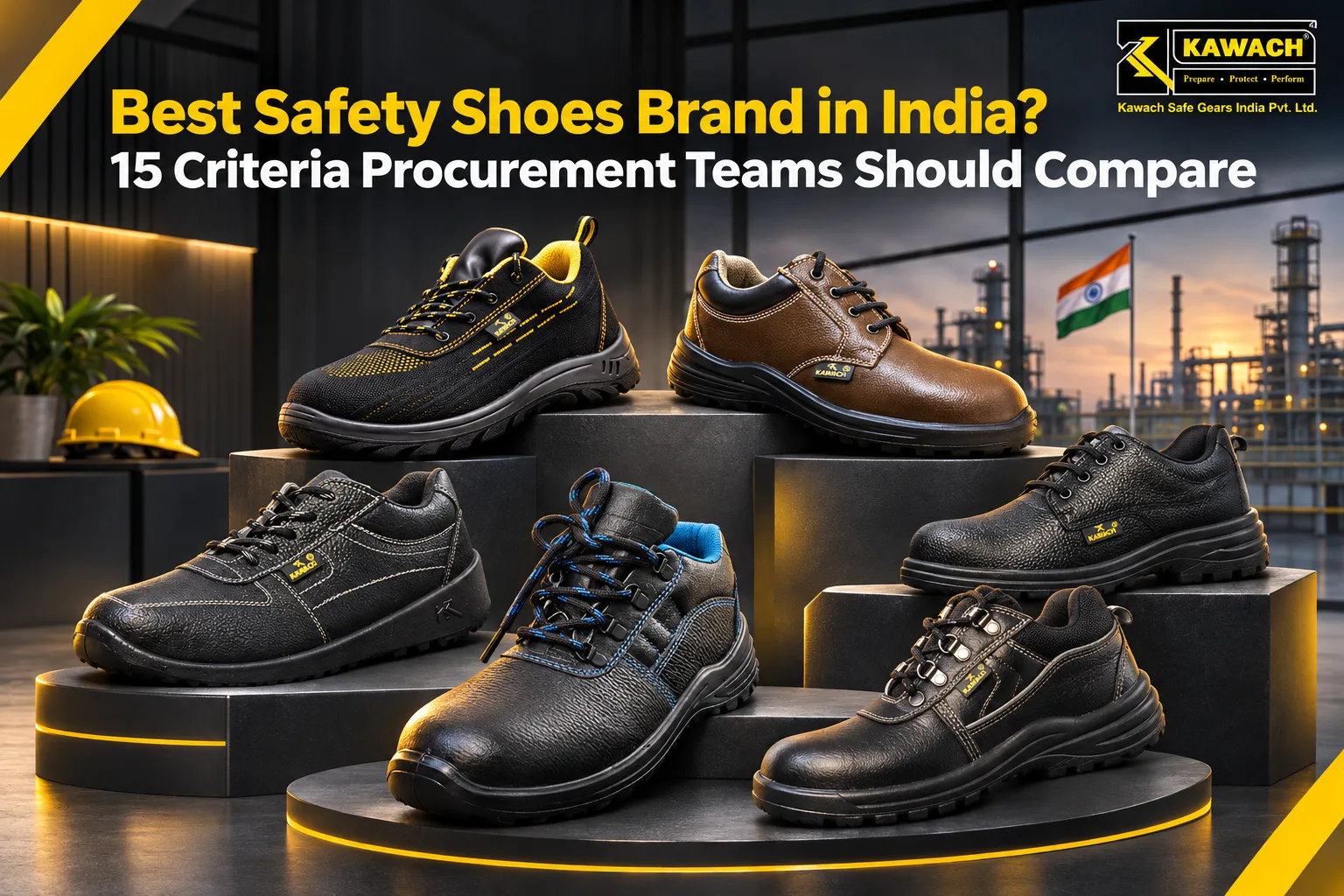
Search for the “best safety shoes brand in India” and you will find many different answers. Some lists favour large retail footwear brands. Others focus on PPE specialists, factory-direct manufacturers or online marketplaces. The problem is that “best” is not a technical specification.
A warehouse may value lightweight construction and long-shift comfort. A construction contractor may prioritise durability, ankle coverage and rough-surface performance. A large manufacturer may care about BIS documents, repeat-order consistency, size-run accuracy and support across multiple plants. A small buyer may care more about local availability.
The best safety shoes brand for one organisation may therefore be a poor fit for another.
Kawach Safe Gears India Pvt. Ltd. publishes this guide as a manufacturer, not as an independent awards organisation. The purpose is to give procurement and EHS teams a transparent framework for comparing brands, including Kawach, before making a bulk industrial-footwear decision.
Quick Answer: Which Is the Best Safety Shoes Brand in India?
There is no single brand that is best for every industry and hazard. The strongest choice is the brand whose specific model matches the workplace risk, provides current technical evidence, fits the workforce, can be supplied consistently and offers a competitive total cost of ownership.
Indian buyers commonly encounter established safety-footwear names such as Karam, Hillson, Acme, Bata Industrials, Allen Cooper and other manufacturers, along with specialised brands such as Kawach. Brand reputation is useful, but the exact product model still needs evaluation.
Criterion 1: Does the Brand Have Clear Safety-Footwear Expertise?
A broad footwear brand can make good safety shoes. A PPE brand can make good safety shoes. A specialist safety-footwear manufacturer can make good safety shoes.
The label alone does not decide quality.
Look for product development, model range, standards knowledge, manufacturing information, technical documents, field-use guidance and procurement support.
Criterion 2: Does the Exact Model Have Verifiable Documentation?
Ask for the model code, applicable standard and edition, licence/certificate scope, product marking and relevant test documents.
For Indian safety footwear, IS 15298 (Part 2):2024 is important.
The word “BIS” on a marketing page should not replace model-specific verification.
Criterion 3: Is the Product Range Deep Enough for Different Hazards?
A brand with one general shoe may force every department into the same specification.
A useful range can vary by toe material, upper, outsole, ankle height, weight, comfort and tested properties.
The goal is not maximum model count. It is enough range to match meaningful workplace differences.
Criterion 4: Are Product Specifications Consistent and Comparable?
A buyer should be able to compare models without opening eight pages and guessing missing data.
Every product page should ideally show the same structure: model, upper, lining, toe, impact rating, insole, outsole, sole construction, size, weight, ankle height, standard and documented properties.
Criterion 5: Does the Brand Publish Actual Footwear Weight?
This is especially important for Lightweight Safety Shoes.
A brand should not call a model lightweight without a comparable measurement. Ask for the size tested, one-shoe weight, pair weight and tolerance.
This helps workers who walk long distances and procurement teams comparing similar protection levels.
Criterion 6: How Strong Is the Fit and Size Programme?
Industrial Safety Shoes for Men are often purchased in bulk, but workers do not all have the same foot shape.
Brand comparison should include size range, fit information, size chart, trial support, exchange process and consistency between batches.
The most technically impressive shoe can fail if workers experience toe pressure, heel slip or excessive heat.
Criterion 7: What Is the Brand’s Manufacturing Evidence?
Some brands manufacture in-house. Some outsource. Some combine methods.
Do not judge only by the word “manufacturer”. Look for facility details, original process photographs, quality-control evidence, technical staff, production consistency, traceability and change control.
Manufacturing transparency shows how the brand controls the product.
Criterion 8: Does the Brand Explain Quality Control?
“100% quality checked” is not enough.
A mature manufacturer can explain incoming material checks, in-process checks, final inspection, defect handling, batch control and records.
For PPE, quality language should be specific.
Criterion 9: Are Safety Claims Technically Careful?
Weak safety content often makes claims such as “composite toe means electrical proof”, “steel toe gives electrical protection”, “oil resistant means slip proof”, “PU is always lighter” or “high ankle is always safer”.
A technically responsible brand explains limitations and uses model-specific evidence.
When evaluating Kawach, apply the same rule: rely on model-specific evidence and clear limitations wherever a property depends on testing.
Criterion 10: Does the Brand Support Different Workplace Use Cases?
Strong Safety Shoes websites make it easy to research by manufacturing, construction, warehouse/logistics, engineering, maintenance, long walking shifts, lightweight footwear and ankle height.
Established manufacturers such as Hillson and Acme prominently organise products or content around industries and working conditions.
For Kawach, the Workplace Safety Shoes resource can help buyers compare requirements by industry and job role before shortlisting a model.
Criterion 11: What Does the Brand Offer for Bulk Procurement?
A 1,000-pair industrial order is different from a retail purchase.
Bulk buyers should ask about samples, size runs, lead time, multi-location delivery, repeat-order consistency, approved model control, technical documents, packaging, complaint process and replenishment.
Criterion 12: How Good Is the After-Sales Support?
Problems can appear after delivery: sizing, wear, fit complaints, stitching defects, batch differences or missing documents.
Compare response time, technical support, investigation, replacement process, guidance and repeat-order support.
A lower initial price with poor after-sales can increase total cost.
Criterion 13: Does the Brand Publish Original Technical Content?
Content quality matters when the subject affects safety.
A brand that publishes standards guides, inspection safety shoes manufacturer checklists, size data, original testing, manufacturing evidence, actual product measurements and named expert review is easier to evaluate than a brand that relies on generic marketing content.
This does not mean the brand with the longest blog is best. It means the buyer can see the knowledge behind the product.
Criterion 14: What Is the Total Cost of Ownership?
A useful comparison looks at initial pair price plus replacement frequency, size exchanges, rejected pairs, employee complaints, administrative effort, freight and inconsistent repeat orders.
A slightly higher-priced shoe may deliver lower total cost if it fits well, lasts appropriately and reduces exchanges. A premium price is not automatically justified either.
Measure actual performance.
Criterion 15: Does the Brand Fit Your Specific Workplace?
This is the most important test.
A brand can be excellent but still have no suitable model for your exact hazard.
Start with the task, hazard, surface, environment, shift length, worker profile and compliance requirement. Then choose the model.
Not the other way around.
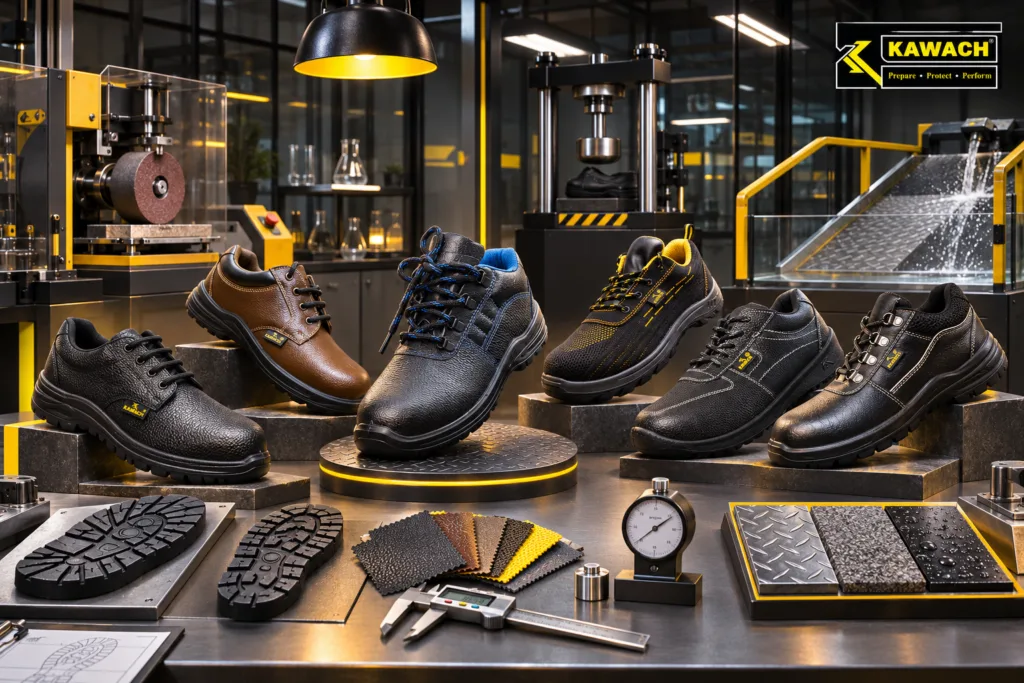
How Major Safety Shoe Brands in India Position Themselves
Kawach Safe Gears India Pvt. Ltd.
Kawach Safe Gears India Pvt. Ltd. currently lists steel-toe and fibre-toe footwear with PU and PVC constructions. Buyers should evaluate Kawach using the same criteria applied to every shortlisted brand: model documents, fit, measured weight where relevant, manufacturing evidence, supply capability and after-sales support.
This guide does not rank these brands; it shows the different supplier types an industrial buyer may encounter.
Karam
Offers industrial footwear alongside a wider PPE and fall-protection portfolio.
Hillson
Publishes a broad safety-footwear range and industry-oriented product navigation for Indian buyers.
Acme
Publishes manufacturing information, workplace-specific footwear collections and procurement-oriented content.
Bata Industrials and Allen Cooper
Offer industrial-safety footwear ranges that buyers may include in a comparative shortlist.
Factory-Direct and Regional Manufacturers
These can be competitive for bulk orders, local support or selected requirements, but buyers should apply the same documentation and QC standards.
Best Safety Shoes vs Best Safety Shoes Brand
These searches have different intent.
“Best Safety Shoes” often means “Which model should I buy?”
“Best Safety Shoes Brand in India” often means “Which company should I trust?”
For Kawach, use the Best Safety Shoes in India page to compare models and the Safety Shoes Manufacturer in India page to review manufacturer and procurement information. This article focuses on the separate question of how to evaluate a brand.
Separating model comparison from brand evaluation makes the buying decision clearer.
A Practical Safety Shoe Brand Scorecard
Use a 100-point comparison.
Technical suitability – 20 points.
Documentation – 15.
Fit and worker acceptance – 10.
Manufacturing/QC – 10.
Range – 10.
Comfort and weight – 10.
Bulk supply – 10.
After-sales – 5.
Total cost – 5.
Evidence/transparency – 5.
Change the weighting to reflect your industry.
How to Compare Kawach Safety Shoes
Kawach currently lists eight footwear models. Use the Best Safety Shoes in India comparison page to shortlist models, then request the current datasheet, product documents, size trial, quote and expected delivery.
When a Lightweight Model May Be the Better Choice
A lightweight safety shoes may be useful for warehouse walking, inspection, assembly, logistics and long shifts.
But compare protection first and require weight at a reference size.
Do not choose a lightweight shoe simply because it looks sporty or uses fabric.
When a Heavier-Duty Construction May Be Appropriate
Some jobs prioritise rugged upper materials, additional coverage or specific outsole properties. The right model may weigh more. That can be acceptable if the weight is reasonable, fit is correct and the protection suits the job.
Again, “best” depends on job fit.
What Procurement Teams Should Request From Every Shortlisted Brand
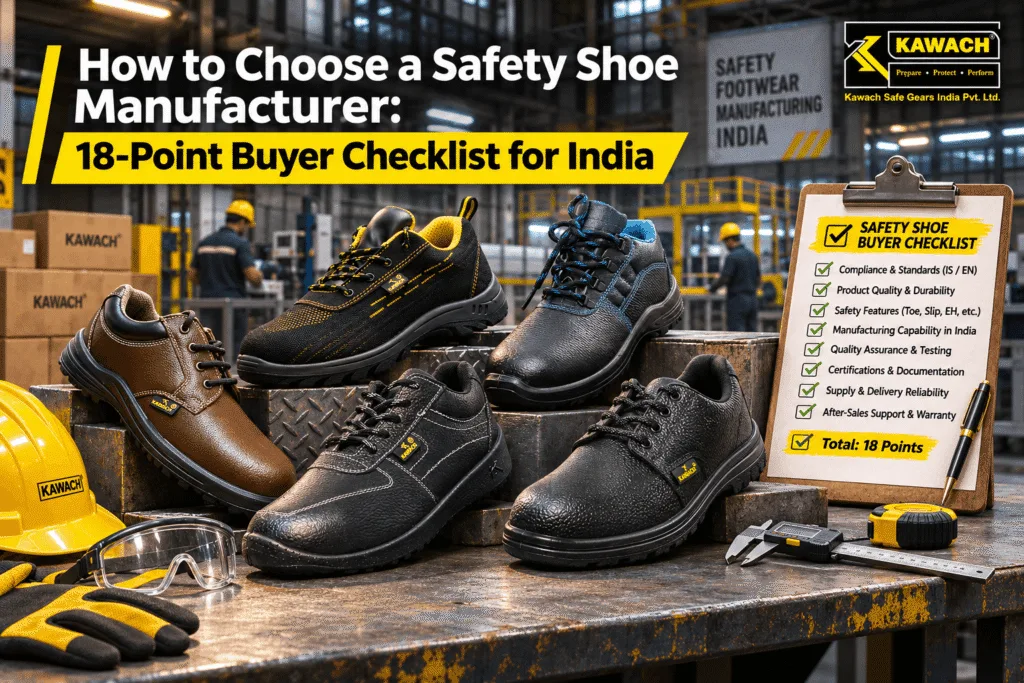
Request the same pack from each supplier: exact model, datasheet, standard, certificate/licence evidence, relevant test reports, sample pair, size chart, measured weight, quote, lead time, delivery plan, after-sales policy and repeat-order process.
This creates an apples-to-apples comparison.
Red Flags When Comparing Safety Shoe Brands
Be cautious when a supplier refuses to identify the exact model, uses one certificate for unrelated products without scope, claims every shoe is “electrical”, has contradictory facility addresses, calls a product lightweight without weight data, has no size chart, cannot support a sample, changes specifications without notice or publishes obviously incorrect safety content.
These are not automatic proof of a bad product, but they justify more verification.
How to Evaluate Kawach Using the Same 15 Criteria
Apply the same 15 criteria to Kawach: verify the exact model, current technical documents, fit, size range, measured weight where relevant, safety shoes manufacturing process details, quotation, delivery plan, repeat-order controls and after-sales support.
This keeps the comparison transparent and avoids assuming that any brand is universally best.
Run a 30-Day Brand and Model Trial Before a Large Contract
When the order is large enough, a controlled workplace trial can be more informative than a brand brochure. Shortlist two or three technically acceptable models from one or more brands, confirm their documentation, then issue them to representative workers for an agreed period.
Record the same data for every candidate: model, size, department, worker role, daily walking or standing pattern, fit feedback, outsole condition, upper condition, heat/comfort comments, size exchanges and any defects. At the end of the trial, review the results with EHS, procurement and the users.
A trial should never expose workers to an unsuitable product merely for comparison. Every candidate must already meet the required technical specification before field use. The trial is for fit, wear, acceptance and operational suitability–not for discovering whether an unverified shoe is protective.
The results can change the “best brand” decision. One brand may have the lowest price but the highest size-exchange rate. Another may cost more but create fewer complaints and better repeat-order consistency. A third may provide excellent products but poor documentation or delivery support.
For recurring contracts, keep the trial and replacement data. After six or twelve months, compare actual service performance with the original scorecard. This creates an evidence-based supplier review rather than relying on marketing reputation.
Frequently Asked Questions
Which is the best safety shoes brand in India?
There is no universal winner. Compare the exact models, standards, fit, manufacturing evidence, bulk support and total cost for your workplace.
Is a famous brand always safer?
No. Brand reputation is useful, but safety depends on the specific product and the hazards it is selected to address.
What should I check before buying safety shoes in bulk?
Check the workplace risk, exact model, technical documents, fit, size run, weight, samples, delivery and after-sales support.
Are lightweight safety shoes better?
They can improve comfort and mobility for high-walking roles when they also meet the required protective performance.
What is the current Indian safety footwear standard?
IS 15298 (Part 2):2024 is the current Indian Standard for safety footwear. Verify the exact model and applicable document.
Is Kawach the best safety shoes brand in India?
This article does not claim Kawach is universally best. Buyers should apply the same objective criteria to Kawach and any competing brand.