When procurement teams compare industrial footwear, they often start with the toe cap and stop at the price. Yet a worker’s outsole touches the worksite throughout the shift. The wrong sole can affect traction, wear, comfort and suitability for a particular exposure-even if the upper and toe cap appear adequate.
This guide compares PU vs rubber vs PVC safety shoe soles for buyers in India. It explains how each material is commonly used, where each can be a practical option, and the questions to ask a manufacturer before buying. There is no universally safest sole material: a finished shoe must be assessed for the actual workplace floor, contamination, temperature, chemicals and required performance markings.
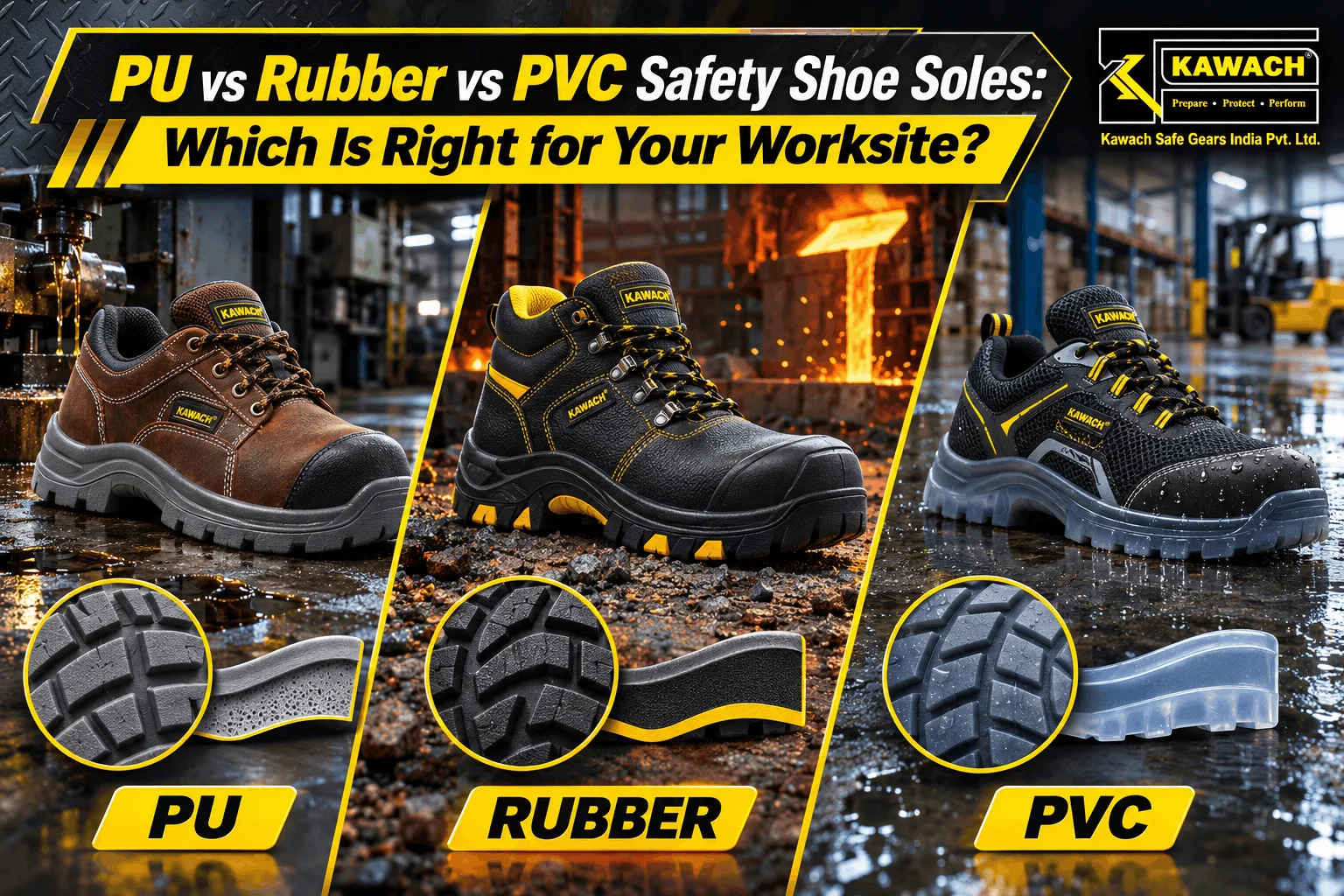
Quick answer: PU can offer a useful balance of cushioning, weight and everyday industrial comfort; rubber may suit certain demanding wear and temperature applications when properly specified; PVC can appear in economical constructions and some wet-use applications. But material names cannot replace model-specific slip, wear, heat, oil or chemical-resistance evidence.
PU vs rubber vs PVC soles: quick comparison
• PU (polyurethane): often chosen where buyers want cushioning and flexibility, subject to the finished shoe’s tested performance and exposure limits.
• Rubber: may be appropriate for selected heat, abrasion or harsh-worksite applications when the exact compound and test results support that use.
• PVC (polyvinyl chloride): used in some footwear constructions but not automatically waterproof, chemical-proof or slip-resistant.
Direct answer: There is no universally best safety-shoe sole material. Choose the complete footwear model based on the floor, contamination, expected wear, temperature and required standards—not on the outsole material name alone.
Why outsole selection matters as much as toe protection
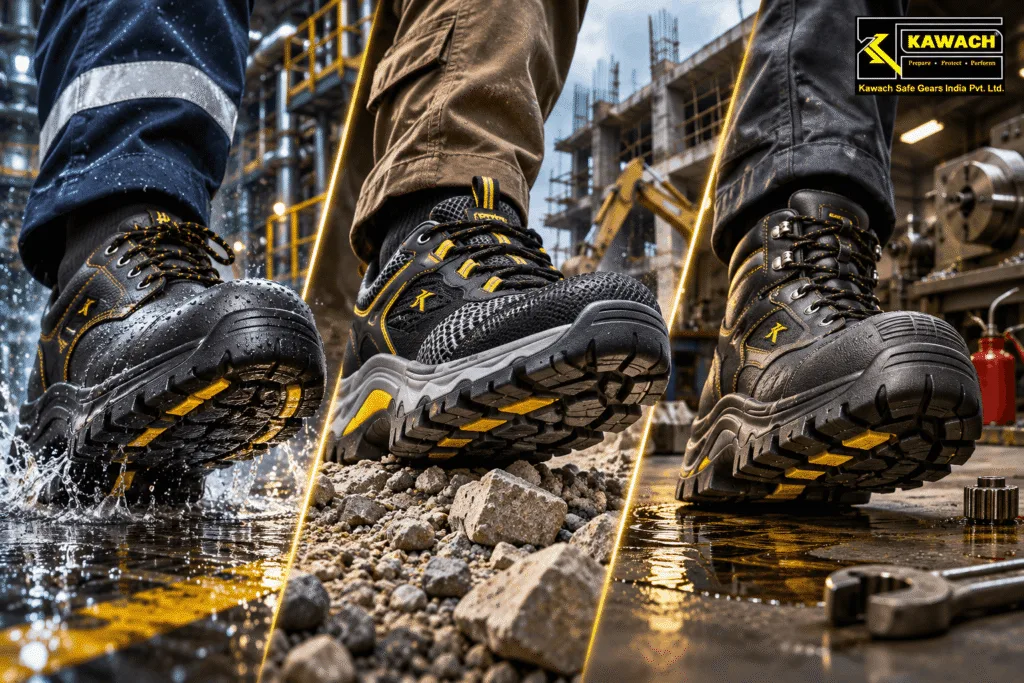
A toe cap protects against particular impact and compression risks. The outsole influences a different set of hazards: slips on contaminated floors, wear from rough concrete, durability in wet environments, and the way a worker stands or walks during a long shift.
Picture three jobs. One person walks 15,000 steps daily inside a dry distribution centre. Another works around coolant, metal offcuts and industrial machinery. A third walks over rubble and wet soil on a construction project. If all three are given shoes solely because they share the same 200-joule toe-cap claim, a critical part of footwear selection has been ignored.
ISO 20345:2021 covers multiple properties of safety footwear, including mechanical risk, slip resistance, thermal risk and ergonomics. A purchasing decision should start with the finished product’s applicable marking and evidence, not an assumption about the raw sole material.
PU safety shoe soles: features and limitations
Polyurethane (PU) is widely used in industrial safety footwear. Depending on the formulation and construction, manufacturers can create shoes that combine cushioning with a durable wearing surface. Single-density and dual-density approaches can feel different underfoot and may be aimed at different work patterns.
When PU can make sense
• Workplaces where staff walk or stand for extended periods.
• General manufacturing and warehousing, when tested traction suits the floor.
• Roles where flexibility and comfort help improve consistent PPE use.
• Buyers seeking a balance between cushioning, weight and cost.
What to verify on a PU shoe
Ask for the actual outsole configuration, documented slip performance, resistance claims and suitable storage conditions. Some PU constructions are sensitive to long storage in unsuitable conditions or to chemical exposure, while durability depends on the specific formulation and use. A statement such as “PU sole” does not confirm oil resistance, antistatic performance or electrical protection.
A quality wear trial should include the real floor and work cycle: stairs, bending, standing, walking and any permitted wet or contaminated area. Inspect the tread after the trial rather than judging only the comfort of a brand-new pair.
Rubber safety shoe soles: features and limitations
Rubber compounds are used when manufacturers require particular traction, abrasion or temperature-related performance. This does not mean rubber always outperforms PU. A rubber compound designed for one application may be unsuitable for another, and some rubber safety footwear can be heavier or less flexible than alternatives.
When rubber can be worth considering
• Outdoor work where the outsole meets abrasive ground or mixed surfaces.
• Certain maintenance or fabrication tasks with clearly defined temperature requirements.
• Sites where the selected rubber compound has verified resistance to identified substances.
• Buyers who need a specific outsole specification rather than the lowest possible weight.
What to verify on a rubber shoe
Request proof for the property that actually matters. For heat exposure, ask for documented limits and test classification. For oily floors, verify the finished shoe’s slip results on suitable test surfaces, not just a claim that the rubber contains “anti-skid material.” For chemicals, match the particular chemical and contact conditions to the documentation. Rubber is a family of materials, not a performance certificate.
PVC safety shoe soles: features and limitations
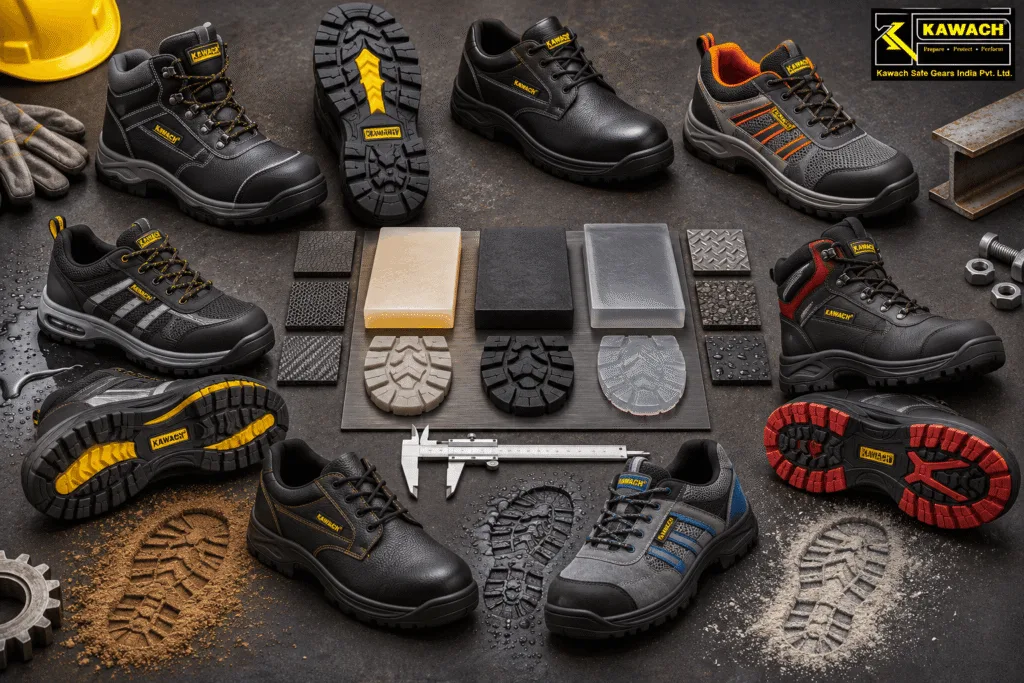
Polyvinyl chloride (PVC) is used in footwear constructions that can include moulded and budget-oriented designs. The relevant considerations depend on whether PVC is used in the outsole, upper or a fully moulded boot. Some products are practical around water, but that does not make every PVC shoe suitable for chemical handling, slippery tile, hot surfaces or sustained heavy industrial wear.
When PVC may be considered
• Applications where the product’s moulded construction and moisture-related features are relevant.
• Budgets that require economical footwear while still meeting a clearly defined specification.
• Selected cleaning and general site tasks, subject to documented material suitability.
What to verify on a PVC shoe
Check flexibility in the expected temperature range, tread behaviour, fit, protective toe provision if needed, and compatibility with substances on site. A waterproof-looking boot is not automatically chemical protective. Request the manufacturer’s product instructions and the correct technical evidence.
PU vs rubber vs PVC: side-by-side comparison
| Buying criterion | PU sole | Rubber sole | PVC sole |
| Common selection interest | Comfort and versatile industrial use | Specific wear, grip or temperature applications | Moulded or economical constructions |
| Weight | Often designed to be relatively light | Depends on compound and design; can be heavier | Varies significantly by construction |
| Slip performance | Must be verified on finished footwear | Must be verified on finished footwear | Must be verified on finished footwear |
| Oil/chemical exposure | Formulation and model dependent | Compound and model dependent | Formulation and model dependent |
| Heat performance | Requires model-specific evaluation | Certain formulations suit selected applications | Requires model-specific evaluation |
| Best purchasing approach | Match comfort plus certified properties | Match exposure plus certified properties | Match intended use plus certified properties |
This table describes selection tendencies, not tested performance or a guarantee for a particular shoe. It would be misleading to rank all three materials from “best” to “worst” without knowing the full construction and workplace.
Which sole should you buy for your industry?
Warehousing and logistics
Assess dry versus wet zones, floor polish, dust, forklifts, stair use and walking distance. A properly specified PU shoe may be comfortable for long shifts, but the decision should follow traction testing and employee wear trials. A premium sole still cannot compensate for spills left on the floor.
Construction and infrastructure
Consider loose stones, wet soil, rough concrete, metal debris, stairs and temporary access routes. Prioritize the complete footwear’s grip, wear characteristics and required penetration protection. A robust outsole may be worth paying for, but make the decision from data rather than outsole appearance.
Engineering and fabrication
Identify hot material, metal shavings, oil and repeated kneeling. A heat claim needs the relevant standard marking and exposure limits; an “oil-resistant” label does not prove slip performance in a spill. Match the full footwear specification to the operation.
Food, cleaning and wet processes
Check cleaning agents, floor wetness, the substances handled and hygiene expectations. If chemical protection is required, evaluate the correct chemical-resistance footwear category rather than assuming a moulded PVC sole or boot is adequate.
Utilities and electrical maintenance
Electrical risk must be evaluated separately. A non-metallic sole or toe cap is not proof that the shoe is suitable for energized electrical work. Use footwear with documented properties selected by a competent person for the actual hazard.
Why Indian buyers should check the current footwear standard
For Indian procurement, confirm what edition applies to your tender or activity and verify the complete shoe against IS 15298 (Part 2):2024, where relevant. The BIS safety-footwear product manual is a useful official starting point. Slip performance, penetration resistance, electrical behavior, heat properties and chemical exposure are distinct requirements; a sole-material label is not proof of any of them.
Toe-cap material is a different decision. Compare it separately using the Kawach steel-toe vs fibre-toe guide.
How to read a safety-shoe specification before buying
Ask your supplier to provide a one-page, model-specific datasheet. Look for the exact model name, size range, upper construction, toe-cap details, sole material, applicable test standard, edition, product markings and instructions. If penetration resistance, slip, heat, antistatic or another property matters, its marking and evidence should appear explicitly.
Do not rely on outdated shorthand alone. For example, uvex’s explanation of EN ISO 20345:2022 notes changes to slip-resistance marking compared with the older standard. When comparing two certificates, confirm the edition and what the reported marking actually means.
A test report for a different model is not acceptable evidence for the one your team will wear. Likewise, an image of a shoe does not establish its sole formulation or performance.
What changes outsole performance beyond PU, rubber or PVC?
Two shoes with soles described by the same material can perform differently. Compound formulation is one reason: additives and manufacturing processes affect hardness, flexibility and how a sole behaves as it wears. Tread design is another. Deep patterns may help shed some loose material, while the contact area and channel layout influence how the sole interacts with different surfaces. None of these design traits proves a slip-resistance rating by sight alone.
The finished shoe also matters. A thin outsole bonded to one upper, a thicker sole on another construction and a fully moulded boot may behave differently during bending, prolonged wet exposure or temperature changes. Midsole layers, heel geometry, shoe weight and upper flexibility influence the experience of walking and standing. Buyers should therefore compare completed footwear models, not isolated material labels.
Worksite contamination introduces further uncertainty. A sole used on dry concrete may encounter oil, detergent, fine dust, coolant or standing water on another shift. A pattern that feels grippy on one clean floor is not automatically suitable for a different contamination. Request tests relevant to the conditions you actually have, and examine the limitations documented by the manufacturer.
A supplier may advertise “dual-density PU”, “rubber sole” or “PVC sole” as if those terms were complete specifications. They are starting points for asking informed questions, not a purchase approval. Ask what other layers are present, whether the shoe has an appropriate protective toe and any required penetration-resistant component, and which properties have been verified for the specific model and version. A sole cannot compensate for missing protection elsewhere in the footwear.
A worksite outsole trial that produces useful evidence
A responsible selection process does not ask workers to deliberately walk on hazardous surfaces to see whether they slip. Instead, begin with the hazard assessment and documentation review. Only shoe models that satisfy the required protective properties should proceed to a supervised fit and usability trial in conditions approved by the employer’s safety team.
Select a small group representing the jobs where the footwear will be used. Record floor type, hours spent standing, whether workers climb ladders or steps, routine cleaning agents, and whether the site has heat, metal chips, sharp objects or other particular exposures. Then specify what the trial is actually measuring: comfort, ease of cleaning, fit retention and observable wear under ordinary authorized work—not an unscientific pass/fail claim about slip resistance.
Use a simple observation log. Each entry should identify the model, date, wearer feedback, cleaning method and any sign of premature damage. Have the site EHS lead review reported issues without asking staff to continue wearing footwear that appears unsafe. If several workers report the same pressure point or sole separation, record that as a reason to investigate; do not use it as proof that all products made from that material are defective.
A meaningful sample decision has three parts: documented standards conformity for the identified hazard, acceptable fit and usability, and reasonable purchasing/service terms. If all three are met, the buying team can compare options more confidently. If the approved product specification requires a property that the supplier cannot demonstrate, do not substitute a favorable comfort score for the missing evidence.
For projects with multiple departments, trials may justify more than one shoe. A dry warehouse, a workshop with metal debris and a wash-down operation can have distinct risks. Standardization saves effort only when it does not erase those differences.
Wear, cleaning and storage: what purchasers should include in instructions
Outsoles change during use. Abrasion can flatten tread, repeated flexing can expose cracks, and some substances can affect materials over time. Storage conditions can matter too. Specific behavior depends on the formulation and product design, so a generic rule such as “rubber always lasts longest” or “PU is always lighter” should not be treated as a test result.
When footwear is issued, workers should receive the actual manufacturer’s cleaning, drying and storage instructions. Encourage users to remove ordinary dirt by the prescribed method and to report contamination or damage promptly. Avoid recommending strong solvents, direct high heat or improvised chemical cleaning without the manufacturer’s approval. Such methods may degrade adhesives, surfaces or protective parts.
Supervisors should define simple withdrawal triggers: visible sole separation, serious cracking, unstable fastening, worn-through tread, damage to the toe area, contamination that cannot be cleaned safely, or any other condition the manufacturer’s instructions identify as unacceptable. The exact replacement decision belongs to the competent site process. A fixed replacement calendar can support inventory planning, but it cannot justify continued use of visibly unsafe footwear.
From a buying perspective, include care instructions and defect-handling terms in the RFQ. A procurement comparison becomes more complete when it includes how much support the supplier will provide for users to maintain and replace the products appropriately. This is often more useful than an unsupported claim of a universal number of months of service life.
Understanding common outsole claims in a product listing
“Anti-slip” is not a precise description of performance in every environment. Ask which recognized test, shoe model and conditions support the claim. The actual floor and contaminants remain important.
“Oil-resistant” requires context. A material’s response to a test substance is not proof that the entire shoe is suitable around every lubricant or process chemical. Obtain the relevant evidence and consider other hazards present at the worksite.
“Heat-resistant” should be tied to an applicable requirement and test condition. A brief hot-contact property, where specified and verified, is different from continuous exposure to high temperatures.
“Chemical-resistant” is especially broad. The chemical, concentration, duration and shoe construction matter. Do not treat ordinary PVC or rubber footwear as universally compatible with industrial chemicals.
“Electrical safety” should never be inferred because a sole looks non-metallic. Electrical protective properties involve the complete product, controlled conditions, maintenance and the employer’s electrical risk controls. Obtain exact evidence relevant to the operation before issuing footwear for such work.
A practical five-step outsole evaluation
Step 1: Map surfaces and contaminants. Record the areas that workers actually enter, including ramps, stairs, outdoors, oily production areas and wet cleaning zones.
Step 2: Define the minimum documented properties. Specify relevant standards and needed performance rather than saying “best anti-slip sole.”
Step 3: Shortlist actual finished models. Compare approved footwear with model names and supporting datasheets, not raw-material claims.
Step 4: Run a controlled wear trial. Check fit, comfort, repeated movement, sole wear and worker feedback under normal approved conditions. Never use a trial as an excuse to deliberately expose a worker to an uncontrolled slip or electrical hazard.
Step 5: Agree on replacement triggers. Train supervisors to recognize damaged outsoles, worn tread, delamination and deterioration. Replace unsafe shoes promptly and keep the approved model record current.
Explore Kawach safety-footwear options
Kawach Safe Gears India Pvt. Ltd. lists multiple industrial safety-shoe models, including Tougher Rock and other footwear for industrial buyers. The correct choice depends on the model-specific datasheet and your site risk assessment. Buyers considering sole types should request current specifications rather than assuming a particular outsole is fitted to every named model.
If your procurement team has been asked to compare PU, rubber or PVC safety footwear, contact Kawach with the industry, floor conditions, required property, quantity and size mix. A clear specification leads to a more useful quotation.
Frequently asked questions
Which is better for safety shoes: PU or rubber?
Neither is universally better. PU may be selected for cushioning and versatile workwear, while a specified rubber compound may be suited to certain demanding conditions. Compare finished models against your actual hazards and documented requirements.
Are PVC safety shoes waterproof?
Some fully moulded PVC footwear constructions are designed to limit water entry, but a PVC outsole alone does not make an entire shoe waterproof. Verify the finished model’s construction and stated limitations.
Is a rubber sole always anti-slip?
No. Slip performance depends on compound, tread, footwear design, contaminants and the walking surface. Check product test information and improve housekeeping.
Which sole is best for oil on factory floors?
Choose a finished safety shoe with suitable verified slip and material properties for the specific work environment. “Oil-resistant” and “slip-resistant” are not interchangeable claims.
Do non-metallic soles protect workers from electric shock?
Not automatically. Electrical protective properties must be demonstrated for the complete shoe and must match the application. Use the site’s electrical-risk assessment and approved PPE criteria.
How this comparison was prepared
This is a materials-and-selection explanation, not a controlled laboratory trial comparing three Kawach sole compounds. Material performance can vary with formulation, outsole design, aging and surface condition. Product-specific claims must be checked against current manufacturer documents and test results before approval.