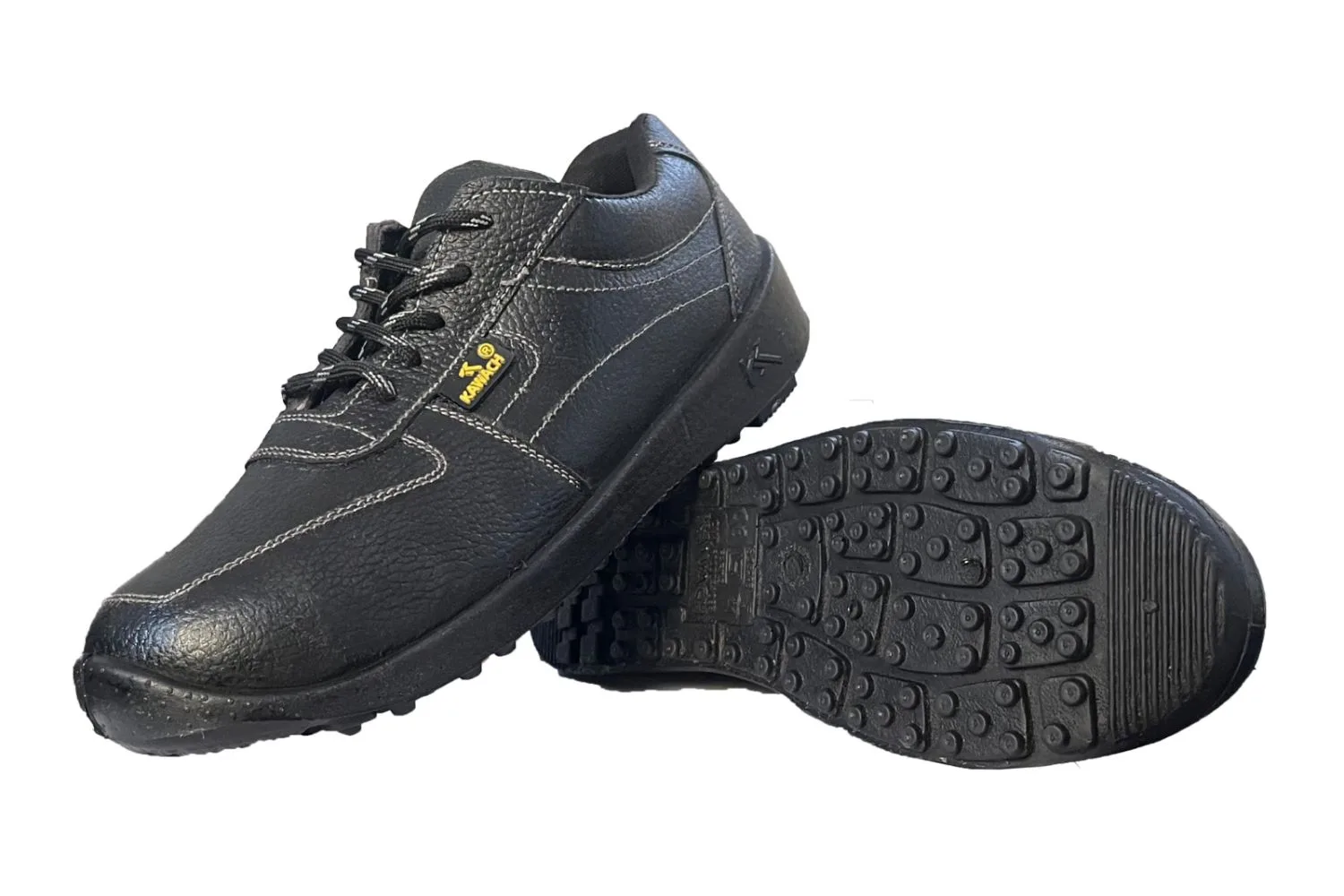
How to Choose the Best Safety Shoes – Industrial Buying Checklist
Choosing the best safety shoes for an industrial workforce requires a structured purchasing process.
Before comparing products, employers should identify workplace hazards, determine mandatory protection features and establish the fit and comfort requirements of employees.
This guide explains how safety officers and procurement teams can create a selection checklist, evaluate specifications and review product documentation.
Once your purchasing requirements are clear, visit our Best Safety Shoes in India comparison page to compare the Kawach models.
Why Safety Shoes Are Essential at Industrial Worksites
Construction sites, manufacturing facilities, warehouses, mines, engineering units, oil and gas facilities and electrical projects can expose workers to several foot-related hazards. These may include falling tools, moving materials, sharp debris, slippery floors and contact with oils or chemicals.
Ordinary shoes are not designed to protect against these conditions. Industrial Safety Shoes may incorporate a protective toe cap, slip-resistant tread, energy-absorbing heel, water-repellent upper, antistatic properties and oil- or chemical-resistant outsole.
Safety footwear in India is covered by IS 15298 (Part 2):2024, based on ISO 20345:2021. The current BIS product manual applies to general-purpose safety footwear and includes requirements related to protective performance and testing. Buyers should request documentation for the exact product being supplied rather than assuming that one certificate applies to an entire footwear range.
How Kawach Evaluates Safety-Footwear Requirements
Kawach operates a manufacturing unit in Bawana, Delhi. According to the company, its team remains involved from material sourcing through production and final quality checks, helping maintain consistency and compliance across its safety products.
When evaluating footwear for an industrial requirement, the following factors should be reviewed:
- The hazards present in the department
- Toe-cap material and impact specification
- Outsole material and tread design
- Upper material and construction
- Shoe weight and flexibility
- Insole, lining and cushioning
- Ankle height
- Water, oil or chemical exposure
- Applicable standard and test documentation
- Worker fit and comfort during a sample trial
This approach is more reliable than choosing a single safety shoe model for every employee or selecting footwear solely on the basis of the lowest quotation.
Types of Safety Shoes
Steel-Toe Safety Shoes
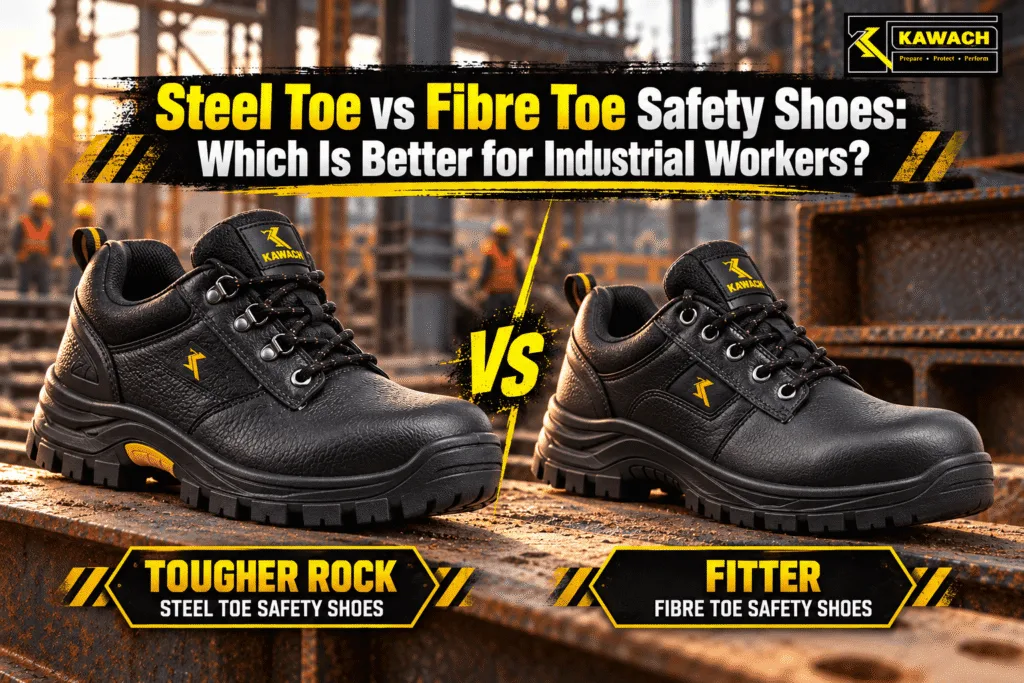
Steel-toe footwear contains a metal safety cap intended to protect the front of the foot against specified impact and compression hazards. It is commonly used in construction, fabrication, warehousing, mining and heavy manufacturing.
Several Kawach models list a steel toe cap with impact resistance up to 200 joules, including K-111, Boss, Active, Tougher, Tougher Rock, AirBoss and Force. The exact claims and certification should be confirmed from the relevant product page, datasheet and supporting documents.
Fibre-Toe Safety Shoes
Fibre-toe or non-metallic toe-cap shoes can be considered where lower weight or non-metallic construction is desirable.
Kawach Fitter uses a fibre toe cap and lists impact resistance up to 200 joules, antistatic properties and electrical resistance up to 18 kV for one minute. It is presented for tower climbing, electrical work, construction and mining. Electrical protection should never be assumed from the toe-cap material alone; buyers must verify the complete shoe’s test documentation and suitability for the intended task.
Low-Ankle Safety Shoes
Low-ankle shoes generally provide greater freedom of movement. They may be suitable for indoor factories, warehouses, assembly lines, inspection teams and other environments with relatively even surfaces.
High-Ankle Safety Shoes
High-ankle footwear provides greater ankle coverage and may be considered for outdoor maintenance, construction and work on uneven surfaces. Fit remains important because excessive pressure or rubbing can discourage consistent use.
Lightweight Safety Shoes
Lightweight Safety Shoes are particularly useful for employees who walk frequently or remain standing for extended shifts. Breathable uppers, flexible PU soles, mesh lining and cushioned EVA insoles can improve wearer comfort.
Kawach AirBoss features a breathable fabric upper, mesh lining, moulded EVA insole, PU outsole and a listed 200-joule steel toe cap. These features make it a practical model to evaluate where mobility and ventilation are priorities.
A lightweight design should not be chosen at the expense of the protection required by the workplace risk assessment.
PU Sole or PVC Sole: Which Is Better?
Both PU and PVC soles can be suitable, depending on the application.
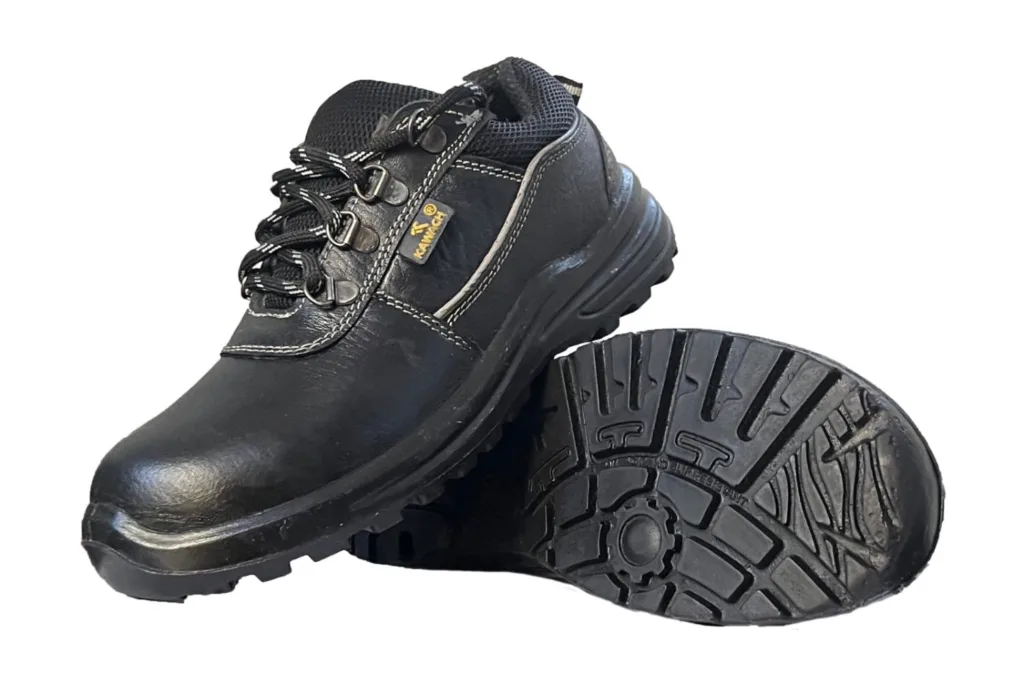
A PU outsole is commonly selected when flexibility, cushioning and relatively low weight are important. Dual-density PU construction is also used in the wider Indian safety-footwear market to combine a softer cushioning layer with a denser wear layer.
PVC soles can provide a durable, cost-conscious option for select general industrial applications. Kawach Force, for example, uses a single-density PVC outsole, an EVA sheet insole and a steel toe cap rated on its product page up to 200 joules.
Neither material is automatically suitable for every floor, chemical or temperature. Procurement teams should match the sole specification to the conditions at the actual worksite.
Key Features of High-Quality Safety Shoes
1. Correctly Rated Toe Protection
Check the toe-cap material, impact rating and test documentation. The cap should also provide sufficient toe room without pressing against the wearer’s foot.
2. Slip-Resistant Tread
The outsole pattern should support grip on the intended surface. Safety shoes can reduce risk, but they cannot compensate for oil spills, poor housekeeping or badly maintained flooring.
3. Comfortable Footbed
A moulded EVA insole, cushioned lining and padded collar can improve comfort during long shifts. Comfort matters because workers are more likely to wear PPE consistently when it fits correctly.
4. Durable Upper
Full-grain and split leather are commonly used in industrial footwear. Kawach models list leather thicknesses of approximately 1.8–2.0 mm on several product pages, although specifications should be reconfirmed when ordering.
5. Resistance for the Intended Environment
Some Kawach footwear pages list antistatic construction, water-repellent uppers, oil- and chemical-resistant soles, slip resistance and high energy absorption. Resistance can vary by model and by substance, so buyers should ask for model-specific confirmation.
Which Kawach Safety Shoe Should You Consider?
| Workplace requirement | Model to evaluate | Relevant published features |
| Long walking or standing shifts | AirBoss | Breathable upper, mesh lining and moulded EVA insole |
| General heavy industrial work | K-111 | Full-grain leather, PU sole and 200J steel toe |
| Electrical or tower-related work | Fitter | Fibre toe and listed electrical-resistance properties |
| Manufacturing and construction | Active or Boss | Full-grain leather, PU sole and moulded EVA insole |
| Rugged industrial conditions | Tougher Rock | Full-grain leather, PU sole and steel toe |
| Cost-conscious general requirement | Force | PVC sole, EVA insole and steel toe |
This table is intended as a shortlist, not a substitute for a risk assessment. The procurement or EHS team should confirm the final selection using current technical documents and a wearer trial.
How to Select the Best Safety Shoes in India
Step 1: Identify the Hazard
Record whether employees face falling objects, sharp materials, slippery surfaces, oils, chemicals, moisture, electricity, heat or uneven ground.
Step 2: Shortlist the Required Protection
Decide the necessary toe-cap type, sole construction, ankle height and resistance properties.
Step 3: Review Certification
Ask for the BIS licence details, test report, certificate scope and model identification. Confirm that the document applies to the exact footwear being supplied.
Step 4: Conduct a Sample Trial
Allow workers from different departments to test sample pairs. Record feedback on toe room, heel movement, grip, flexibility, heat, cushioning and overall weight.
Step 5: Confirm Size Distribution
Do not estimate the full order from a small number of workers. Collect an accurate size requirement before placing a bulk order.
Step 6: Inspect Footwear Regularly
Replace safety shoes when the tread is badly worn, the sole separates, the stitching fails, the upper cracks or the toe-protection area is damaged.
Safety Shoes in Delhi and PAN-India Supply
Kawach’s head office and manufacturing operations are located in Bawana, Delhi. The company supplies PPE and industrial safety products and accepts enquiries regarding product selection, quotations and workplace safety requirements.
Businesses looking for safety shoes in Delhi or arranging industrial footwear for teams across India should provide:
- Industry and worksite location
- Main workplace hazards
- Required quantity
- Size distribution
- Preferred ankle height
- Required toe-cap type
- Delivery schedule
- Relevant tender or compliance requirements
Providing this information helps the supplier recommend a more appropriate model instead of quoting a generic shoe.
Frequently Asked Questions
1. Which are the best safety shoes for industrial work?
The best option is the shoe whose documented protection matches the workplace hazard. Compare toe protection, grip, upper material, sole construction, ankle height, comfort and certification.
2. Are lightweight safety shoes safe for factory use?
They can be, provided the complete footwear meets the protection required for the task. Low weight alone does not establish safety performance.
3. Are steel-toe shoes better than fibre-toe shoes?
Neither type is universally better. Steel toe caps are widely used for impact protection, while fibre-toe construction may be preferred where lower weight or non-metallic components are important. Certification and application matter more than material alone.
4. Which safety shoes are suitable for electrical work?
Use only footwear that has been specifically tested and documented for the relevant electrical requirement. Kawach Fitter lists electrical resistance up to 18 kV for one minute, but suitability must be confirmed for the exact workplace and supplied model.
5. How long do industrial safety shoes last?
There is no universal replacement period. Service life depends on usage, surface conditions, moisture, chemicals, maintenance and storage. Replace damaged or excessively worn footwear immediately.
6. Can Kawach supply bulk safety shoes across India?
Kawach accepts product and quotation enquiries from its Delhi office and presents itself as an industrial PPE manufacturer and supplier in India. Buyers should contact the company with their quantities, locations and technical requirements.
Final Recommendation
Finding the Best Safety Shoes in India requires more than comparing prices or selecting the strongest-looking pair. Start with the hazard, verify the model’s documentation, test the fit and involve workers in the final evaluation.
Kawach offers steel-toe, fibre-toe, PU-sole and PVC-sole Industrial Safety Shoes with breathable, cushioned designs for different working conditions. Organisations in Delhi and across India can use the product range as a starting point and request model-specific guidance before finalising a bulk order.