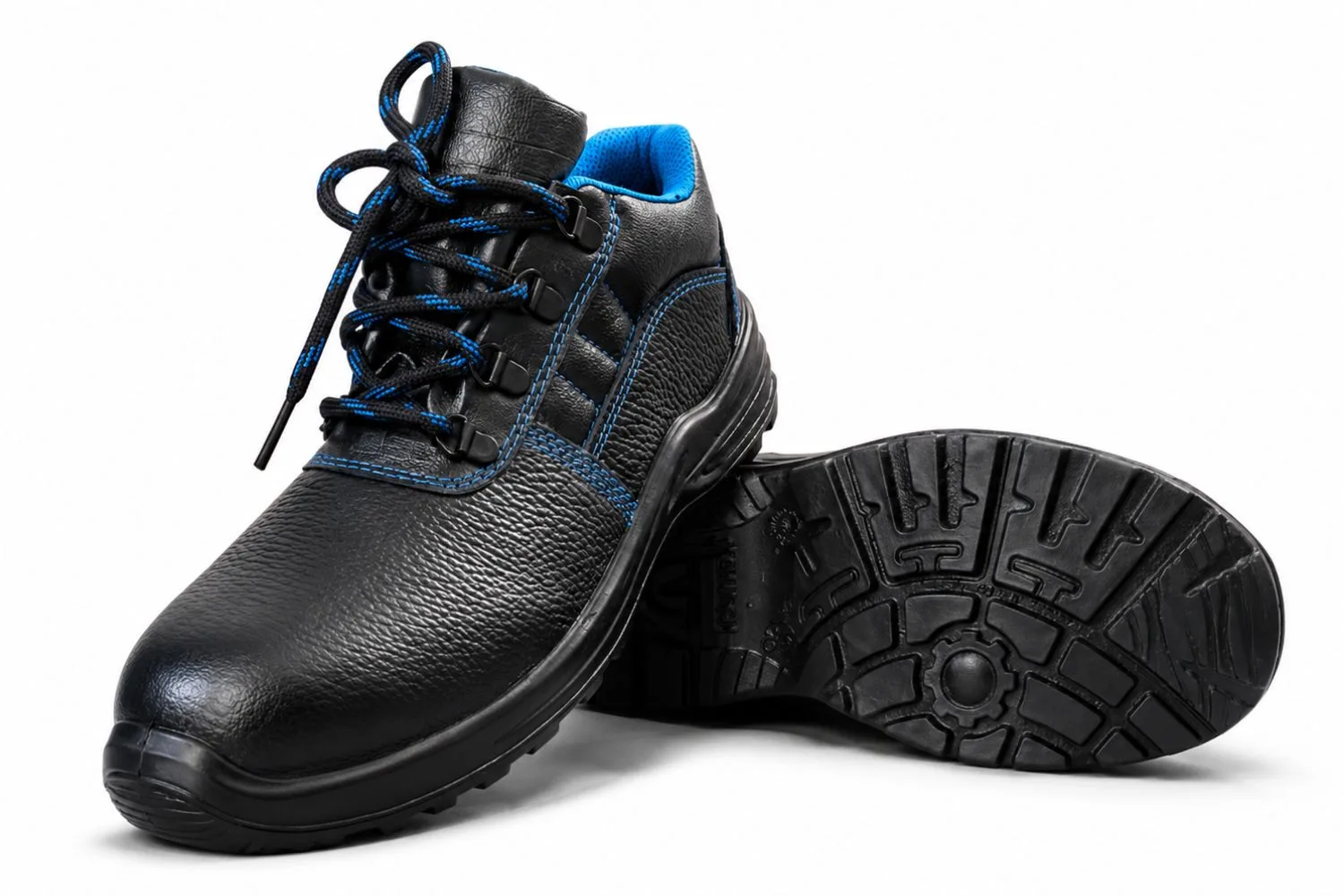
Lightweight safety shoes should be evaluated using actual footwear weight, fit, protective performance and the demands of the working shift.
A fabric upper, PU outsole or fibre toe cap may contribute to a particular design, but these features do not automatically prove that a shoe is lighter than another model.
For an accurate comparison, buyers should check footwear weight measured at the same size, along with toe protection, outsole performance, comfort and workplace suitability.
Explore the Kawach Industrial Safety Shoes range to review currently available models and specifications.
What Makes a Safety Shoe Lightweight?
A lightweight safety shoe is designed to reduce avoidable weight through its materials and construction. Depending on the model, this may include:
- A single- or dual-density PU outsole
- A fibre or composite toe cap
- A breathable fabric or lightweight leather upper
- A mesh lining
- A moulded EVA or cushioned insole
- A low-ankle design
- Lightweight eyelets and fastening components
The total weight depends on the shoe size, ankle height, sole thickness, upper material and toe-cap construction. Two shoes described as lightweight may therefore feel very different after several hours of use.
Buyers should request the weight of a single shoe or a pair in a stated size-preferably a commonly purchased size such as UK/India size 8-rather than accepting an unsupported “lightweight” claim.
Why Lightweight Safety Shoes Matter During Long Shifts
Reducing footwear bulk may facilitate movement for employees who frequently walk between production lines, storage racks, loading areas, or inspection points.
Greater freedom of movement
Flexible construction can make routine walking, bending and climbing more comfortable. This may be particularly useful for warehouse staff, supervisors, assembly workers, technicians and logistics teams.
Better wearer acceptance
Workers are more likely to wear protective footwear correctly when it fits well and does not cause excessive pressure, heel movement or heat build-up. Kawach identifies cushioning, lower weight and supportive fit as important considerations for long-standing and walking shifts.
Improved comfort in Indian conditions
Industrial workplaces in India may involve heat, dust, moisture and long operating hours. Breathable uppers, mesh linings, cushioned insoles and correctly fitted collars can help make footwear more practical for daily use.
Lightweight construction should nevertheless be treated as a comfort feature-not a replacement for impact, slip, puncture, electrical, chemical or other required protection.
Types of Lightweight Industrial Safety Shoes
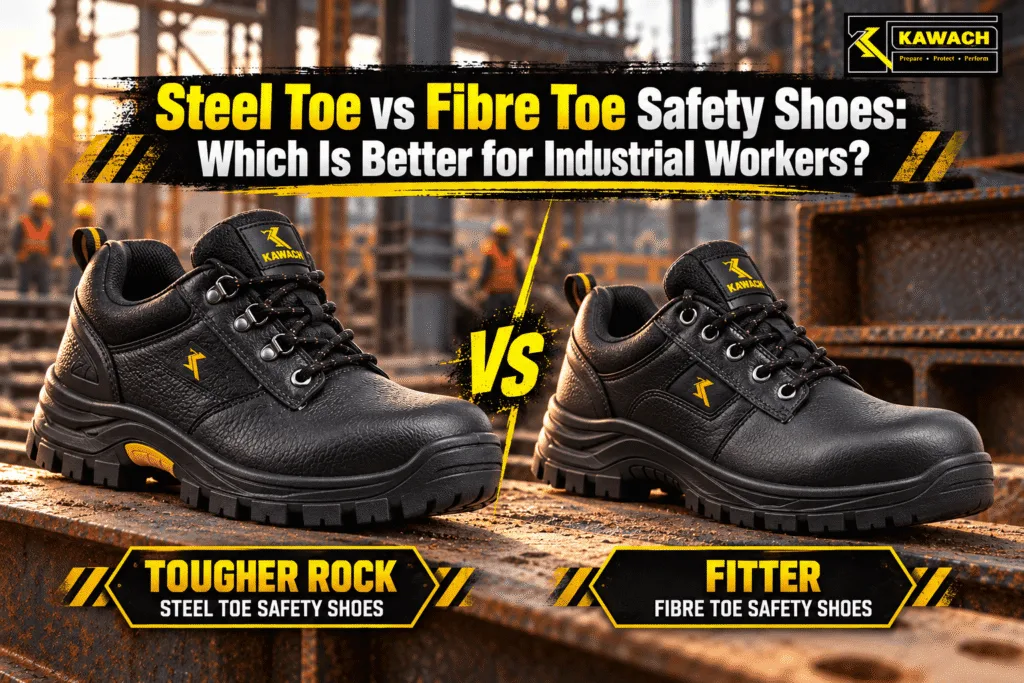
Lightweight steel-toe safety shoes
Steel-toe caps are commonly used where workers may be exposed to falling or rolling objects. Modern steel-toe footwear can still be lightweight when paired with a PU outsole, a cushioned insole and a lightweight upper.
Kawach AirBoss, for example, combines a breathable fabric upper, mesh lining, a moulded EVA insole and a single- or dual-density PU outsole with a steel toe cap rated for 200-joule impact resistance. It is available in sizes 6–11.
Fibre or composite-toe safety shoes
Fibre and composite toe caps provide non-metallic alternatives to conventional steel protection. They may help reduce weight in selected designs, but a non-metallic toe cap does not automatically make footwear electrically protective.
Kawach Fitter uses a fibre toe cap, split leather upper, mesh lining, EVA insole and single-density PU outsole. Its product page lists 200-joule toe protection, anti-static properties and electrical resistance up to 18 kV for one minute. Buyers should request the current model-specific test certificate before relying on any electrical claim.
Low-ankle safety shoes
Low-ankle shoes provide greater ankle movement and can be considered for:
- Warehouses
- Assembly lines
- Automotive units
- Quality inspection
- General manufacturing
- Indoor maintenance
- Logistics and packaging
They are generally more suitable for relatively even working surfaces where additional ankle coverage is not required.
High-ankle safety shoes
High-ankle footwear provides additional ankle coverage and may be considered for construction, mining, outdoor maintenance and uneven surfaces. The design should remain flexible enough to avoid rubbing or restricting normal movement.
Lightweight Safety-Shoe Features to Compare
Protective toe cap
Check whether the model uses steel, fibre or composite protection. Ask for its impact rating and the test documentation for the complete footwear model.
The current Indian safety footwear standard is IS 15298 Part 2:2024. BIS documentation classifies safety footwear into material-based categories and sets model-testing and certification requirements.
Do not rely only on a toe-cap supplier’s certificate. Request documentation applicable to the complete shoe being purchased.
PU outsole
Polyurethane soles are widely used because they offer a useful combination of cushioning, flexibility and manageable weight. Single-density PU may suit general applications, while dual-density construction can offer different properties in the midsole and contact layer.
PU is not automatically suitable for every chemical, temperature or surface condition. The outsole must be matched to the actual worksite.
Cushioned insole
A moulded EVA insole can improve underfoot cushioning during prolonged standing and walking. Buyers should also check arch support, heel stability and whether the insole remains secure inside the shoe.
Breathable upper and lining
Mesh linings and breathable uppers can improve ventilation. This is particularly relevant in warm factories, warehouses and outdoor working conditions.
Slip and oil resistance
Outsole tread should be evaluated against the actual floor. A shoe used on dry concrete may perform differently on oily tiles, wet metal or dusty warehouse flooring.
No safety shoe can prevent every slip. Footwear must be supported by housekeeping, spill control, floor maintenance and employee training.
Correct fit
A shoe that is too tight can create pressure around the toes. An oversized shoe may allow heel movement and instability.
Before placing a bulk order, check:
- Internal width
- Toe clearance
- Heel grip
- Sock thickness
- Insole support
- Ankle comfort
- Flexibility while walking
- Size consistency across the order
Kawach Lightweight Safety-Shoe Options
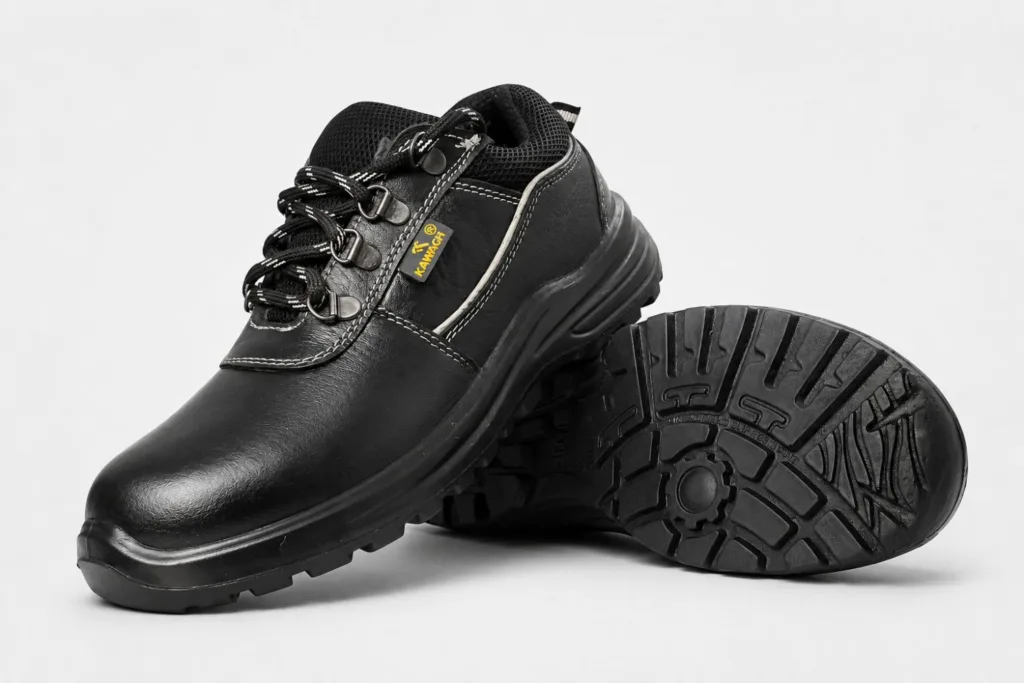
Kawach’s safety-shoe category currently includes Tougher Rock, Tougher, K-111, Fitter, Boss, AirBoss, Active and Force models. Construction varies between models, including steel and fibre toe caps, PU and PVC outsoles, leather and breathable uppers, mesh linings and EVA insoles.
| Model | Toe cap | Sole and comfort construction | Suggested consideration |
| AirBoss | Steel, 200J | Breathable upper, mesh lining, moulded EVA and PU outsole | Long walking shifts where breathability matters |
| Fitter | Fibre, listed 200J | Leather upper, mesh lining, EVA sheet and PU outsole | Buyers seeking a non-metallic toe-cap option |
| Active | Steel, 200J | Full-grain leather, moulded EVA and PU outsole | General heavy industrial applications |
| Boss | Steel, 200J | Full-grain leather, moulded EVA and PU outsole | Construction, manufacturing and engineering use |
| Force | Steel, 200J | Leather upper, EVA sheet and PVC outsole | Applications where PVC construction is specified |
The model descriptions above are based on the product specifications currently published by Kawach. Final selection should be made only after reviewing the latest technical datasheet, certificate and workplace risk assessment.
Product-Weight Transparency
At the time of this review, exact per-shoe or per-pair weights were not displayed on the Kawach product pages reviewed.
Because footwear weight changes with size and construction, Kawach should publish:
- Weight of one shoe and one pair
- Size used for measurement
- Measurement tolerance
- Toe-cap material
- Date of measurement
- An original photograph of the shoe on a calibrated weighing scale
Publishing this first-party information would help customers compare models and would provide original evidence that competing generic articles may not offer.
How Kawach Controls Product Quality
Kawach operates a manufacturing unit in Bawana, Delhi. The company states that it remains involved in material sourcing, production and final checks, with products designed for Indian working conditions, including long hours, heat, dust and wet environments.
Kawach’s website also lists MSME, ISO, BIS/ISI, CE and laboratory testing credentials. Buyers should still request certificates relevant to the exact product model and intended application rather than assuming that every company-level credential applies equally to every shoe.
For stronger quality assurance, a safety footwear evaluation should include:
- Visual inspection of leather or fabric
- Upper-to-sole bonding checks
- Toe-cap positioning
- Outsole flex inspection
- Stitching and eyelet checks
- Size and fit verification
- Grip assessment on the intended floor
- Review of model-specific test documents
- Employee trial before bulk approval
How to Choose the Best Safety Shoes for Your Workplace
The Best Safety Shoes are not necessarily the lightest, heaviest or most expensive. They are the shoes that match the identified hazards while remaining comfortable enough for consistent use.
Before buying, document:
- Industry and job activity
- Floor type
- Falling-object risk
- Sharp-object or puncture risk
- Water, oil or chemical exposure
- Electrical hazards
- Required ankle height
- Daily walking distance
- Shift duration
- Quantity and size distribution
For bulk orders, test samples with workers from different departments. Collect structured feedback after a full shift instead of judging comfort from a five-minute fitting.
Businesses searching for the Best Safety Shoes in India should compare verified protection, fit, durability and after-sales support-not only price or appearance.
Why Buy Lightweight Safety Shoes from Kawach?
Kawach began its industrial safety journey in 2011 and formally launched the KAWACH brand in 2013. Its Bawana, Delhi facility supports manufacturing, quality control, bulk supply and on-ground guidance for industrial customers.
Companies looking for Lightweight Safety Shoes in Delhi or bulk Industrial Safety Shoes across India can share their workplace hazards, floor conditions, required quantity, size range and delivery location with the Kawach team.
Final Takeaway
Lightweight Safety Shoes can improve mobility and comfort during long working hours, but lower weight should never come at the cost of required protection.
The right approach is to compare verified specifications, fit, cushioning, outsole construction, toe-cap material and model-specific test documents. A worker trial and size-specific weight measurement can then help businesses choose footwear that employees can wear safely and comfortably throughout the shift.
Frequently Asked Questions
1. Are lightweight safety shoes suitable for factory work?
Yes, when their documented features match the factory hazards. Check toe protection, outsole grip, fit, resistance properties and applicable certification before selection.
2. Are fibre-toe safety shoes lighter than steel-toe shoes?
Fibre and composite caps may reduce weight, but total shoe weight also depends on the upper, outsole, ankle height and insole. Compare verified weights in the same shoe size.
3. Which safety shoes are best for long hours?
Look for a manageable weight, correct width, sufficient toe room, a cushioned insole, a breathable lining, a flexible construction and an outsole suited to the working surface.
4. Can lightweight safety shoes be used in construction?
Yes, but construction footwear may require protective toe caps, ankle coverage, suitable grip and additional resistance properties. Selection should follow a site-specific risk assessment.
5. Does a fibre toe cap provide electrical protection?
Not automatically. A non-metallic toe cap alone does not make the complete shoe electrically protective. Verify the documented electrical test results for the exact model.
6. When should industrial safety shoes be replaced?
Replace footwear when the tread is badly worn, the outsole separates, stitching fails, the upper tears, the toe area is damaged or the shoe no longer fits securely. Shoes that have been subjected to a significant impact should be removed from use until assessed according to the manufacturer’s instructions.