Choosing a safety shoes manufacturer in India is not the same as buying ordinary footwear. Industrial footwear sits inside a workplace risk-control system. If the shoe is poorly specified, inconsistently manufactured, incorrectly sized or supplied without reliable documentation, the purchasing decision can affect worker protection, comfort, compliance and the total cost of the PPE programme.
For procurement managers, EHS teams, contractors, factories and infrastructure businesses, the most useful question is therefore not simply, “Which supplier has the lowest quotation?” A better question is, “Which manufacturer can consistently supply the right footwear for our hazards, our workforce and our documentation requirements?”
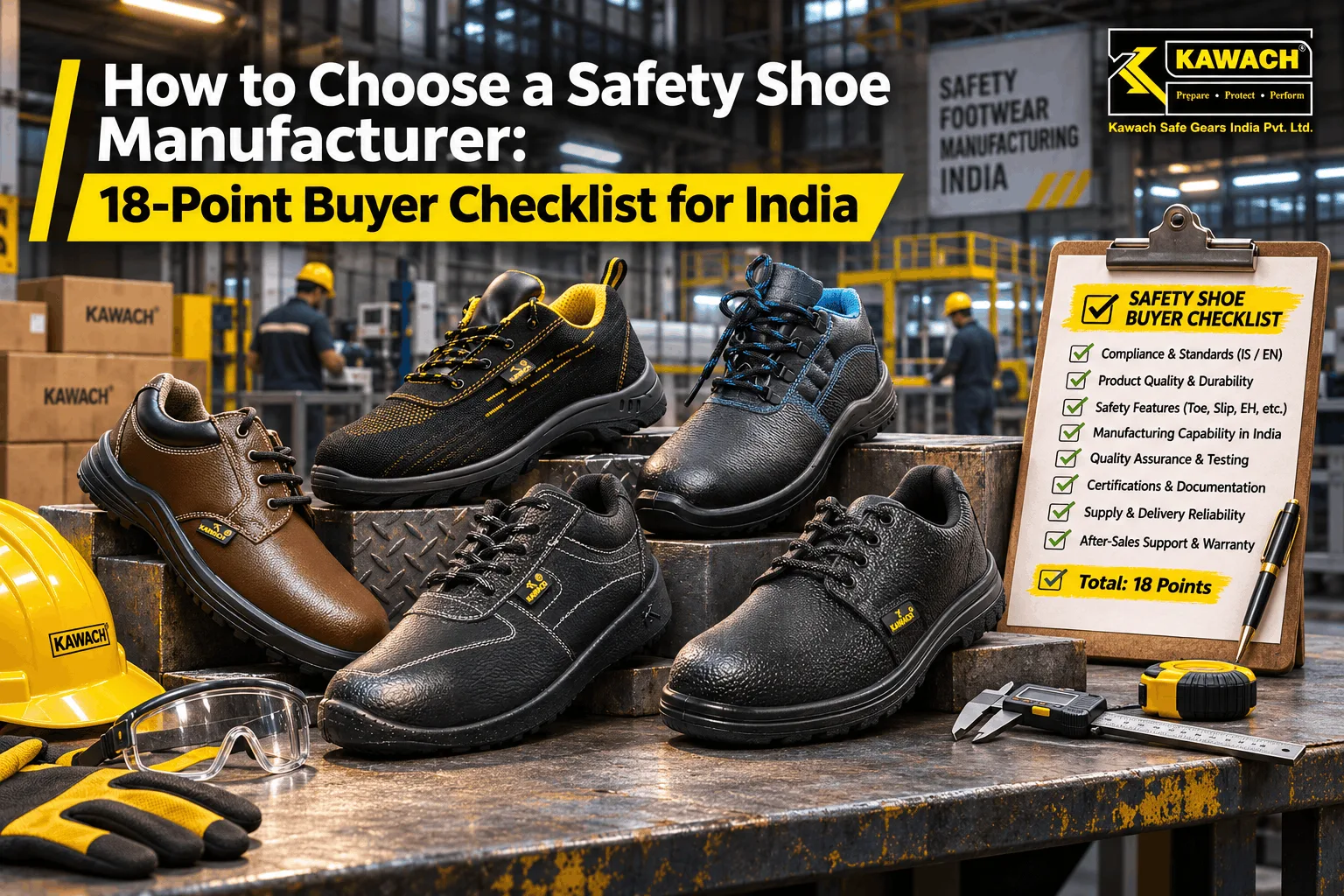
Kawach Safe Gears India Pvt. Ltd. recommends evaluating a manufacturer through evidence: product specifications, applicable standards, factory and quality-control processes, size consistency, sample trials, traceability, repeat-order capability and post-delivery support. This guide gives Indian buyers a practical 18-point checklist for doing that.
Quick Answer: What Makes a Reliable Safety Shoes Manufacturer in India?
A reliable safety shoes manufacturer should be able to identify the exact model being offered, provide current technical documents for that model, explain the applicable safety standard, show consistent manufacturing and quality-control processes, support representative samples and size trials, maintain traceability and deliver repeat orders with the same approved specification.
For Indian safety footwear, buyers should also verify current model-specific documentation connected with IS 15298 (Part 2):2024 where applicable. A logo, catalogue claim or general company certificate should not be treated as proof that every shoe in a range has the same certified properties.
1. Start With the Workplace Risk, Not the Manufacturer’s Catalogue
Before comparing manufacturers, define the job. A construction contractor may need protective footwear for uneven ground, impact hazards, sharp debris and wet outdoor conditions. A warehouse may prioritise toe protection, traction, long walking comfort and lower footwear weight. A fabrication department may require a different upper and outsole from an indoor assembly team. Maintenance personnel may face oils, water, electrical work or mixed tasks.
If the requirement is vague, every supplier can appear suitable.
Prepare a short footwear brief that includes worker roles, floor or terrain, impact/compression risk, sharp-object risk, water/oil/chemical/heat exposure, electrical requirements if any, ankle-height preference, expected shift length, quantity, size distribution, delivery schedule and mandatory documents.
A good manufacturer should ask these questions before recommending a model.
2. Confirm Whether You Are Dealing With a Manufacturer or Only a Reseller
There is nothing inherently wrong with buying from a distributor. Dealers can provide local stock, multiple brands and faster small-quantity fulfilment. But when a company specifically needs a safety shoes manufacturer in India, it is usually looking for deeper control over product specification, repeat supply, quality systems, samples, bulk production and technical documentation.
Ask the supplier to explain where the footwear is manufactured, which stages are in-house, how the upper is made or sourced, how soles are attached or moulded, how protective toe caps are integrated, where final inspection is performed, who controls the technical specification and how batch changes are managed.
Do not use the word “manufacturer” as a marketing assumption. Ask for evidence.
3. Verify the Exact Legal and Brand Identity
Industrial procurement becomes difficult when the quotation, invoice, certificate, website and product label use different company names without explanation.
When evaluating a manufacturer, confirm how the legal company name, brand name, manufacturing entity, registered office, factory, sales office, warehouse and customer-service contact relate to one another.
Consistent company and facility information makes supplier due diligence easier. If different documents show different locations, ask the supplier to clarify which address applies to manufacturing, registration, sales or warehousing.
For Kawach Safe Gears India Pvt. Ltd., buyers should verify the current company and location structure against the latest About information, quotation, invoice and certificate documents.
4. Check the Applicable Safety Footwear Standard
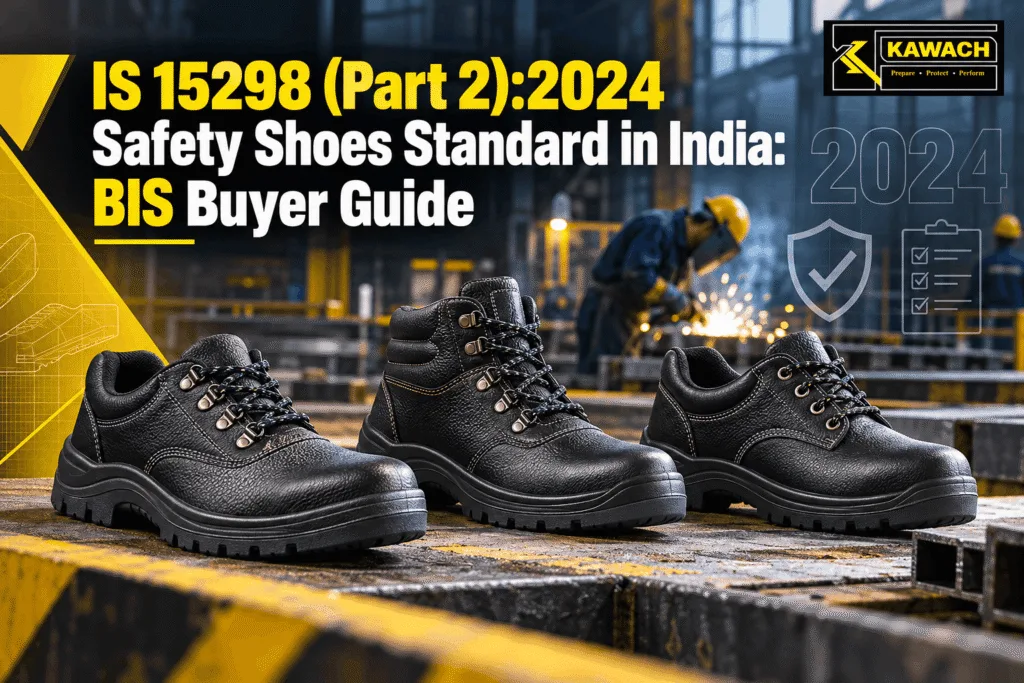
In India, industrial safety footwear is covered by IS 15298 (Part 2):2024 for safety footwear. The standard is based on ISO 20345:2021 with Indian modifications.
Procurement teams should not stop at seeing “BIS”, “ISI” or “ISO” in marketing copy.
Ask which exact standard and edition applies, whether the model is covered by a current BIS licence or other applicable document, what the licence/certificate number is, what product scope is covered, what markings appear on the footwear and whether the supplier can provide the relevant document.
5. Separate Company Certifications From Product Certification
An ISO 9001 quality-management certificate is not the same thing as product conformity to a safety footwear standard. Laboratory accreditation is not the same thing as a BIS product licence. A CE-related declaration for one product does not prove that an entire company or every product is “CE certified”.
For a serious bulk purchase, build a document register with document name, purpose, exact model covered, issuer, validity and verification status.
6. Compare Product Depth, Not Just Number of Models
A manufacturer with 40 models is not automatically better than one with eight. The useful question is whether the range covers distinct workplace needs.
A meaningful portfolio may vary by protective toe material, upper, ankle height, outsole, sole density, breathable construction, measured weight, size range, tested properties and intended industries.
Kawach currently lists Tougher Rock, Tougher, K-111, Fitter, Boss, AirBoss, Active and Force. The main Industrial Safety Shoes category should make their differences obvious through one consistent comparison structure.
7. Ask for a Standardised Technical Datasheet
Every model should use the same factual structure: model code, image, upper, lining, toe cap, documented impact/compression performance, midsole if applicable, insole, outsole, density, size range, measured weight at a stated size, ankle height, standard, tested properties, care and retirement guidance.
Consistent product data makes procurement easier and helps buyers compare models accurately.
8. Evaluate Manufacturing Process Control
A factory is not valuable merely because it exists. The buyer needs to understand how variability is controlled.
Ask how the manufacturer manages incoming materials, leather/fabric inspection, toe caps, outsole materials, cutting, stitching, lasting, sole moulding or bonding, curing, finishing, final inspection, size verification, packaging and batch identification.
For safety shoes, small changes in materials, adhesive, moulding, fit or component placement can affect the finished footwear.
9. Ask How Quality Control Is Documented
“Every pair is quality checked” sounds reassuring but is incomplete.
Ask what is actually checked and recorded. Examples can include visual defects, size consistency, sole-to-upper bonding, toe position, stitching, outsole finish, closure function, label accuracy, weight and batch records.
A strong manufacturer should explain the difference between in-process QC and formal product testing.
10. Do a Representative Sample Trial
A technically correct shoe can still fail if workers dislike wearing it.
Test representative samples with actual users from different departments. Ask workers to comment on toe room, heel movement, width, heat, flexibility, cushioning, grip, ankle movement, perceived weight and comfort after a full shift.
A five-minute office fitting is not enough for long-shift footwear.
11. Check Actual Footwear Weight
“Lightweight Safety Shoes” is often used without a measurement.
If weight matters, ask for one-shoe weight, pair weight, shoe size used, tolerance and measurement date or batch. Compare models at the same reference size.
A breathable upper, PU sole or fibre toe may contribute to lower mass, but none automatically proves that the complete shoe is lighter.
12. Audit Size Consistency and the Bulk Size-Run Process
A better process is to collect employee-wise sizes, issue samples, confirm model-specific fit, record approved sizes, consolidate the size run and then place the order.
Ask how size consistency is managed between batches. A repeat order that fits differently can create major operational cost.
13. Check Repeat-Order and Batch Consistency
A low first-order price has little value if later batches change upper material, sole formulation, insole, colour, fit or toe-cap construction without approval.
Use an approved sample, approved datasheet revision, certificate/document version, colour/branding reference, size range, packaging requirement and change-control process.
14. Review Bulk Production and Delivery Capability
Ask for standard lead time, peak-season lead time, quantity capability, dispatch process, multi-location delivery, packaging method, urgent replenishment process and whether products are stocked or made to order.
If capacity is published, it should be a verified number rather than a marketing estimate.
15. Evaluate After-Sales and Technical Support
Useful support can include model-selection guidance, size trials, document support, wear advice, complaint investigation, repeat-order planning and training.
Kawach positions training and site guidance as part of its safety approach. That becomes a stronger differentiator when real examples and clear scope are shown.
16. Compare Total Cost, Not Only Pair Price
The cheapest pair can become expensive through wrong sizes, early replacement, rejects, discomfort, inconsistent batches, late delivery and missing documentation.
A useful calculation is purchase price plus replacement frequency, exchanges, rejects, freight and administrative effort.
17. Review First-Party Evidence on the Website
Strong evidence includes original factory photographs, process video, named technical staff, real QC photographs, labels, datasheets, certificate documents, original product measurements, case studies and industry guidance.
Generic stock images and claims such as “best quality” are weaker.
18. Use a Weighted Manufacturer Scorecard
A practical scorecard may weight technical suitability at 25%, documentation at 20%, product quality/sample trial at 15%, manufacturing/QC at 15%, commercial terms at 10%, delivery at 5%, after-sales at 5% and worker fit at 5%.
The weighting should reflect your organisation’s risk.
Questions to Ask Before the Purchase Order
Ask the shortlisted manufacturer for the exact model, factory location, standard, document scope, toe material, outsole, actual weight, sizes, sample trial, batch-change control, lead time, complaint process and current test/technical documents.
A serious manufacturer should be comfortable answering them.
How Kawach Supports Evidence-Led Procurement
Kawach Safe Gears India Pvt. Ltd. supplies industrial safety shoes for men and other PPE categories for Indian workplaces. Its current Safety Shoes range includes steel-toe, fibre-toe, PU-soled, PVC-soled, leather and breathable-upper constructions.
For each shortlisted Kawach model, buyers should request a consistent datasheet, measured weight where relevant, current certificate or licence scope and verified manufacturing information. These details make supplier evaluation more transparent and reduce reliance on general marketing claims.
For buyers, this is more useful than a claim that one model is universally “the best safety shoes in India”.
Final Manufacturer Selection Checklist
Before approving a supplier, confirm that the hazards are known, the exact model is identified, current documents are available, the manufacturing entity is clear, samples have been reviewed, workers have tested fit, sizes are accurate, weight is known where relevant, QC expectations are agreed, repeat-order specification is controlled, delivery is realistic and after-sales responsibility is clear.
How to Verify a Manufacturer’s Website Before Shortlisting
A procurement team can learn a great deal before sending an enquiry. Review the manufacturer’s website as if you were conducting a remote pre-audit. Check whether the legal company name is clear, the factory address is consistent, product models have unique pages, technical specifications use the same format, certification claims identify their scope and the contact details match across the site.
Look for original evidence rather than only design quality. Useful signals include factory photographs that can be connected to a named facility, close-ups of products and labels, current catalogues, model-specific datasheets, named technical staff, quality-control images and explanations of the production process. A professional-looking website built entirely from stock photographs tells a buyer much less about actual manufacturing capability.
Also review the age and accuracy of the information. Old standards, conflicting size ranges, different materials listed for the same model or inconsistent factory addresses are reasons to ask questions. The supplier may have a perfectly valid explanation, but the discrepancy should be resolved before a large purchase.
For Kawach products, compare the website, quotation and datasheet against the same core fields: upper material, toe type, outsole, size range, weight, standard and certificate references. Any inconsistency should be clarified before a large order.
Frequently Asked Questions
Who is a good safety shoes manufacturer in India?
A good manufacturer matches footwear to the workplace risk, provides model-specific evidence, maintains consistency, supports sizing and samples and supplies repeat orders reliably. Brand popularity alone is not enough.
What safety shoe standard should Indian buyers check?
Review the applicability of IS 15298 (Part 2):2024 and verify the current model-specific documents.
Should I buy directly from a manufacturer or a dealer?
Both can be appropriate. Manufacturers may offer stronger specification control and bulk continuity; dealers may offer local stock and multiple brands.
How do I compare safety shoe brands for bulk procurement?
Use a weighted scorecard covering technical suitability, documentation, quality, fit, manufacturing, delivery, support and total cost.
Does a steel toe automatically mean the shoe is BIS compliant?
No. The toe cap is one component. Compliance relates to the complete footwear and the applicable model/document scope.
What should I ask for before placing a large order?
Request the current datasheet, applicable certificate/licence details, samples, size chart, delivery plan, markings and a repeat-order specification.