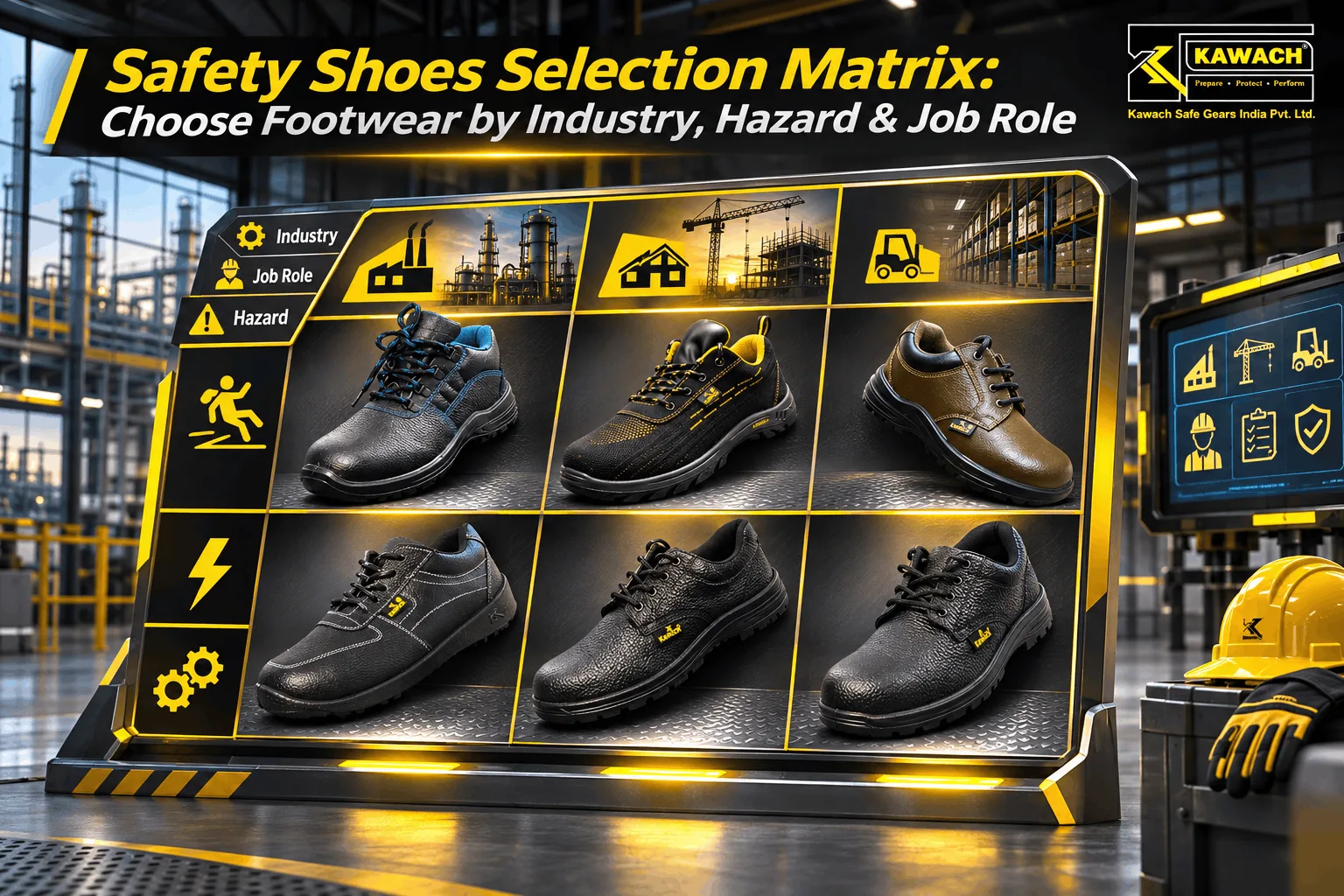
Workplace safety shoes should be selected for the work people actually do, not for a generic job title or one-size-fits-all PPE policy. A warehouse operator, construction worker, maintenance technician, machine operator and site engineer may all work for the same organisation but face different foot hazards during a normal shift.
That is why the strongest safety-footwear programmes begin with three questions: What can injure the worker’s foot? What workplace conditions affect grip, durability and comfort? What documented footwear properties are required for that job?
This guide from Kawach Safe Gears India Pvt. Ltd. provides a practical workplace safety shoes selection matrix for Indian factories, construction projects, warehouses, engineering teams and industrial maintenance departments.
Quick Answer: How Do You Choose Safety Shoes for a Workplace?
Choose workplace safety shoes by matching the complete footwear to the hazard. Protective toe footwear may be relevant where falling or rolling objects are present. Workers walking long distances may need lower-weight, flexible and well-cushioned footwear. Wet or oily floors require attention to tested outsole performance. Electrical, chemical, heat or penetration risks require specialised properties that must be verified for the exact model.
No single safety shoe is best for every department.
Why One Shoe for the Entire Company Can Be a Mistake
Bulk purchasing encourages standardisation. Standardisation can reduce cost and simplify inventory, but it can also create risk if one footwear model is forced into jobs with different hazards.
Consider a large manufacturing facility. The warehouse team may spend most of the day walking on smooth concrete and handling packaged material. The fabrication section may work around heavy metal parts, grinding debris and hot work. The maintenance department may access plant rooms, outdoor areas and electrical equipment. The quality team may spend long hours standing and walking but face lower impact risk.
All four teams need protective footwear. They do not necessarily need the same footwear.
A better strategy is to define approved models by job family.
Build a Workplace Foot-Hazard Profile First
Impact and Compression
Falling tools, metal components, pipes, pallets and other objects can injure the toes. Protective toe footwear may be required depending on the risk assessment.
Sharp Objects Underfoot
Construction debris, nails and metal off-cuts can create penetration risk. Do not assume a thick-looking outsole provides penetration protection. Verify the construction if it is required.
Slips and Contaminated Floors
Oil, water, coolant, grease, dust and polished floors can affect traction. Oil resistance and slip resistance are not interchangeable terms.
Moisture and Outdoor Exposure
Wet construction sites, monsoon work and outdoor maintenance can affect upper material, drying time and comfort. Water repellency is not the same as waterproofing.
Heat and Hot Work
Foundry, welding and hot-process environments can expose footwear to heat or sparks. General-purpose industrial safety shoes should not be assumed suitable.
Electrical Hazards
Electrical footwear requires model-specific evidence. A non-metallic toe cap does not automatically make a shoe electrically insulating.
Chemical Exposure
Resistance depends on the actual chemical, concentration, contact time and footwear material. Generic “chemical resistant” claims are too broad.
Long Shifts and High Walking Distance
Weight, fit, cushioning, breathability and flexibility become operational concerns when a worker walks several kilometres or stands for eight to twelve hours.
Workplace Safety Shoes Matrix by Industry
Manufacturing and Assembly
Common concerns include moving components, dropped tools, hard floors, oils or coolants, prolonged standing and repeated walking.
Investigate appropriate protective toe, stable outsole, grip, cushioning, fit, footwear weight and upper durability.
Warehousing and Logistics
Warehouse employees can spend a large part of the shift walking, pushing, lifting and working around pallets, forklifts and racking.
Important factors include toe protection where material-handling risk exists, lower unnecessary weight, cushioning, heel fit, traction and flexibility.
Construction and Infrastructure
Construction footwear may need to address falling materials, rough ground, sharp debris, moisture, mud and heat. Depending on the task, a low-ankle factory shoe may not provide the required coverage or features.
Engineering and Fabrication
Engineering shops may involve heavy components, swarf, grinding debris, lubricants, welding and metal handling. Toe protection is important, but outsole and upper exposure also matter.
Automotive and Component Manufacturing
Automotive facilities combine repetitive walking, assembly lines, oils, metal components, maintenance zones and logistics areas. Different departments can justify different approved models.
Maintenance and Facility Teams
Maintenance employees may move between indoor plant rooms, rooftops, external services, electrical panels, pumps and general repair areas. A “maintenance shoe” should not be selected by title alone.
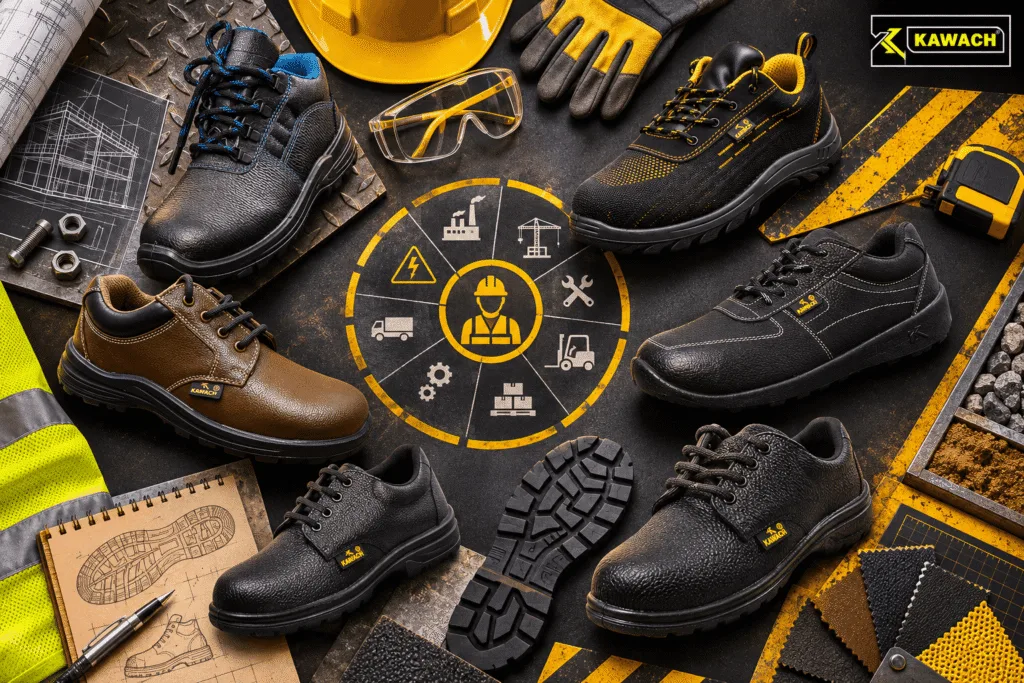
Workplace Safety Shoes Matrix by Hazard
Falling or rolling object: investigate documented protective toe performance and complete-shoe suitability.
Sharp debris underfoot: investigate penetration-resistant construction where required.
Wet floor: investigate tested outsole performance and housekeeping; do not rely on tread appearance alone.
Oily floor: investigate oil compatibility and slip performance as separate properties.
Long walking: investigate measured footwear weight, fit, flex, cushioning and heat.
Chemical contact: investigate material compatibility with the specific substance.
Electrical work: investigate the exact electrical property and test documentation for the complete shoe.
Outdoor rough terrain: investigate outsole, upper, ankle coverage, moisture and stability.
High heat or molten material: investigate specialist heat-protective footwear.
Workplace Safety Shoes by Job Role
Production Operator
A production operator may need toe protection, floor-specific grip and cushioning for long standing periods. The best footwear is usually not the heaviest shoe; it is the model that meets the risk requirement while remaining wearable for the full shift.
Warehouse Picker or Material Handler
Workers who walk continuously should compare actual weight at the same size, toe protection, heel fit, cushioning and outsole traction.
Construction Worker
Construction footwear needs to be chosen around terrain and task. High ankle coverage may be useful in some jobs, but ankle height alone does not make a shoe safer.
Maintenance Technician
Mixed-task workers require careful selection. The temptation is to buy a “do everything” shoe. Instead, identify the most significant hazards and confirm specialist requirements.
Site Engineer or Supervisor
Supervisors may spend less time handling heavy materials but still enter active work zones. Footwear should meet site rules and remain comfortable for extended walking.
Electrician or Electrical Maintenance Worker
Do not select footwear based on a fibre or composite toe alone. Electrical protective properties must be verified for the complete shoe and intended hazard.
Industrial Safety Shoes for Men: Fit Matters as Much as the Model Name
Most industrial safety shoes for men purchases in India use men’s size runs heavily, so fit and size consistency are important.
A protective shoe that is too tight can create toe pressure. An oversized shoe can cause heel movement and instability.
A fitting trial should check toe clearance, width, heel hold, sock thickness, insole comfort, ankle rubbing, flex and pressure after prolonged standing.
For bulk orders, collect employee-wise sizes instead of estimating from previous casual footwear.
Low Ankle vs High Ankle Workplace Safety Shoes
Low-ankle footwear can suit indoor manufacturing, warehouses, assembly and logistics where extra ankle coverage is not required.
High-ankle footwear can provide additional coverage and may suit construction, outdoor maintenance or rougher ground.
The choice still depends on risk, fit and documented product performance.
Steel Toe vs Fibre Toe for Workplace Use
Neither type is universally better. Steel toe caps are widely used for impact protection, while fibre-toe construction may be preferred for other design objectives. Certification and application matter more than toe material alone.
Do not assume fibre means electrical protection or steel makes the complete Steel Toe vs Fibre Toe safety shoes electrically conductive.
Lightweight Safety Shoes for 8–12 Hour Shifts
Footwear weight matters most after the shoe already meets the protection requirement.
For long-shift workers, compare actual weight, outsole flex, upper breathability, lining, insole, heel stability, toe room, heat build-up and post-shift comfort.
For comfort-focused comparisons, use Kawach’s Lightweight Safety Shoes page and request verified model weights for the shortlisted model.
How to Run a Worker Footwear Trial
1. Select representative workers from different departments and sizes.
2. Issue the candidate model in the correct size.
3. Allow use during normal work for an agreed period where safe.
4. Collect standardised feedback on fit, grip, cushioning, weight and heat.
5. Investigate outliers and recurring complaints.
Build a Workplace Footwear Approval Matrix
Create a controlled record with Department, Role, Main Hazards, Approved Model, Approved Size Range, Required Documents and Review Date.
This reduces random purchasing and makes repeat orders easier.
How Often Should Workplace Safety Shoes Be Replaced?
There is no universal replacement period. Replace or remove footwear when the sole separates, tread becomes severely worn, the upper is cut or damaged, stitching fails, the toe area is visibly damaged, contamination cannot be removed, the shoe loses secure fit or the manufacturer’s retirement criteria are reached.
Standards and Product Documentation
IS 15298 (Part 2):2024 is an important current Indian safety-footwear standard. A workplace matrix should not simply say “BIS shoe” and stop there.
Verify the exact model, applicable standard, document scope, marking, datasheet, tested properties and care instructions.
How to Compare Kawach Safety Shoes by Workplace Need
Kawach currently lists eight models: Tougher Rock, Tougher, K-111, Fitter, Boss, AirBoss, Active and Force.
Buyers can compare the range through practical selection pathways such as long-shift comfort, leather industrial footwear, non-metallic toe options, PU sole, PVC sole, manufacturing, construction and warehouse/logistics.
Each selection pathway should be supported by actual product specifications and model-specific documents.
Why Workplace-Specific Footwear Selection Improves PPE Procurement
Different workplace teams ask different questions: factory workers may prioritise long-shift fit, warehouse teams may compare measured weight and construction teams may focus on terrain, debris, moisture and coverage.
A clear selection process separates product comparison from technical guidance: the main category shows the footwear range, workplace guidance explains use cases and individual product pages provide exact specifications.
This helps buyers move from a workplace requirement to an appropriate model without confusing product, technical and procurement information.
Turn the Selection Matrix Into a Procurement SOP
The strongest workplace footwear programme is not only a web page or buying guide; it becomes a simple operating procedure. The organisation should define who identifies hazards, who approves models, who manages samples, who collects sizes, who records complaints and who decides when a model needs review.
For example, EHS can define the technical requirement, procurement can manage quotations and delivery, supervisors can coordinate wearer trials and stores can maintain issue records. If the responsibilities are unclear, footwear decisions can become inconsistent between plants or projects.
The SOP should also define how a new model is introduced. A sensible sequence is: hazard review, document verification, technical approval, sample trial, size confirmation, commercial approval, controlled first order, feedback review and then full-scale repeat ordering. This avoids placing a large order before the organisation knows how the model fits the workforce.
For multi-site companies, use one central specification but allow site-specific approved alternatives where the hazards genuinely differ. A warehouse in Noida and an outdoor construction project in Gurugram should not be forced into the same footwear merely because they share a procurement system.
Kawach Safe Gears India Pvt. Ltd. can support this process by providing standardised product data and clearly identifying the workplace conditions each model is intended to be evaluated for. Buyers should still verify the exact specification and hazard suitability before approval.
Workplace Safety Shoes Procurement Checklist
Before approving footwear for a department, confirm the hazards are documented, the model matches the risk, the exact product is known, current documents are available, fit has been tested, sizes are confirmed, weight is measured if relevant, the outsole suits the surface, specialist properties are verified and a replacement process exists.
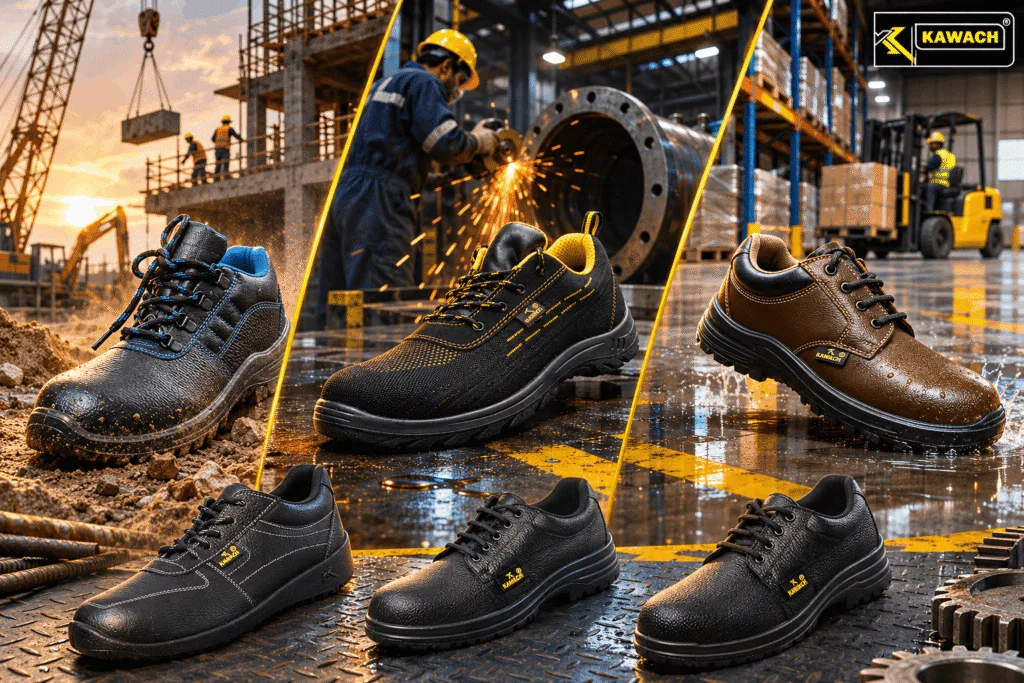
Frequently Asked Questions
What are workplace safety shoes?
They are protective footwear selected to address job-specific hazards such as impact, slips, debris, moisture or other industrial risks. Exact properties vary by model.
Which safety shoes are best for factory workers?
There is no universal best shoe. Compare toe protection, outsole, floor conditions, comfort, weight, fit and current documents.
Are industrial safety shoes for men different from normal shoes?
Yes. Industrial footwear can contain protective components and tested properties intended for workplace hazards.
Are lightweight safety shoes suitable for warehouse workers?
They can be useful for high-walking roles when the complete protection and grip match the workplace risk.
Can one safety shoe be used across every department?
Sometimes, but not automatically. Departments with different hazards may need different approved footwear.